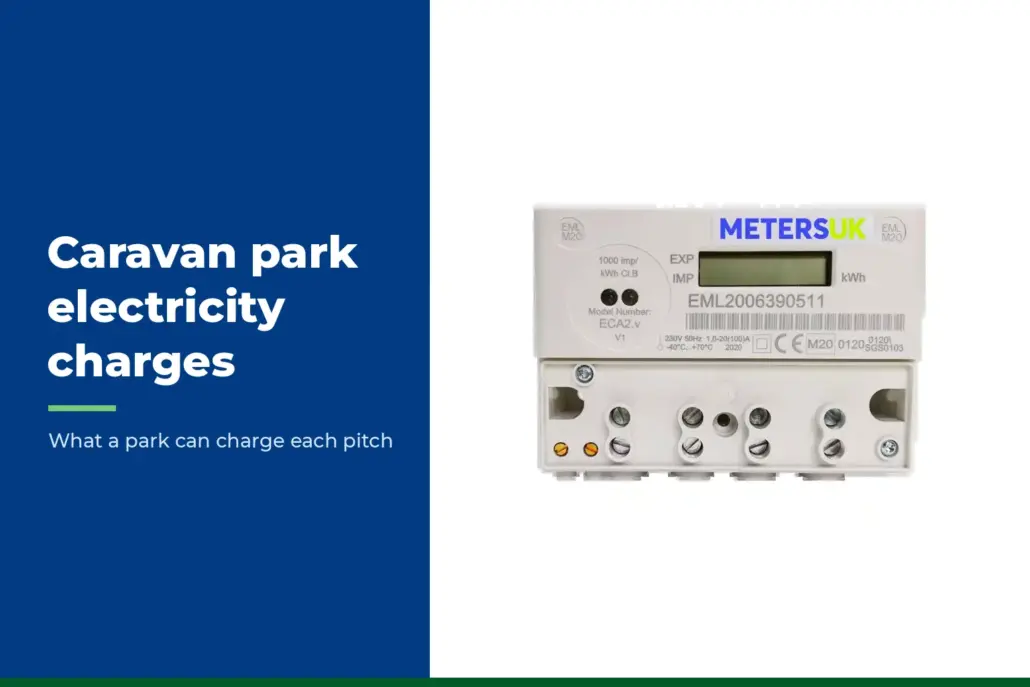
Forty pitches, one supply and one bill from the supplier. How a park splits that bill is where a lot of rows with residents and holiday owners begin.
The rules are short. They also differ for electricity and water, and that catches park owners out.
What can a caravan park charge for electricity? A park that resells mains electricity for domestic use can charge no more than it pays its own supplier, standing charge included. Ofgem’s resale guidance names caravan parks and holiday accommodation. Water has its own Ofwat cap, with different rules for holiday lets.
Last updated: November 2026. Ofgem’s rules cover Great Britain, not Northern Ireland, and Ofwat’s cover England and Wales. Prices in the examples are illustrations, not current rates.
Key Takeaways
- Ofgem’s guidance says the most a reseller can charge for electricity is the price it paid, including any standing charges.
- The cap covers residents on caravan parks and energy resold for use in holiday accommodation. An all-in pitch price with no separate energy charge falls outside it.
- The park’s own meter and upkeep costs cannot be loaded onto the unit price. Ofgem says they can be recovered separately, where the park’s agreements allow it.
- A meter on each pitch turns one shared bill into a reading per pitch, which is far easier to defend.
Does the Resale Cap Apply to Caravan and Holiday Parks?
Ofgem’s guidance on the maximum resale price was last updated in October 2005, and the rule itself dates from 1 January 2003. It applies when anyone buys gas or electricity from an authorised supplier and resells it for domestic use. The guidance lists residents on caravan parks who buy their fuel from the park owner.
Holiday parks are not exempt. The same guidance says gas or electricity resold for use in holiday and student accommodation is also subject to the rule. A static caravan owner who pays a separate electricity charge is covered on that reading.
There are limits. The rule does not apply where an inclusive charge is made for accommodation, with no separate charge for energy. Some touring pitches are sold that way, at one nightly price with the hook-up included.
Our guide to the maximum resale price for landlords explains the cap itself in more depth.
What Can a Park Charge For, and What Sits Outside the Cap?
The price a park pays is more than the unit rate. Ofgem’s call for input of October 2025 says the cap covers unit rates, standing charges and metering fees charged by the supplier to the reseller. It does not cover billing, maintenance or sub-meter charges.
So what happens to the cost of running the park’s own network? Under the guidance, a reseller is not entitled to recover the cost of running its own electricity system through the charges made for electricity.
Ofgem says those costs can be recovered separately, and gives a service charge or the accommodation charge as examples. Whether you can add one depends on your agreements and the law. On a residential park home site, admin costs may already sit inside the pitch fee, so take advice first.
The park’s own buildings are a separate matter again. Electricity used in the reseller’s own facilities, such as a clubhouse, laundry or shower block, is not resold energy. The guidance says it must be billed separately, for example as a service charge.
Dedicated electric vehicle (EV) charging has a separate exemption. Ofgem says the cap has not applied to electricity resold through dedicated charge points since 2014. See our guide to metering EV charging for how to keep that supply apart.
| Supply | Whose rule | Most a park can charge | Watch for |
|---|---|---|---|
| Mains electricity to a pitch | Ofgem | The price the park paid, standing charge included | The park’s own meter and upkeep costs stay off the unit price |
| Water | Ofwat | The water company’s charge plus a small admin charge | Not applied to holiday lets or second homes |
| Dedicated EV charge point | Outside the Ofgem cap | No Ofgem maximum | A caravan hook-up is not a charge point |
How Does Water Differ From Electricity?
Water follows Ofwat, not Ofgem. Ofwat says a reseller should charge no more than the water company charges, plus a reasonable administration charge. It puts that charge at about £5 a year for a purchaser without a meter and £10 a year for one with a meter. The legal limits are 1.5p a day without a meter and 2.5p a day with one.
For a purchaser with a meter, the rate per cubic metre also cannot be more than the water company’s standard domestic tariff.
Here the holiday side splits away. Ofwat says its maximum resale price does not apply to holiday lets, second homes or commercial customers. A holiday park can be capped on electricity and not on water. Our guide to water sub-metering covers the meters.
What Does a Fair Bill Look Like on a 40 Pitch Park?
Picture a park with 40 metered pitches on one supply. In a 30 day month the supplier bills 12,000 kilowatt hours (kWh) at an example 25p each, which is £3,000. The standing charge is an example 60p a day, or £18.
The pitch meters add up to 9,600 kWh. The other 2,400 kWh went through the park’s own meters on the clubhouse, the laundry and the site lighting. That part stays off the pitch bills.
Pitch 14 used 310 kWh, which comes to £77.50. Pitch 22 used 120 kWh, or £30. Split the £18 standing charge by share of all 12,000 kWh. Pitch 14 owes about 47p more and Pitch 22 owes 18p, while the park carries £3.60.
Now take the meters away and split the pitch energy equally. Each pitch pays for 240 kWh, or £60. On energy alone, Pitch 22 overpays by £30 that month and Pitch 14 underpays by £17.50. Neither figure can be backed by a reading.
Why Fit a Meter on Every Pitch?
Ofgem’s guidance expects a reseller to charge by the meter where there is one. Without a meter, the park has to use reasonable endeavours to estimate each share. The guidance suggests floor space, the rating of appliances or the number of occupants.
Those can be hard to apply on a park, where a winter resident with electric heating can sit next to an owner who visits six weekends a year.
Choose the meter with care. Meters used for billing have to be an approved type, and our guide to Measuring Instruments Directive (MID) approval explains what to look for. Fitting one is work for a qualified electrician, as we set out in when to hire a qualified contractor.
Reading 40 meters on foot takes time. Meters that report on their own save the walk, and our guide to remote meter reading compares the options.
Park meters live outdoors, in pedestals and cabinets that take the weather all year. Pick an enclosure rated for that, and think about February before you choose a meter with no remote reading.
Meters UK technical team
Common Mistakes to Avoid
Adding a penny or two per unit to cover the park’s own meter upkeep is the classic one. The intention is fair, but the unit price is capped at what the park paid. If your agreements allow a separate charge, make it in the open and keep it off the unit price.
Some parks spread the whole supplier bill across the pitches, clubhouse and all. Pitch holders then pay for the bar fridges and the pool pump. Meter the park’s own buildings, or at least take them out before you divide the bill, and keep the workings with your billing records.