Landlords ask one of two questions when MID approval comes up. Either “what does it mean and do I need it?” or, more often, “the meter I bought online doesn’t seem to have it, am I in trouble?” The honest answer to the second is usually yes, you are. The good news is fixing it isn’t complicated once you know what to look for.
What is MID approval and do landlords need it? MID stands for the Measuring Instruments Directive, which is the European framework now embedded in UK law as the Measuring Instruments Regulations 2016 (often called MIR). Any meter used for trade billing, which includes a landlord reselling electricity or gas to tenants, must meet that standard. Placing on the market or putting into service a meter that doesn’t is an offence, and a tenant can challenge a bill if the underlying meter isn’t approved.
Last updated: May 2026. Reflects the Measuring Instruments Regulations 2016, the UKCA mark introduced in January 2021, and the Product Safety and Metrology etc. (Amendment) Regulations 2024 (made 23 May 2024, in force from 1 October 2024) which keeps CE marking recognised in GB indefinitely for measuring instruments.
Key Takeaways
- Every meter used to bill a tenant for energy has to meet the Measuring Instruments Regulations 2016 (MID/MIR).
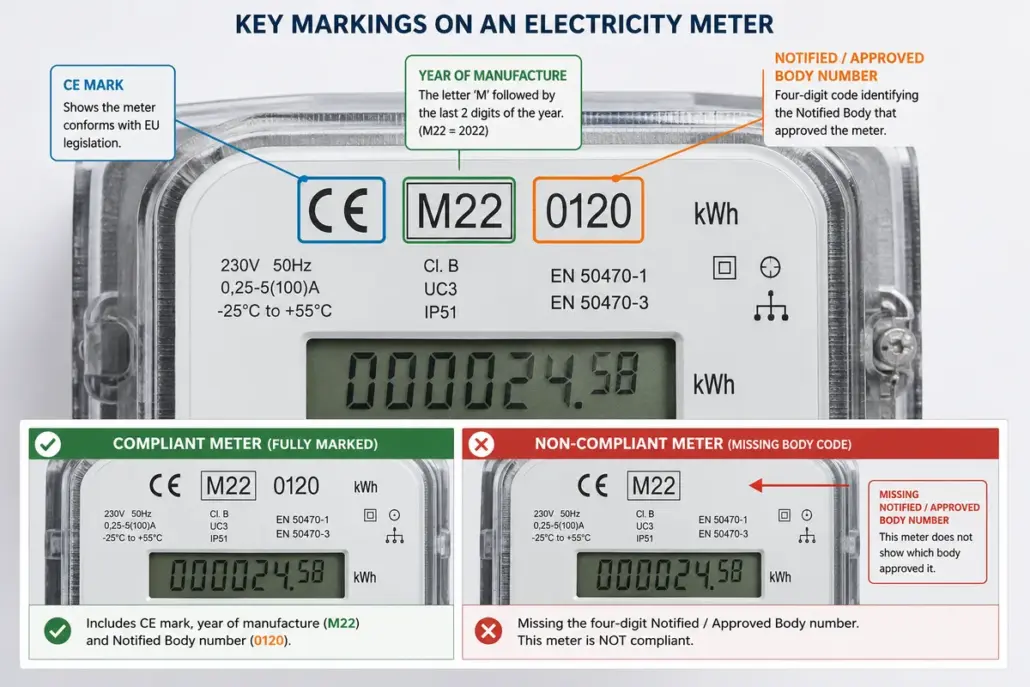
- You can recognise an approved meter by the CE or UKCA mark, plus an “M” with the two-digit year of manufacture, plus a four-digit body number (an EU Notified Body for CE-marked meters, a UK Approved Body for UKCA-marked meters).
- Class B is the typical industry choice for residential and commercial sub-metering. The maximum permissible errors aren’t a single flat percentage; they vary by load and temperature per Annex V of the Directive.
- CE and UKCA marks are both accepted in Great Britain for measuring instruments, indefinitely. The CE recognition was extended by the 2024 SI from 1 October 2024.
- An MID/MIR-approved meter has no fixed recertification cycle, but in-service checks still matter.
What does MID approved actually mean?
MID is shorthand for the Measuring Instruments Directive (2014/32/EU). The European framework sets accuracy, durability, and tamper-resistance standards for billing instruments. In the UK it was transposed into the Measuring Instruments Regulations 2016, often shortened to MIR. People still say “MID approved” in everyday conversation, but technically a meter sold for the GB market today is approved under MIR. They are functionally the same standard.
The point of the framework is to ensure that anyone billed for measured energy can trust the number on the meter. The manufacturing process is checked. The accuracy is tested. The device is sealed against tampering. If a meter passes, it gets a body identification number (EU Notified Body for CE meters, UK Approved Body for UKCA meters) and a manufacturer’s year stamp showing when it was made.
Without that approval, the meter is fine for internal monitoring (you can use it to check how much your communal lighting circuit draws, for example) but it cannot legally be used as the basis for a billing reading. MIR specifically covers electricity meters “for use for trade”, and landlord resale to tenants is in that category.
Why does MID approval matter for landlord billing?
Because MIR sets the basis on which a billing reading is legally trustworthy. Ofgem’s Maximum Resale Price rules and the broader resale framework (under the Electricity Act 1989 and Gas Act 1986) work on the assumption that the underlying meter reading is from an approved instrument. If your meter isn’t, you have a much weaker basis for the figure you’re charging.
In practice, if a tenant disputes a bill and the meter doesn’t meet MIR, a few things can happen. The tenant has good grounds to challenge the charge. They can complain to Trading Standards or seek a refund through the small claims process. And the supplier or installer (depending who put the meter in) could face enforcement action under MIR for placing on the market or putting into use a non-compliant instrument.
The Ofgem Maximum Resale Price rules don’t replace the meter approval requirement; they sit alongside it. Even if your unit rate is bang on what your supplier charged you, the bill is on shakier ground if the underlying meter isn’t approved. Get the meter right first, then the pricing.
How do I check if my meter is MID approved?
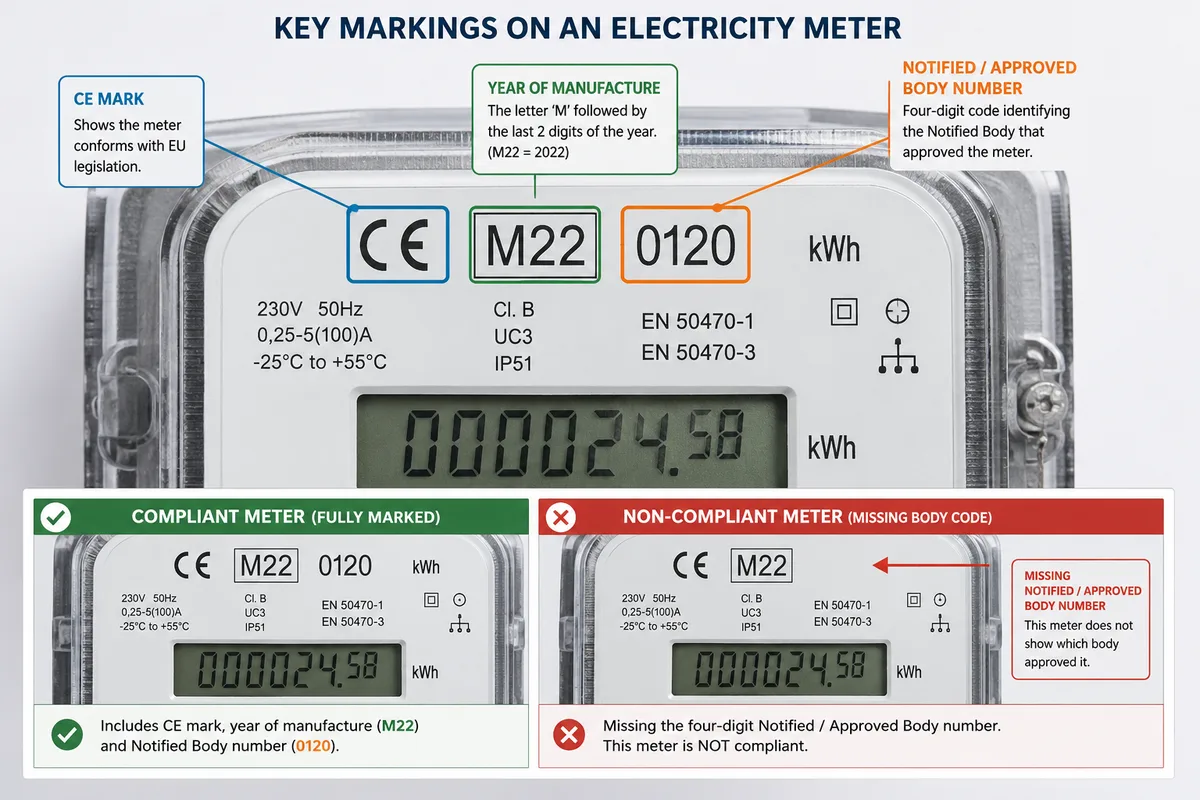
Look at the front of the meter. Three things should be visible together.
First, a CE mark or UKCA mark. CE is the original European marking; UKCA is the post-Brexit UK equivalent. Both are currently acceptable on a GB meter.
Second, an “M” followed by the last two digits of the year of manufacture. So an “M22” stamp means the meter was made in 2022. “M24” would be 2024, and so on.
Third, a four-digit identification number for the body that did the conformity assessment. For CE-marked meters that’s an EU Notified Body. For UKCA-marked meters that’s a UK Approved Body. The number sits next to the CE or UKCA mark.
If any of those three are missing or look wrong, treat the meter with caution. The “M” stamp alone isn’t proof of approval. Plenty of low-end online meters carry an “M” stamp without the corresponding body code, because the seller is hoping nobody checks. A determined tenant in a dispute will check.
If you’ve bought from a reputable UK supplier, the meter will also come with a Declaration of Conformity (DoC) document. Manufacturers are required to draw one up and ensure it accompanies the instrument. Keep it on file. It is the paperwork equivalent of the markings on the meter and proves to a tenant or tribunal that the device meets the standard.
Does CE marking still count after Brexit?
Yes, indefinitely. This was a genuine question for a couple of years after Brexit, when it looked like the UK might move to UKCA-only and force everyone to re-procure. That fear is now resolved.
From 1 January 2021, new electricity meter designs placed on the GB market could carry either CE or UKCA marking. The Product Safety and Metrology etc. (Amendment) Regulations 2024, made on 23 May 2024 and in force from 1 October 2024, keeps CE-marked measuring instruments recognised in GB on an indefinite basis. So a meter you buy today with a CE mark is just as legally valid for billing as one with a UKCA mark.
This matters because most of the Europe-wide meter manufacturers ship CE-marked products as standard. If you’d been worried about future-proofing, the 2024 decision largely settles it. In practical terms, don’t pay a premium just to get the UKCA mark unless your tenant base is unusually suspicious of European certification.
What accuracy class do I need for landlord billing?
Class B for almost any normal landlord setup. The three MID accuracy classes for active electrical energy meters (A, B, and C) are defined in Annex V of the Directive (MI-003), with the related EN 50470 and IEC 62053 standards giving the technical detail. The actual maximum permissible errors aren’t a single flat percentage per class. They vary by current, power factor, phase loading, and temperature. The figures below are the nominal headline tolerances people quote in practice, not the full legal definition.
| Class | Indicative tolerance | Typical use |
|---|---|---|
| Class A | Around ± 2% under reference conditions | Permitted under MIR. In practice, residential and commercial billing usually specifies higher. |
| Class B | Around ± 1% under reference conditions | The everyday choice for residential and commercial sub-metering. What most landlord setups specify. |
| Class C | Around ± 0.5% under reference conditions | High-power industrial use, EV charging, and applications where tight accuracy matters financially. |
If you’re buying for a domestic HMO or a small commercial multi-let, Class B is the practical default. Don’t pay extra for Class C unless you have a specific high-consumption use that warrants it. For the precise legal tolerances (which vary by current, power factor, and temperature), see Annex V Table 2 of the Directive.
What happens if I bill tenants through a non-MID meter?
It weakens your billing position in three ways.
First, your bills are challengeable. A tenant who realises the meter isn’t approved has good grounds to dispute the charge. They can take it to Trading Standards or pursue a refund through small claims, particularly if the meter readings cannot be shown to come from an approved instrument.
Second, you may have to refit. Once one tenant flags it, others in the building tend to follow. Replacing every meter in a multi-flat building costs more than just buying the right ones first time, and it usually has to happen at short notice.
Third, MIR creates offences around placing on the market or putting into use a non-compliant measuring instrument used for trade. Most disputes never get to formal enforcement, but the option exists, and a well-organised tenant or property tribunal won’t be sympathetic.
None of this happens if you buy the right meters from the start. The hardest cases are landlords who installed years ago and never checked, and now find themselves with a building full of unapproved meters and a stack of historic bills that suddenly look very fragile.
How long does MID approval last?
Indefinitely for the meter itself, in normal use. OPSS guidance is clear that there are no prescribed certification periods for MIR-approved gas and electricity meters. The certification is granted to the design at the time of conformity assessment, and the meter remains compliant as long as it isn’t tampered with, damaged, or modified.
What does happen over time is that tamper seals can fail, displays can degrade, and very old meters can drift outside their accuracy class. In-service testing still matters. Best practice is to visually check the seals on each meter annually and replace any meter where the seal is broken or missing. A broken seal makes the reading unreliable in a dispute, regardless of whether the meter is technically still within tolerance.
Heat meters with battery-backed displays are a separate case. The integrator unit (the bit on the wall) typically has a battery life of 6 to 12 years, and the meter needs replacing rather than re-batteried when it dies.
“The single thing that catches landlords out most is the ‘M’ stamp on its own. People see a meter stamped ‘M22’ and assume that’s all the proof they need. It isn’t. The ‘M’ is the year of manufacture, and it has to appear alongside the CE or UKCA mark AND the four-digit body number. If any of those three are missing, the certification chain is incomplete and a tenant in a dispute can pick it apart. We get calls every month from landlords trying to retrofit certification on meters they’ve been billing through for years. There’s no retrofit. You replace the meter.”
Meters UK technical team
Common Mistakes Landlords Make
A few traps catch landlords out repeatedly.
Buying meters from generic online marketplaces without checking the certification. Cheap meters from non-UK sellers often lack the full marking chain, even when they carry an “M” stamp. The price difference is rarely worth the legal exposure.
Assuming a CE mark alone is proof of MID compliance. It isn’t. CE is a general European conformity mark. MID compliance is shown by CE (or UKCA) plus the M-year stamp plus the body’s four-digit identification number, together. Check all three.
Losing the Declaration of Conformity paperwork. The DoC is the documentary equivalent of the markings on the meter. Keep it in a file (digital is fine) tied to each property. Without it, you’re relying on the markings still being legible when a dispute happens.
Confusing MID with “MID-2”. There is no such thing as “MID-2” in any official sense. Some marketing materials use it loosely to mean meters built after the 2014/32/EU update. If a seller is offering “MID-2 approval”, ask them to point at the actual standard reference. They usually can’t.
How do I make sure I buy approved meters?
Three habits make this straightforward.
Buy from a UK supplier that specialises in metering. Generalist online marketplaces are where the certification gaps appear. Specialists won’t list unapproved meters because their customers ask the right questions.
Ask the supplier for the Declaration of Conformity before you buy, not after. Reputable suppliers send it on request without hesitation. If you get any pushback or vague answers, walk away.
Check the physical meter when it arrives. Three things: CE or UKCA mark, M-year stamp (year of manufacture), four-digit body identification number. All present together. If not, return the meter.
This is also a good moment to check your accuracy class needs. Class B is right for almost every domestic and small-commercial scenario. The supplier should be able to confirm this in writing if you ask.