If you mention a “prepayment meter” to a tenant and they tend to picture the 2023 British Gas headlines. Force-fitted meters, vulnerable households left in the cold, an Ofgem code of practice nobody followed. None of that applies to a landlord installing a prepayment sub-meter behind their own supply. They are completely different things, governed by different rules. People mix them up constantly.
Are landlord prepayment sub-meters legal? Yes, when they sit behind your own supply and bill tenants for what they actually use. The 2023 Ofgem rules on forced prepayment installations apply to licensed energy suppliers, not to landlords running their own sub-metering. Ofgem’s Maximum Resale Price rules still apply, which means you can recover from tenants what you paid your supplier, no more, including a fair pass-through of unit rates, standing charges, and VAT.
Last updated: May 2026. Reflects Ofgem’s 2005 MRP guidance, the 2023 supplier reforms, and the October 2025 MRP review currently under way.
Key Takeaways
- Landlord prepayment sub-meters are legal, and the 2023 forced-installation rules don’t apply to them.
- The Maximum Resale Price (MRP) rule covers your full pass-through cost, including unit rates, standing charges, and VAT.
- Ofgem opened a Call for Input on the MRP rules in October 2025, the first review in over 20 years.
- App-based smart prepayment is now the default for new installs; token systems are still around but increasingly legacy.
- Real-world UK evidence on smart meter savings is around 3 to 4% on average, not the 30 to 50% sometimes claimed.
Should I use prepayment meters for my HMO?
If you’re tired of chasing rent-plus-energy invoices and you want a hands off approach without chasing tenants for payment, absolutely!
Are tenants paying you separately for energy already? If yes, prepayment removes the chase, removes the disputes, and removes the void problem when tenants leave with an outstanding bill. The cash-collection upside is the single biggest reason landlords switch.
Do tenants stay short term? Student lets, professionals on six-month assured shorthold tenancies, and HMOs with high turnover are exactly where prepayment shines. Each new tenant starts at zero credit, no historic balance to argue about.
Can your tenants self-serve a top-up? In 2026, the answer is almost always yes. Modern smart prepayment systems take payment by card on a phone app. The “find a Paypoint shop and a £20 note” world is mostly behind us. If your tenant base genuinely struggles with smartphones, ask the supplier whether their system has a phone-line top-up option.
How does landlord prepayment differ from supplier prepayment?
Two completely different setups that share a name. The difference matters because the regulatory horror stories from 2023 only apply to one of them.
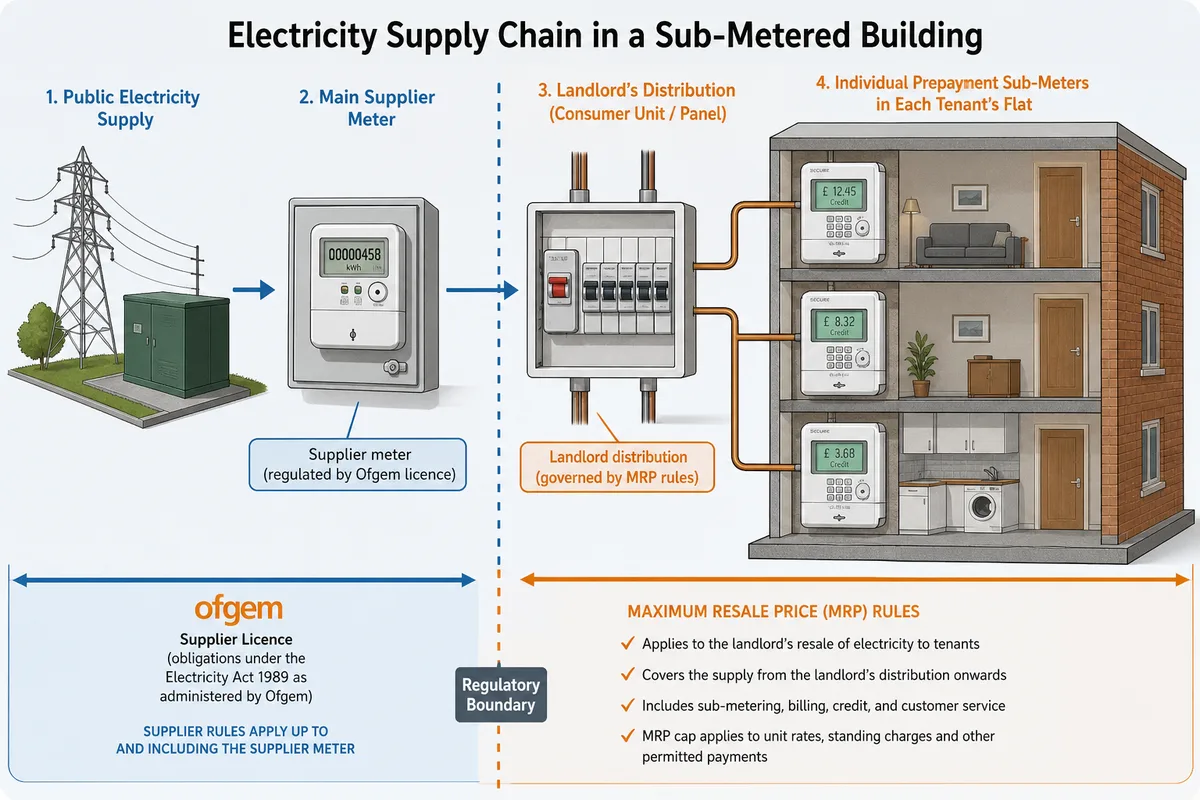
A supplier prepayment meter is the actual incoming utility meter. Your tenant has a direct contract with British Gas, EDF, Octopus or another supplier. The supplier owns the meter, sets the tariff, and historically had powers to force-fit a meter when a customer fell behind on bills. That is what got reformed in 2023, with bans on forced installations for households with under-2s, over-75s with no support, and other vulnerable categories. Ofgem confirmed the stronger protections on 13 September 2023, and they took effect on 8 November 2023.
A landlord prepayment sub-meter sits behind your own supply. You buy electricity (or gas) from your supplier, measure individual tenant consumption with sub-meters, and recharge them via a prepayment system. The tenant’s contract is with you, not the supplier. Ofgem’s 2023 forced-installation reforms do not apply here, because you are not a licensed energy supplier.
What does apply are the Maximum Resale Price rules, set under the Electricity Act 1989 and Gas Act 1986, with the current Ofgem guidance dating from October 2005. Ofgem opened a Call for Input on those rules in October 2025, the first review in over 20 years.
Do Ofgem’s Maximum Resale Price rules apply to prepayment?
Yes, fully. The MRP rule does not change because the mechanism is prepayment rather than monthly invoicing. What you charge your tenant cannot exceed what your supplier charged you for the same energy, including standing charges and VAT.
The practical bit. If your supply tariff is, say, 28p per kWh plus a 50p per day standing charge plus VAT, then what you collect from the tenant for their consumption has to reflect those same components on a cost pass-through basis. You cannot quietly add 5p per kWh to cover the cost of the prepayment platform. The platform might charge the tenant a small visible service fee directly, or it might charge you and you absorb it as part of the cost of running the property. What it cannot do is silently inflate the unit rate above what you paid.
If you’re not sure your prepayment system handles this correctly, ask the provider for a sample tenant statement. Either the prices passed through match what you pay, or they don’t. If a tenant ever disputes their charges and you cannot show a clean trail, the position collapses fast.
This is the same rule covered in our Maximum Resale Price guide, and it is enforced through the same channels.
What’s the difference between token meters and smart prepayment?
Generation gap. Token meters need a physical key, card, or coin loaded at a Paypoint or similar outlet. The tenant disappears when the credit runs out and you find out about it when they hammer on your door at 11pm. Smart prepayment systems do top-up via a phone app, online portal, or text, and give the landlord a dashboard showing real-time balance and consumption per flat.
For new installs in 2026, smart is the typical choice. Token meters still exist in the wild and still get sold, mostly for situations where simplicity and a low up-front price matter more than the dashboard. Some manufacturers continue to ship new token meters, so it is fair to call them current rather than discontinued. The market preference for new HMO setups has clearly shifted towards smart, app-based systems.
| Approach | Smart prepayment sub-meter | Postpay sub-meter (monthly invoice) | Energy included in rent |
|---|---|---|---|
| Cash collection risk | None. Tenant pre-loads credit | Real. Bills can go unpaid | None, but you absorb usage volatility |
| Admin overhead | Low. Most platforms automate it | Medium. Reading, invoicing, chasing | Lowest. No metering admin |
| MRP compliance complexity | Manageable, provider does most of it | You manage it manually | Bundled, harder to demonstrate |
| Tenant behaviour effect | Useful real-time visibility | Weaker, bill arrives a month later | None. Use is invisible to tenant |
| Best fit | HMOs, student lets, transient tenants | Long-term lets, professional tenants | Short-term lets, all-bills-included rentals |
How much does it cost to install prepayment sub-meters?
Hardware prices on the UK market vary widely. A basic token-based landlord prepayment sub-meter from Metro Prepaid sells for around £50, while a smart, app-based meter from suppliers like Emlite or MeterPay typically lands in the £130 to £200 range. Three-phase or M-Bus-equipped variants cost more. Always quote the specific unit you’re considering rather than relying on a single number.
Installation labour depends on local rates and access. A qualified electrician working on an existing supply with sensible cable runs can usually fit a sub-meter in well under half a day. Where you also need a comms gateway for an app-based system, that’s an additional one-off cost on top, plus any platform setup fees the provider charges.
The thing to look at most carefully is the platform fee structure. Metro Prepaid, for instance, charges 10% of collected payments and remits the balance to the landlord monthly. Other providers charge tenants a small visible service fee per top-up. Either way, factor the ongoing fee into your budget, and check it doesn’t push your total recovery above the MRP cap.
Whether the maths works for you depends on your current cash-collection problem (if any), your total tenant electricity volume, and how often tenants leave with outstanding balances. The savings come more from removing arrears and reducing admin time than from large drops in consumption.
What about tenants bypassing the meter?
It happens. Extension leads from communal sockets into individual rooms, kettles plugged into the hallway socket, the works. The fix is not technical, it’s design. Take the communal sockets out of easy reach (or off entirely outside of cleaning hours), make sure the meter cabinet is sealed properly, and put the energy use in the tenancy agreement so misuse is a deposit issue.
The landlord forums tell stories of tenants doing things you’d not think of. Most of those scenarios stem from communal supplies being too accessible. A clean wiring layout where each flat’s circuit is genuinely separate, and communal areas are minimal, removes the temptation. Sub-metering only works when the building’s electrical setup matches the metering plan.
Should I include energy in the rent instead?
Sometimes yes. For short-term lets, all-bills-included flats marketed to professionals, or anywhere your headline rent figure has to be simple, bundling energy makes sense. You absorb the volatility and price it into the rent.
The reasons to NOT include energy in the rent are that you have no visibility on use, no comeback against a heavy user, and you’re effectively betting that your average tenant won’t run a 3kW tower heater 18 hours a day in winter. Some do. Demonstrating MRP compliance gets harder too, because there is no per-tenant unit rate to point at.
For most HMOs, sub-metering (prepay or postpay) is the more durable choice. For short-let serviced apartments, bills-included usually wins.
“The thing landlords miss most often is the unit rate alignment. They install a prepay system, set the price per kWh based on a tariff they had two years ago, then their supplier raises rates and the prepay tariff stays where it was. Either way is a problem. Undercharge and you eat the loss, overcharge and you breach MRP. Set up an annual review on a calendar reminder, the day after your supply contract anniversary, and just edit the prepay rate to match. Twenty seconds of admin saves you a tenant complaint to Ofgem.”
Meters UK technical team
Common Mistakes Landlords Make
A handful of mistakes show up regularly.
Assuming the 2023 forced-installation horror stories apply. They don’t, you’re not a licensed supplier. Tenants confuse this constantly because they read about prepayment in the news and think their landlord can’t or shouldn’t fit them. Cite the MRP rules in the tenancy paperwork and explain the distinction up front.
Thinking MRP is just about the unit rate. It’s not. The cap covers your full pass-through cost, including standing charges and VAT. Treating it as a per-kWh question alone is how landlords end up overcharging without realising.
Choosing a prepayment provider on price and finding out later that platform fees come out of the tenant’s top-up in a way that pushes the total above your supply cost. That breaches MRP unless the fees are structured properly. Ask the provider for a sample tenant statement before you sign anything.
Installing prepayment without sorting the building’s wiring first. If your communal supply lets tenants run extension cables out of sockets in the hallway, the metering plan is undermined from day one. Get an electrician to walk through with you and identify any leakage points.
How do I actually get prepayment going on a property?
The steps in order. None of them is hard, but missing one creates pain later.
Decide on smart vs token. For 2026 installs, smart is almost always the right call. Tokens make sense only where your tenant base is genuinely smartphone-averse and you’ve checked.
Choose a provider. Compare on pass-through accuracy (can you set unit rate AND standing charge to match your supply costs), platform fees (where they fall, on you or the tenant, and how they’re labelled), and the dashboard quality (can you see balances and consumption per flat in real time).
Get the wiring right. Each flat needs a properly separate circuit through the new sub-meter. An electrician’s site visit is an hour well spent.
Document the setup in the tenancy agreement. Spell out that the tenant tops up via the platform, what the unit rate and standing charge components are, where the platform fees show up, and how to raise issues. Refer to the Maximum Resale Price rules so they know the legal frame.
Set the calendar reminder for tariff alignment. The day after your supply contract anniversary every year, edit the prepay rates to match your new supply costs.