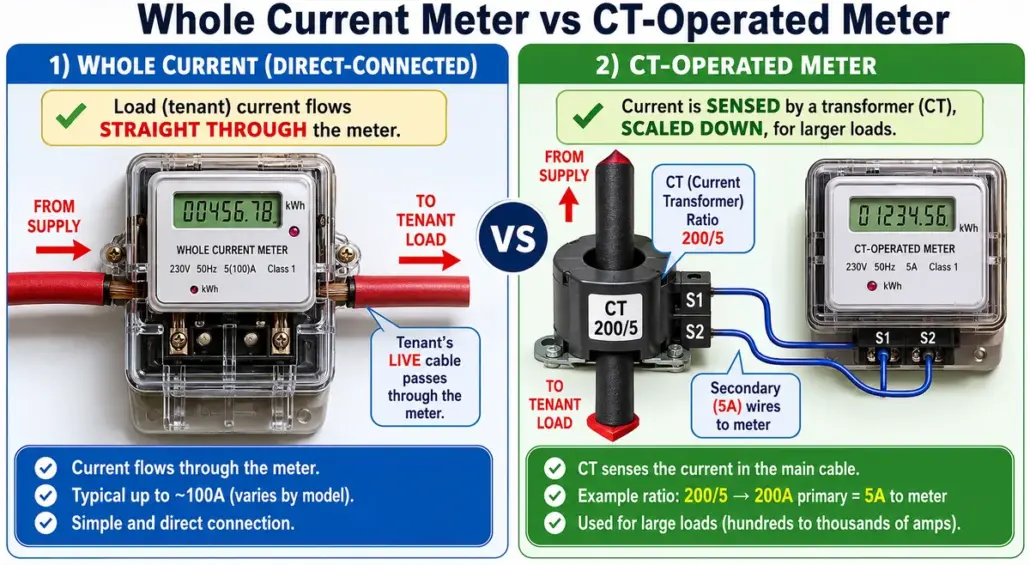
For most landlords, this is a non-question. The flats are small, the loads are modest, and a standard direct-connected meter handles everything. Then you take on a building with a shared commercial unit, a plant room, or an EV charging bay, the current climbs past what a normal meter can carry, and someone says the word “CT”. This is what that means and when it applies to you.
CT-operated or whole current meter? A whole current meter has the load current pass straight through it and is the usual choice for normal loads, with most models rated up to around 100A (some direct-connected meters go to 125A). A CT-operated meter senses current indirectly through current transformers and is used for larger loads. For ordinary flat-sized loads, whole current is simpler and cheaper. Once the load outgrows the available direct-connected meters, CT-operated is the way to go.
Last updated: May 2026.
Key Takeaways
- Whole current (direct-connected) meters carry the full load current through the meter body. Most are rated up to around 100A, with some direct-connected models going to 125A.
- CT-operated meters sense current through current transformers and report a scaled-down signal. They are used for loads beyond what a direct-connected meter is rated for.
- For normal flat-sized loads, whole current is simpler, cheaper, and the sensible default for most HMO flats.
- CT ratio matters. Size the CT so the normal running current sits in the upper part of its range, not the bottom.
- For tenant billing, the meter itself must be MID/MIR approved. The CTs are not covered by MID approval, but they carry their own accuracy class and need to be accurate enough to stand up to a challenge. Cheap, oversized, or badly wired CTs are a common cause of wrong bills.
What’s the difference between CT-operated and whole current meters?
It comes down to whether the electricity you’re measuring physically passes through the meter or not.
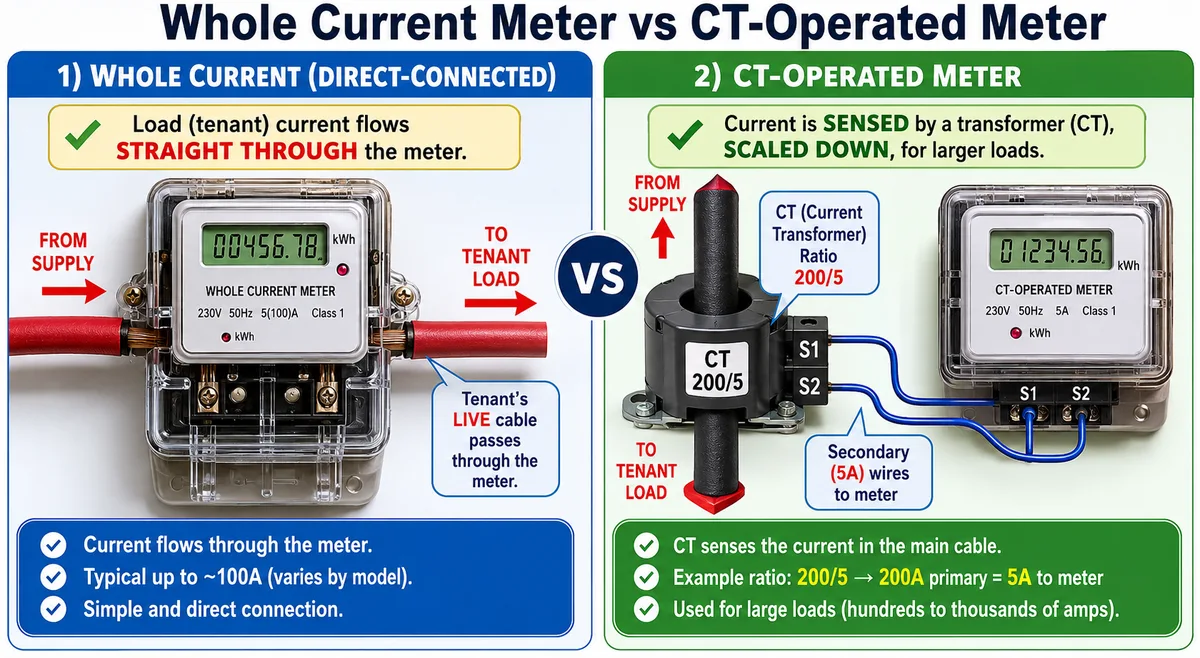
A whole current meter, also called a direct-connected meter, has the tenant’s live conductor wired straight into it. The full current flows through the meter body. This is the type in almost every UK home. It’s simple, there’s nothing to scale or program, and what the meter sees is exactly what the tenant used.
A CT-operated meter doesn’t carry the load current at all. Instead, a current transformer (CT) is clamped or wired around each live conductor. The CT produces a small, proportional secondary current, commonly 5A or 1A at full load, which the meter reads. The meter is then told the CT ratio (for example 200/5, meaning 200A in the cable produces 5A at the meter) and multiplies up to get the real consumption.
The trade-off is straightforward. Whole current is simpler and has fewer ways to go wrong. CT-operated can handle far larger loads and the same meter can cover a wide range just by changing the CTs, but it introduces the ratio, the CT accuracy, and the secondary wiring as things that can be got wrong.
When does a landlord need a CT-operated meter?
Whenever the load exceeds what a direct-connected meter can safely carry. Most whole current meters are rated up to around 100A, and some direct-connected models go to 125A. Beyond the rating of the direct-connected meters available to you, the meter physically cannot take the current and CT-operated is the way to go.
For most residential HMOs, you’ll never reach that. A single flat with normal domestic loads sits well under 100A, so each flat gets a straightforward whole current sub-meter. CT-operated metering tends to appear in three landlord situations: a shared landlord supply feeding the whole building’s communal load, a mixed-use property with a commercial unit drawing heavy current, and large developments with plant rooms, lifts, or EV charging infrastructure.
For ordinary flat-sized loads you have a genuine choice. You can use a CT-operated meter on a small load if you want to, and sometimes people do for consistency across a building. But there’s rarely a good reason. A whole current meter is cheaper, quicker to install, and has nothing to misconfigure. For a standard flat, fit whole current and move on.
How do I choose the right CT ratio?
Match the CT to the actual load, not to the biggest number on the shelf. The single most common CT mistake is oversizing.
The rule of thumb: pick a CT whose primary rating means the circuit’s normal running current sits well up the CT’s range rather than down at the bottom. A CT measures most accurately in the upper portion of its range and gets progressively less accurate as the current drops towards the low end. Avoid gross oversizing.
Here’s the failure mode. Fit a 600/5 CT on a circuit that normally runs at 80A, and that circuit is sitting at barely 13% of the CT’s range. The accuracy down there is poor, and over a year of billing the error compounds. For an 80A circuit, a 100/5 CT is the right call, not a 600/5. The closer you size the CT to the real load, the more reliable the billing.
Whatever ratio you choose, it has to be programmed into the meter correctly. A 200/5 CT with the meter set to 100/5 will report exactly half the real consumption. The CT ratio on the physical device and the ratio in the meter settings must match.
What accuracy class of CT do I need for tenant billing?
For billing a tenant, the CT accuracy class matters as much as the meter’s. A CT carries a class rating that describes how faithfully it reproduces the primary current. For revenue metering, you want Class 0.5 or better, with Class 0.5S and 0.2S being the common revenue-grade options. The “S” classes hold their accuracy better at low currents, which is exactly where billing errors creep in.
The other thing that quietly wrecks CT accuracy is burden. Burden is the total electrical load on the CT’s secondary circuit: the meter’s own consumption plus the resistance of the wiring between the CT and the meter. Every CT has a rated burden. Exceed it, usually by running a long, thin secondary cable, and even a high-class CT loses precision.
The practical guidance: keep the secondary cable run as short as you reasonably can, use an adequate conductor size, and keep the three phase runs roughly equal in length so the burden is balanced. There is no single blanket cable rule that fits every job; the burden has to be calculated for the specific run. If the meter and the CTs are more than a short distance apart, get the installer to work the burden maths properly rather than guessing.
What are the common CT wiring mistakes?
CT metering goes wrong in a small number of predictable ways. All of them produce a bill that’s wrong rather than a meter that’s obviously dead, which is what makes them dangerous.
Reversed polarity is the classic. A CT has a primary direction (often marked P1 and P2) and a secondary pair (S1 and S2). Wire it the wrong way round and the meter reads that circuit as negative, counting backwards. On a three phase setup with one CT reversed, the total can look oddly low rather than obviously broken.
Phase mismatch is the subtle one. Each CT has to be matched to its corresponding voltage phase at the meter. Put the CT from phase L1 against the voltage reference for L2 and the meter calculates the wrong power factor and the wrong kWh, even though every CT is individually installed correctly. This is the mistake that survives a casual inspection.
Then there’s the safety point that every electrician should know but it bears repeating. Never open a CT secondary circuit while the primary is live and unshorted. An open-circuit CT secondary can develop a dangerous high voltage. Always fit and use the shorting link across S1 and S2 before disconnecting anything.
CT-operated versus whole current: a side-by-side
For a landlord weighing the two, here’s the comparison that matters.
| Feature | Whole current (direct-connected) | CT-operated |
|---|---|---|
| Load range | Typically up to around 100A, some models to 125A | Effectively unlimited, set by CT choice |
| How current is measured | Full current flows through the meter | Sensed via current transformers, scaled down |
| Installation complexity | Low. Wire it in and go | Higher. CTs, ratio, polarity, burden all matter |
| Things that can be misconfigured | Very few | CT ratio, polarity, phase matching, burden |
| Cost | Lower | Higher (meter plus CTs) |
| Best fit for landlords | Individual HMO flats, normal domestic loads | Shared landlord supplies, commercial units, plant rooms, EV charging infrastructure |
“The mistake we see again and again is the oversized CT. An installer has a box of 400/5 CTs on the van, the job needs metering on a 60A circuit, and they fit what they’ve got. It works, in the sense that the meter shows numbers. But that circuit is running at 15% of the CT range, the accuracy down there is poor, and the tenant is being billed on a measurement that drifts. Match the CT to the real load. If a circuit runs at 60A, you want a 100/5 CT, not whatever happened to be in the van. And programme the exact ratio into the meter, because a CT and a meter that disagree about the ratio will be wrong by a clean multiple every single day.”
Meters UK technical team
Common Mistakes Landlords Make
A handful of mistakes recur on CT installs.
Using a CT meter where a whole current meter would do. For a normal flat under 100A, a direct-connected meter is cheaper, faster to fit, and has nothing to misconfigure. Don’t pay for CT complexity you don’t need.
Oversizing the CT. A CT that’s far too big for the load reads badly at the bottom of its range, and that’s where a lot of billing happens. Size the CT to the actual circuit current.
A ratio mismatch between the CT and the meter settings. The number stamped on the CT and the number programmed into the meter have to be identical. If they aren’t, every bill is wrong by a fixed multiple, and it’s surprisingly easy to miss because the meter still produces plausible-looking figures.
Ignoring the CT secondary wiring. Long, thin secondary cables push the burden past the CT’s rating and degrade accuracy. Keep the run short, use an adequate conductor, and check the burden if the meter is any distance from the CTs.
What should I actually do?
For the typical landlord, the decision is quick.
If you’re metering individual flats with normal domestic loads, fit whole current sub-meters. Each one is under 100A, direct-connected is cheaper and simpler, and there’s nothing to get wrong.
If you’re metering a shared landlord supply, a commercial unit, a plant room, or anything where the load is over 100A, you need CT-operated metering. At that point, get a competent electrician or metering specialist to do three things: measure the actual circuit current, size the CTs to that current (upper part of the range, revenue-grade class), and confirm the ratio is programmed into the meter to match.
Either way, the meter has to be approved for billing. Our electric meters range covers both whole current and CT-operated options, and the companion guide on single phase versus three phase covers the supply side of the same decision.