Last updated: April 2026. This article reflects current regulations and pricing as of this date.
What is sub-metering? Sub metering is the installation of secondary meters downstream of a main utility supply to measure electricity, water or gas consumption for individual tenants, units or equipment. It allows UK landlords to bill tenants based on actual usage rather than estimates, and any meter used for billing must be of an approved pattern, which, for new installations, means MID-approved under the Measuring Instruments Directive.
Key Takeaways
- Sub meters sit behind your main utility meter and measure what each tenant or area actually uses, replacing estimated bills with accurate ones.
- If you’re billing tenants, your meters must be of an approved pattern (MID-approved for new installations). Using unapproved meters puts you on shaky legal ground.
- Under Ofgem’s Maximum Resale Price rules, you can only charge tenants what you pay your supplier. You cannot profit from reselling energy.
Sub Metering: What It Actually Is (and Isn’t)
Your energy supplier installs a main meter at the point where gas, electricity or water enters your building. That meter records total consumption for the whole property. A sub meter sits further downstream, on an individual circuit, pipe or gas line, and measures what a specific tenant, flat or piece of equipment uses.
That distinction matters. The main meter belongs to your energy supplier and determines your bill. Sub meters belong to you, and they’re how you work out what each tenant owes.
People call them different things. Check meters, secondary meters, sub-meters (with or without the hyphen). They all mean the same thing. The important point is that sub meters don’t replace your main supply. They sit behind it.
Why Bother with Sub Meters?
Without sub meters, you’re stuck splitting bills equally or estimating usage. Both approaches cause problems. Equal splits mean the tenant in a one-bed flat subsidises the family of four next door. Estimates drift further from reality every quarter.
A landlord we’ve worked with had six flats on a single electricity supply. Before sub-metering, they split the bill equally at roughly £85 per tenant per month. After installing electric sub meters, actual usage ranged from £42 to £131 per month across the six units. Two tenants had been overpaying for years, and one had been significantly underpaying. The disputes stopped overnight.
There’s a behavioural effect too. When tenants know they’re paying for exactly what they use, consumption tends to drop. Studies from the water industry consistently show 10-15% reductions in usage after individual metering. People leave fewer taps running when it’s their bill.
Electric Sub Meters
Electricity is where most landlords start, and for good reason. Electric sub meters are straightforward to install on distribution boards, and the data they provide is immediately useful.
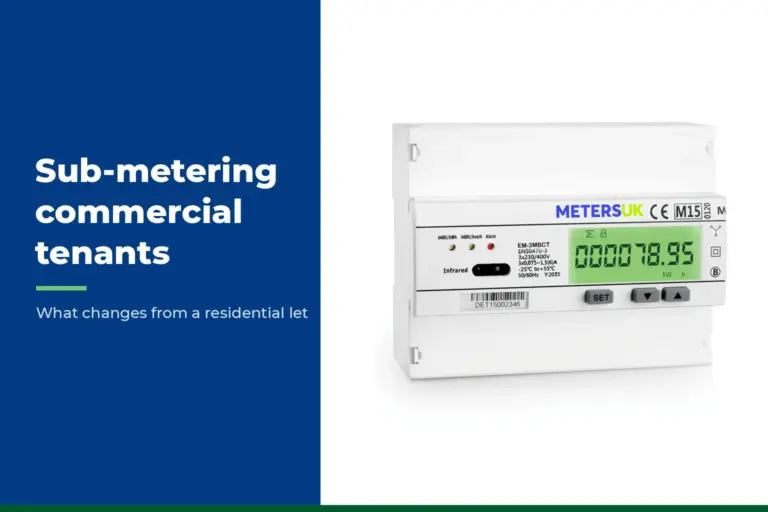
For most residential properties (HMOs, student lets, small apartment blocks), a single phase meter does the job. These connect directly to the circuit supplying each unit. If you’re metering a commercial building, larger loads, or anything with three-phase supply, you’ll need a three phase meter, potentially CT-operated if the current exceeds the meter’s direct connection rating.
Modern electric sub meters aren’t just dumb counters. Most support remote reading through protocols like M-Bus or Modbus, which means you can collect readings from a central point or feed them into billing software without traipsing round the building with a clipboard. If you’re managing more than a handful of units, automated meter reading pays for itself quickly.
One thing to watch. If you’re separately metering communal areas (hallway lighting, lifts, door entry systems), keep those on their own sub-meter too. It makes the cost allocation transparent and avoids arguments about who’s paying for the communal supply.
Water Sub Meters
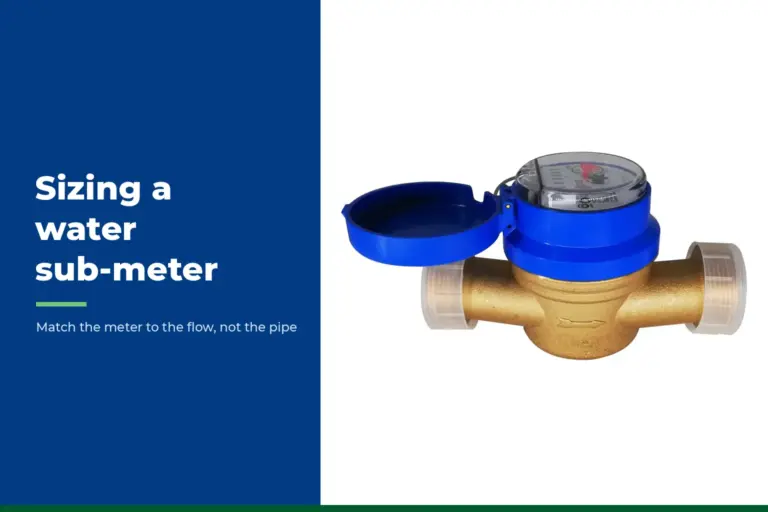
Water sub-metering is increasingly common in residential developments and student accommodation. Individual water meters are installed on the pipework feeding each flat or room, measuring exactly what each occupant uses.
The consumption reduction effect is strongest with water. Tenants who’ve never thought about their water usage suddenly become aware of it. Long showers get shorter. Dripping taps get reported. Based on our experience, total building water consumption can fall noticeably within the first year of individual metering.
Water sub meters also catch leaks early. If a meter shows consumption when nobody’s home, you’ve got a leak. Without sub meters, a slow leak in one flat quietly inflates the building’s water bill for months before anyone notices.
The practical challenge with water metering is access. Meters need to be installed on incoming pipework, which usually means getting into risers or service voids. In older buildings this can be awkward, though rarely impossible. For new-builds, it’s straightforward if metering points are designed in from the start.
Gas Sub Meters
Gas sub metering is less common than electric, partly because it’s more involved to install. Any work on gas pipework must be carried out by a Gas Safe registered engineer, and there are additional safety considerations around ventilation and meter positioning.
That said, gas sub meters are valuable in buildings with individual boilers or where tenants control their own heating. A diaphragm gas meter on each supply line gives you accurate consumption data for billing.
Where things get more complex is buildings with shared or communal heating. A central boiler serving multiple flats means individual gas meters won’t help, because the gas feeds one boiler, not individual units. You need heat meters instead, which measure thermal energy delivered to each flat based on flow rate and temperature differential.
Heat metering has its own regulatory framework. The Heat Network (Metering and Billing) Regulations 2014 were partially replaced in January 2026 when Ofgem took over as the regulator for heat networks under the Energy Act 2023. All heat network operators must now register with Ofgem by January 2027. If you’re running a communal heating system, heat metering requirements are worth looking into separately.
The Legal Bit: What Landlords Must Know
Two rules matter above everything else for billing tenants through sub meters.
First, the meter must be of an approved pattern. For any new meter you buy today, that means MID-approved (Measuring Instruments Directive). Some older GB-approved meters are still lawful for billing, but if you’re purchasing new, MID is the standard to look for. Non-approved meters are fine for monitoring your own energy use or checking equipment consumption, but the moment money changes hands, an approved meter is required.
All meters sold by reputable UK suppliers for billing purposes should be MID-approved, but it’s worth checking. This is particularly important if you’re buying second-hand or from overseas.
Second, the Maximum Resale Price. Ofgem’s MRP rules are simple. You can charge tenants only what you pay. Not a penny more. If your electricity costs 24.5p per kWh from your supplier, that’s the ceiling for your tenants too. You can pass on the standing charge proportionally and add VAT where applicable, but you cannot add a margin.
This catches some landlords out, particularly those who assumed they could recover the cost of meter installation through a small markup on energy. You can’t. The payback comes from accurate billing and reduced consumption, not from profit on the energy itself.
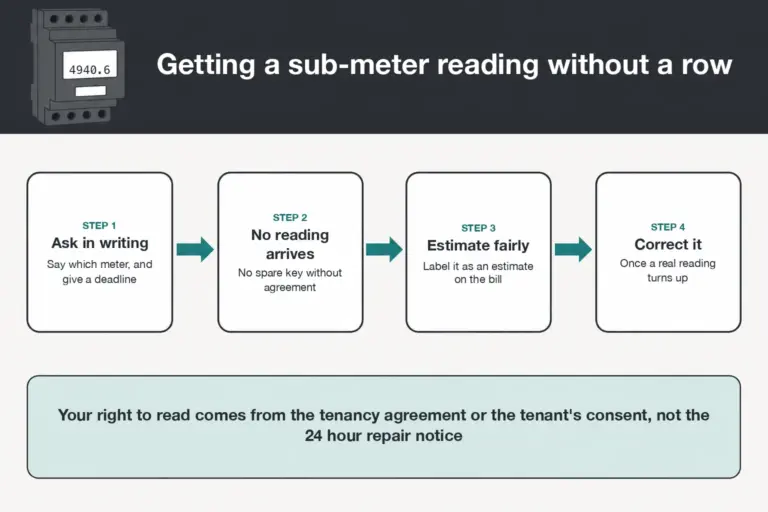
There’s no specific legal requirement for how often landlords must read sub meters, but good practice is to take readings at least quarterly. With modern remote-reading meters this happens automatically, but even with manual meters, regular readings prevent disputes and ensure bills don’t drift too far from reality.
When Sub Metering Doesn’t Make Sense
Sub metering isn’t always the right answer, and it’s worth being honest about that.
Small properties are the obvious case. With only two tenants on short lets, the cost of purchasing, installing and maintaining sub meters may not be worth it compared to a simple agreed-upon bill split. An honest conversation about usage habits might achieve the same outcome.
Properties with extremely complex pipework or wiring can make installation costs disproportionate. Where the building’s infrastructure makes it physically difficult to isolate individual supplies, you might spend more on installation than you’d ever recover in fairer billing.
All-inclusive rents are another consideration. Some landlords, particularly in the student market, deliberately include utilities in the rent. In that model, sub meters are useful for monitoring (you still want to know if a unit is consuming excessively) but not strictly necessary for billing.
| Scenario | Sub Metering Recommended? | Why |
|---|---|---|
| HMO with 4+ tenants | Yes | Fair billing prevents disputes and reduces consumption |
| Student accommodation block | Yes | High turnover and variable usage make estimates unreliable |
| Commercial multi-let | Yes | Business tenants expect accurate billing and may have very different usage profiles |
| Two-bed shared house | Maybe | Cost of installation may outweigh benefits; an agreed split could work |
| All-inclusive rent model | For monitoring only | Useful to spot excessive usage or leaks, but not needed for billing |
| Building with inaccessible infrastructure | Assess first | Get an installer to quote before committing; retrofit costs vary hugely |
Common Mistakes to Avoid
The biggest mistake we see is landlords installing the cheapest meters they can find online, only to discover they’re not MID-approved. They bill tenants with them, a tenant queries the charge, checks the meter certification, and the landlord has no legal basis for the invoice. Replacing every meter and re-doing the billing costs far more than buying the right ones first time.
Another common error is forgetting about communal areas. If you sub-meter individual flats but not the communal supply, someone still has to pay for hallway lighting, security systems and shared appliances. Tenants will rightly ask why their sub-meter reading doesn’t match their share of the main meter bill. The gap is the communal consumption, and you need a plan for allocating it.
Oversizing is the third trap. Matching the meter to the load matters. A three phase CT-operated meter on a circuit that only ever draws 15 amps of single phase is wasted money and unnecessary complexity. A competent installer will assess the load before specifying the meter.
One common misconception we encounter is that landlords and engineers often underestimate the programming requirements for electric meters. In particular, most three-phase meters require some level of configuration before installation or use, such as setting the CT ratio, configuring kWh-only operation, or programming addresses and identification parameters. A lack of awareness around these specifications can lead to installation issues and incorrect meter setup.
Jamie Balmer, Technical Team at Meters UK
Smart Sub Metering and Remote Reading
The days of manually reading meters every month are largely behind us. Modern sub meters with M-Bus, Modbus or pulse output connections feed data to central reading systems or cloud platforms automatically.
For landlords managing multiple properties or larger buildings, this changes the economics entirely. You go from spending hours collecting readings and manually calculating bills to having the data arrive in a dashboard. Some billing platforms will generate tenant invoices directly from the meter data.
Meters UK’s SmartLink platform is one example. It collects readings remotely, stores historical data, flags anomalies (sudden spikes or drops that might indicate a fault or tampering), and exports data for billing. The upfront cost of remote-reading meters is higher than basic units, but for anything beyond a handful of meters, the time savings justify it within a year or two.
If you’re planning a new installation, it’s worth specifying remote-reading capable meters from the start, even if you don’t connect the reading system immediately. Retrofitting communications to basic meters later means replacing them entirely.
Getting Started
The process is simpler than most landlords expect. Start by mapping out what you want to meter: individual flats, specific equipment, communal areas, or all three. Electricity is the easiest starting point. Water adds significant value in residential buildings. Gas depends on your heating setup.
Get a qualified installer to survey the property. They’ll assess the existing infrastructure, identify where meters can be installed, and flag any complications. You can find installers through Meters UK’s recommended installer network.
Based on typical pricing from our range, budget roughly £80-£150 per electric sub meter for the hardware (depending on specification and communications), plus installation costs that vary with the complexity of the job. Water and gas meters are similarly priced, though gas installation costs more due to the Gas Safe requirements.
For a six-unit HMO with electric sub meters only, our customers typically spend £800-£1,500 all-in for hardware and installation. If a single billing dispute or a year of subsidised consumption costs more than that (and it usually does), the payback is fast.