Most UK landlords never have to think about this. The property has a single phase supply, the sub-meters that go behind it are single phase, and that’s the end of the conversation. Then a tenant asks for a 22kW EV charger, or you start looking at heat pumps, or you buy a six-flat HMO with a commercial-grade incoming supply, and suddenly the question matters.
Single phase or three phase for a landlord HMO? Single phase is right for almost every standard residential property and most HMOs. Three phase becomes worth considering when total demand pushes past around 100A (typically 23kVA), when you have multiple high-power loads such as heat pumps or fast EV chargers, or when the existing supply is already three phase because the building used to be commercial. Your sub-meter choice follows your supply, not the other way round.
Last updated: May 2026. Reflects current Energy Networks Association guidance and typical UK DNO pricing for supply upgrades.
Key Takeaways
- Standard UK homes get single phase at 230V, typically 60-100A. That’s usually around 14-23 kVA total capacity.
- Three phase gives you about three times the power on the same incoming connection, at 400V line-to-line.
- The main triggers for three phase are heat pumps drawing more than about 32A per phase (roughly 8kW continuous), EV chargers above the standard 7kW domestic single-phase rating, or total demand pushing past 100A after a proper electrical demand calculation.
- Upgrading from single to three phase via your DNO is typically several thousand pounds and varies widely. Simpler domestic cases can come in around £1,000 to £3,000, while a proper 100A-per-phase three-phase upgrade often lands £3,500 to £12,000 depending on cable runs and street works.
- Your sub-meter choice follows your supply: single phase meter for a single phase circuit, three phase meter for a three phase circuit, CT-operated if the load exceeds the meter’s direct connection rating.
What’s the difference between single phase and three phase?
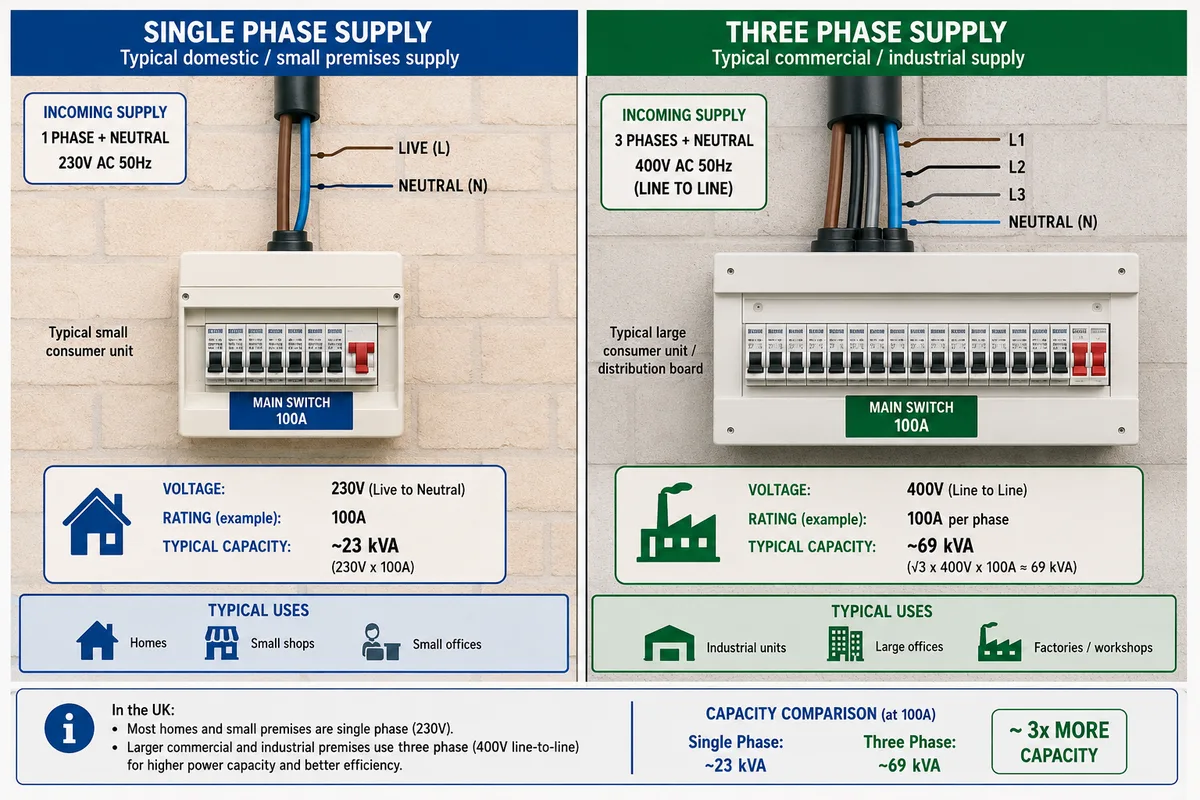
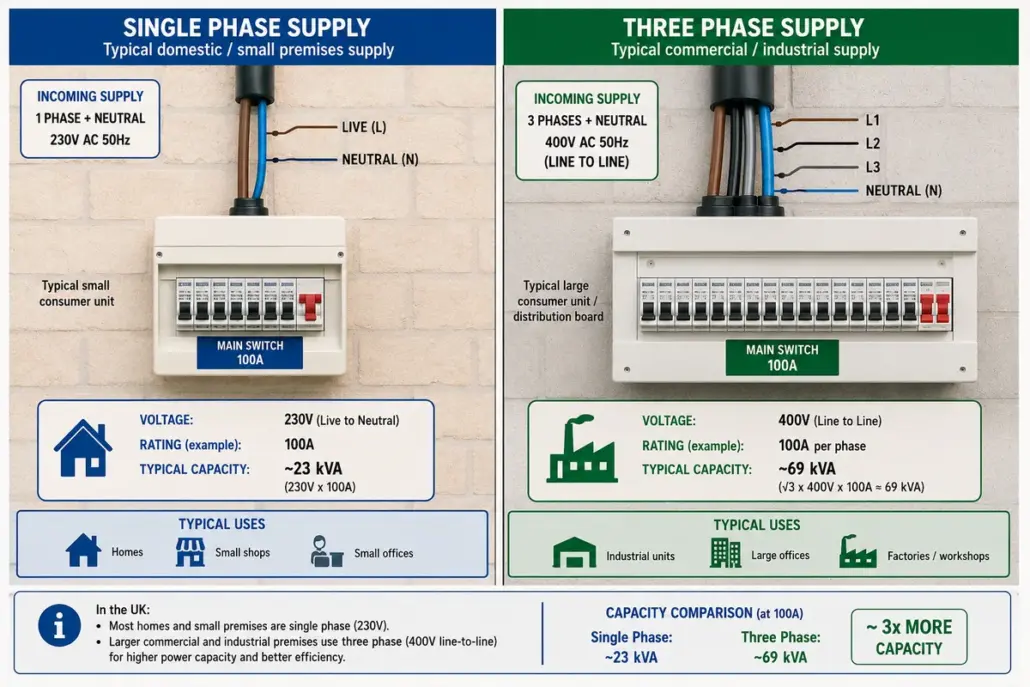
One incoming wire that carries voltage versus three of them, offset in time. In single phase, you get 230V between live and neutral, delivered on one cable. In three phase, you get three live cables at 230V each relative to neutral, with each phase offset by 120 degrees. Between any two of those live phases, you measure 400V (sometimes called 415V in older literature).
The practical effect is more usable power on the same connection size. A 100A single phase supply gives you around 23 kVA. A 100A three phase supply gives you around 69 kVA, because every amp is doing three times the work. That’s the bit that matters for landlords with high loads.
UK Power Networks and the other DNOs default to single phase for new domestic connections because it’s cheaper, the cable run is simpler, and most homes never need more. Three phase is the standard for commercial premises, larger blocks, and anywhere with industrial equipment.
When does a landlord need three phase instead of single phase?
The Energy Networks Association gives clear guidance. Heat pumps drawing more than about 32A per phase, which is roughly 8kW continuous, will typically trigger an apply-to-connect process and may need three phase. The exact threshold depends on the system configuration and the DNO’s assessment, not on a single headline kilowatt figure. For EV chargers, the standard 7kW domestic charger runs comfortably on single phase. An 11kW or 22kW charger is three-phase by design and requires a three-phase supply to install at all.
Beyond the single-appliance triggers, the test is total demand. A qualified electrician will do a demand calculation across the building’s lighting, sockets, heating, hot water, and any large appliances. If that figure goes past 100A on a single phase, you’ve outgrown the supply. For a typical four-flat HMO with electric heating, fast chargers, and shared laundry, that ceiling can arrive sooner than you’d think.
For a standard two- or three-bedroom let with gas central heating, you almost certainly don’t need three phase. For a six-flat HMO with electric showers across the board and an EV charger in the car park, you very possibly do.
What does it cost to upgrade from single phase to three phase?
Quotes vary widely depending on the work involved. Older National Grid Electricity Distribution (formerly WPD) guidance gives a useful range. Simpler domestic cases where you’re just exceeding 32A can come in around £1,000 to £3,000, while a proper three-phase upgrade at 100A per phase or larger more typically falls between £3,500 and £12,000. Real quotes outside London for a 100A per phase three-phase upgrade often land somewhere in the £5,000 to £7,000 region, but it depends entirely on the cable run, the local transformer, and whether any of the work crosses public roads.
The variables are the things you’d expect. How far the cable run is from the street main to the meter cabinet. Whether they need to dig under a public footpath or close part of a road. Whether the local transformer has the headroom or needs upgrading. Whether any of the cable route is shared with neighbouring properties that need permission to dig.
There’s one subtle wrinkle worth knowing. A single phase fuse upgrade (say, from 60A to 100A) is sometimes done free under low-carbon connection initiatives. The same dig for a three phase upgrade is chargeable. If you’re on the borderline and you don’t need the full three phase capability today, an 100A single phase fuse upgrade can buy you a useful amount of headroom for a fraction of the cost.
Which sub-meter type matches my supply?
The meter must match the circuit it is metering, not the building’s incoming supply. A flat fed by a single phase circuit takes a single phase sub-meter, even if the building’s incoming service is three phase. A flat or shared load that is wired across all three phases needs a three phase sub-meter. Putting a single phase sub-meter across a three phase circuit only measures one leg, and the billing will be embarrassingly wrong; putting a three phase meter on a single phase circuit just leaves two of its phases reading zero.
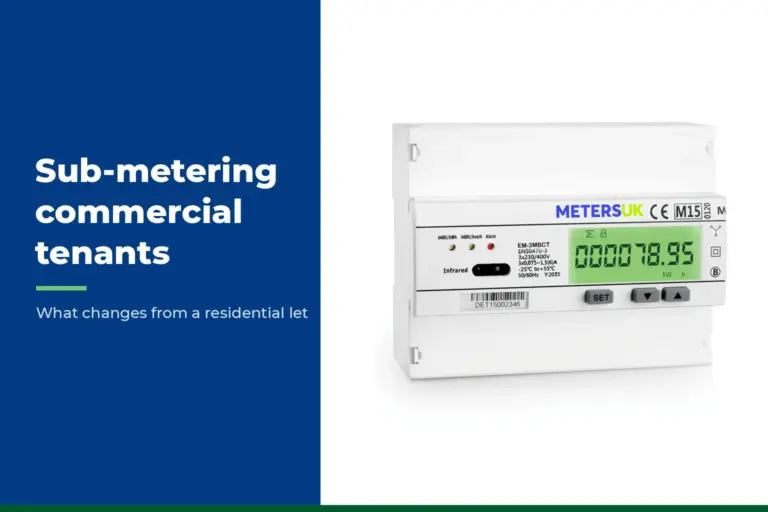
For lower loads, both types come as whole-current meters, where the entire current flows directly through the meter body. A typical single phase whole-current meter handles up to 100A. A three phase whole-current meter usually goes up to 100A per phase.
Above those direct-connection limits, you move to CT-operated meters, where the current is sensed via current transformers clamped around each live conductor and the meter just reads the secondary signal. This is covered in our companion article on choosing electric meters.
| Feature | Single phase | Three phase |
|---|---|---|
| Voltage | 230V (live to neutral) | 230V per phase, 400V line-to-line |
| Typical capacity at 100A | ~23 kVA total | ~69 kVA total |
| Typical UK property | Most homes, small HMOs, low-power flats | Commercial buildings, larger HMOs, properties with 11kW or 22kW EV chargers, or with sizeable heat pumps |
| Whole-current sub-meter limit | Up to 100A direct | Up to 100A per phase direct |
| When CT-operated is needed | Above ~100A total load | Above ~100A per phase |
| DNO upgrade cost (single to three) | n/a | Several thousand pounds, often £3,500 to £12,000 for 100A per phase, depending on cable runs and street works |
When should I install CT-operated meters?
Any time the load exceeds what a direct-connection meter can handle. For single phase that’s about 100A. For three phase that’s about 100A per phase. Above those numbers, the meter itself can’t safely carry the current, and current transformers (CTs) become the right answer.
CT-operated meters have one big advantage and one common pitfall. The advantage is they scale. The same physical meter can measure anything from a small flat to an industrial workshop just by changing the CT ratio. The pitfall is the wiring. CTs have a direction (primary in, secondary out) and a ratio (the number stamped on the body, like 200/5). Wire them backwards and the meter reads negative. Pick the wrong ratio and the meter reports either a tenth or ten times the real consumption.
For most HMOs, you’ll be on direct-connection whole-current meters. CT-operated comes in for larger buildings, plant rooms, or shared landlord supplies that feed multiple high-load circuits.
Can I have some flats on single phase and others on three phase in the same HMO?
Yes, and it’s a sensible setup for many HMOs with mixed unit sizes. The incoming supply to the building is one cable (single phase) or three cables (three phase) from the DNO. From the meter cabinet, you distribute to each flat. A three phase incoming supply can be split so that some flats sit on phase one, some on phase two, some on phase three, and the heavier loads (electric showers, a shared laundry, an EV charger) can be wired across two or three phases as needed.
Each flat then has its own sub-meter sized to its own circuit. Most flats end up with a single phase sub-meter even if the building’s incoming supply is three phase. Only the units with a genuinely three phase circuit need a three phase sub-meter.
The thing to watch is phase balance. If you wire most of the heavy loads off one phase, you’ll trip the breaker on that phase while the other two sit idle. Spread the loads across all three phases at the design stage and the building runs cleanly.
Should I plan for three phase even if I don’t need it now?
Maybe. The case for installing three phase before you strictly need it is that cable trenches and disruption are the same as for a single phase upgrade, so doing it once costs less than doing it twice. The cost difference between a single phase 100A upgrade and a three phase 100A upgrade is largely paperwork and meter; the dig is similar.
The case against is that it’s still several thousand pounds you spend now versus money you might never need to spend. If your property is a standard residential HMO with gas heating and no plans for fast EV chargers, single phase will see you through.
The middle ground that fits most landlords. Get an electrician to do a demand calculation including any obvious near-term additions (a 7kW EV charger, an air-source heat pump, a couple more flats if you’re extending). If that calculation comes in under 100A, single phase stays. If it pushes past, ask the DNO for a three phase quote and assume it’s a “now or in five years” decision.
“The single biggest mistake we see on three phase installs is meter and supply mismatch. A landlord upgrades to three phase because the new EV charger needs it, and the electrician fits the charger across all three phases just fine. Then they install single phase sub-meters on each flat to keep costs down, but the meter cabinet has been rewired and a couple of the flats are now sitting on a different phase than the meter expects. Half the readings come back as zero. We always tell installers to confirm which phase feeds each flat, then match the sub-meter to it. Five minutes with a multimeter saves a billing dispute every time.”
Meters UK technical team
Common Mistakes Landlords Make
A few patterns trip landlords up here.
Assuming three phase is automatically “better”. It isn’t. It’s more expensive to install, more complex to maintain, and only useful if the loads genuinely warrant it. A standard residential HMO with gas central heating has zero reason to be on three phase.
Putting a single phase sub-meter on a three phase circuit. It measures one leg only, the bill comes out a third of actual use, and the tenant is delighted while you absorb the rest. The opposite happens too. A three phase meter on a single phase circuit reads zero on two of its phases and the figures look broken.
Ignoring phase balance. A three phase supply only works as designed if you spread the load across all three phases. Put all your heavy appliances on phase one and you’ll trip the breaker on phase one while phases two and three sit idle. This is the electrician’s job at design stage, but the landlord pays for it later if it’s done wrong.
Not getting the DNO quote in writing before the work starts. Verbal estimates from electricians for street-side work are not the same as a binding DNO quotation. The actual quote from the DNO is what counts, and it’s usually higher.
What should I actually do?
Three steps for a landlord weighing this up.
First, get an electrician to do a proper demand calculation across the whole building. This is a couple of hours of work and it will tell you definitively whether you need three phase or whether single phase has the headroom.
Second, if the demand calculation says you’re close to or past 100A, ask your local DNO for a quote. The quote is free, lasts 90 days, and tells you the real number rather than the rough range. UK Power Networks, Northern Powergrid, National Grid Electricity Distribution, Electricity North West, SP Energy Networks, and SSEN all publish online quotation portals.
Third, match your sub-metering to whatever supply you end up with. Single phase circuit, single phase meter. Three phase circuit, three phase meter. Above 100A on either, CT-operated. Our electric meters range covers both with MID-approved options across the load spectrum.