
Last updated: April 2026. This article reflects current regulations and Ofgem guidance as of this date. Ofgem is reviewing the MRP rules, with a decision expected later in 2026.
What is the maximum resale price? The Maximum Resale Price (MRP) is a cap set by Ofgem that stops landlords charging tenants more for gas or electricity than they paid their own supplier. Section 44 of the Electricity Act 1989 and section 37 of the Gas Act 1986 give Ofgem the power to set the cap. The detailed rules sit in Ofgem’s MRP direction. No profit margin is allowed on domestic energy resale.
Key Takeaways
- You can never charge more per kWh than your own supplier charges you, and the standing charge has to be split fairly between everyone on the supply.
- MID-approved sub-meters are the only practical way to prove your charges are accurate. Without them, you are estimating, and estimates are where disputes start.
- Ofgem is currently reviewing the MRP rules. Possible 2026 changes include EV charging, mixed-use buildings, and how complaints get enforced.
Who Does the MRP Apply To?
If you buy gas or electricity from an authorised supplier and resell any of it to someone else for domestic use, the MRP applies to you. That covers the obvious cases. Landlords billing tenants in HMOs. Managing agents recharging leaseholders. Caravan park owners charging pitch holders. Student accommodation providers running inclusive tenancies.
It also covers some less obvious ones. If a tenant in a large flat sub-lets a room and passes on an energy charge, they have just become a reseller too. The rule follows the energy, not the contract.
There is one significant exception. The MRP does not apply to energy resold purely for use at commercial or industrial premises. If you let office space or workshop units and the lease covers energy as a commercial arrangement, the cap does not apply and the price becomes a contractual matter between you and your tenant. Mixed-use properties need careful handling. Where some units are residential and others commercial, the MRP applies to the residential units regardless of the overall use of the building.
How to Calculate the Maximum Resale Price
The maths is straightforward. The details trip people up.
If the tenant has a sub-meter, you charge them for the kWh they have actually used at the same unit rate you pay your supplier. If your supplier charges 24.5p/kWh for electricity, that is what you charge your tenant. Not a penny more.
Standing charges are split proportionally between every unit on the supply, including any that you occupy yourself. If your standing charge is 61.64p per day and you have six flats plus your own usage on the same meter, each share is 8.81p per day. You cannot charge each tenant the full 61.64p. That would mean collecting seven times what your supplier actually billed you.
If the tenant does not have a meter, you have to estimate their usage. Ofgem’s guidance asks for “reasonable endeavours”, which in practice means basing the split on factors like floor area, number of occupants, or hours of use. An equal split is only fair when all the units are genuinely identical.
A Worked Example
Say you own a converted house with four bedsits and you live offsite. Your electricity bill for the quarter looks like this:
- Total units consumed: 3,200 kWh at 24.5p/kWh = £784.00
- Standing charge: 92 days at 61.64p/day = £56.72
- Total bill: £840.72
Each bedsit has an MID-approved electric sub-meter. The readings for the quarter are:
| Flat | Usage (kWh) | Energy charge | Standing charge share | Total billed |
|---|---|---|---|---|
| Flat 1 | 920 | £225.40 | £14.18 | £239.58 |
| Flat 2 | 680 | £166.60 | £14.18 | £180.78 |
| Flat 3 | 810 | £198.45 | £14.18 | £212.63 |
| Flat 4 | 790 | £193.55 | £14.18 | £207.73 |
| Total | 3,200 | £784.00 | £56.72 | £840.72 |
Your bill is covered. Nobody is overcharged. If a tenant challenges any line, you can show the meter reading, the supplier rate, and the standing charge calculation in about thirty seconds.
Why Sub-Meters Make MRP Compliance Easier
You can technically comply with the MRP without sub-meters. Ofgem allows estimation where metering is not practical. Estimation is also where disputes start.
Without a meter, you are guessing. If Flat 2 has one tenant who works away three weeks a month, and Flat 3 has a couple who run electric heaters all winter, an equal split is obviously unfair. The tenant in Flat 2 will challenge it. They would be right to.
An MID-approved sub-meter removes the argument entirely. The reading is the reading. End-of-tenancy billing becomes simple too: take a final reading, calculate the charge, done. No estimates, no small claims court.
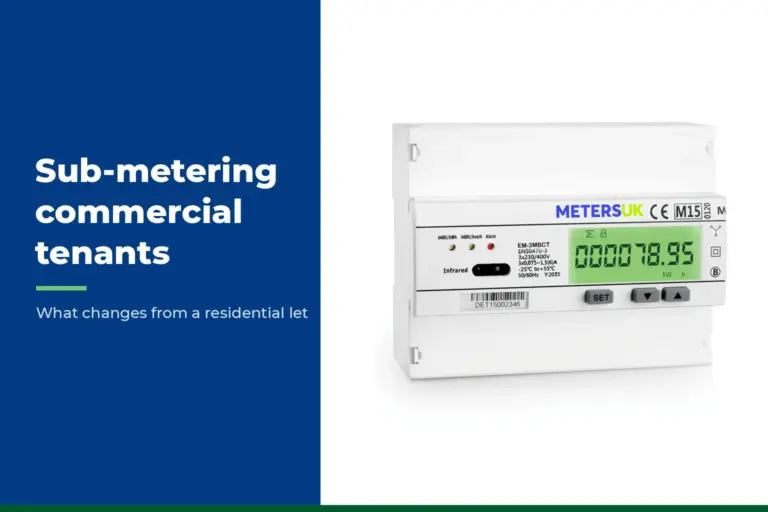
For billing purposes, any sub-meter you use must be of an approved design. In practice that means an MID-approved meter (the Measuring Instruments Directive sets accuracy requirements for meters used in trade, and was originally implemented in UK law from 30 October 2006, with the recast Measuring Instruments Regulations following at the end of 2016). Older meters that received national approval under the Electricity Act or Gas Act regime before October 2006 can still be used if their original approval is intact, although they are increasingly rare in the field. Using an unapproved meter for billing is a regulatory offence and exposes you to enforcement action by trading standards. Look for the “M” marking on the meter face followed by the last two digits of the year of manufacture and the four-digit code of the notified body that approved it.
From the Meters UK technical team: The most common mistake we see on new installations is landlords picking the cheapest meter they can find online without checking it carries the MID mark. If a tenant later challenges the bill, those meters give you nothing to fall back on. A proper approved sub-meter typically costs less than the time and aggravation of a single disputed billing cycle.
Meters UK technical team
Can a Landlord Profit from Reselling Energy?
No. The MRP exists specifically to prevent it. If you charge more than you paid, you are breaching the rules and the tenant can take you to court.
If a court or tribunal finds you have overcharged, you owe the tenant a refund of the excess plus interest. Ofgem’s 14 March 2014 direction sets the interest rate at twice the base rate of Barclays Bank plc, applied from the date the overcharge was made until repayment. That adds up quickly if you have been overcharging across multiple tenants for months or years.
One nuance worth understanding. The MRP only covers the energy itself. That means the unit rate and the proportional standing charge. It does not cover the cost of billing administration, sub-meter maintenance, or running your own distribution network within the building. You can recover those separately, and many landlords do. The charges have to be reasonable, transparent, and shown as separate line items. Bundling an admin fee into a higher unit rate would breach the MRP, even if the total felt fair to you.
The Standing Charge Problem
Standing charges cause more landlord billing disputes than unit rates do. The principle is simple. The standing charge on your supplier bill must be shared proportionally between all the units using that supply. What “proportionally” actually means is the bit that catches people out.
If all your units are roughly the same size with similar usage patterns, dividing equally is reasonable. If they are not, you may need to weight the allocation. A studio flat and a three-bedroom maisonette sharing the same supply should not pay the same daily standing charge if you are allocating based on usage proportions or floor area.
Communal areas complicate things further. Energy used in shared hallways, external lighting, or laundry rooms is the landlord’s cost, not the tenants’. The MRP only applies to energy resold to tenants, so communal usage should sit on your side of the ledger. This is another reason sub-meters pay for themselves. You can meter the communal supply separately and keep the numbers clean.
Ofgem’s MRP Review: What Could Change in 2026?
In October 2025, Ofgem opened a call for input on the MRP rules, the first significant review in over twenty years. The consultation closed on 5 December 2025. A decision or policy statement is expected during 2026. Several areas under review affect landlords directly.
EV charging. The 2014 direction excludes electricity resold from a chargepoint for use by an electric vehicle, regardless of whether the chargepoint is public or private. As more residential buildings install chargepoints for tenant use, that broad exclusion has become a live question. The review is asking whether the MRP should apply to certain residential EV charging arrangements (for example, a landlord recharging a flat-block chargepoint to a specific tenant) and where the line between domestic energy and propulsive power should sit.
Non-domestic edge cases. The MRP currently does not cover commercial premises, but there is a grey area around mixed-use buildings and micro-businesses operating from residential units. Ofgem is considering whether protections should extend further.
Enforcement. This is the big one. Ofgem sets the MRP but has no power to enforce it directly. If a tenant thinks they are being overcharged, their only route today is the civil court. The review is considering whether a formal dispute mechanism could handle MRP complaints instead. One possible route is the Private Rented Sector Landlord Ombudsman framework introduced by the Renters’ Rights Act 2025, which the government plans to roll out in phases through 2028 (mandatory landlord sign-up to the Ombudsman is currently planned for 2028).
Billing transparency. Ofgem is also looking at whether resellers should be required to provide more detailed billing information to tenants, including breakdowns of unit rates, standing charge allocations, and the basis for any estimates.
None of this is decided yet. The direction of travel suggests more transparency, clearer rules, and easier enforcement for tenants. For landlords already billing correctly with MID-approved meters and clear records, none of these changes should cause a problem. For those who have been estimating loosely or bundling charges, this is a good moment to tighten up.
Common Mistakes to Avoid
Charging a flat rate per room. Plenty of HMO landlords charge a fixed weekly amount for electricity, especially where bills are included in the rent. If that flat rate exceeds the MRP for what the tenant actually uses, it is a breach. The fix is to install sub-meters and bill on actual usage, or to set your inclusive rate well below the MRP equivalent so you have headroom even on a heavy month.
Forgetting to update the rate when your tariff changes. If your supplier changes their unit rate and you carry on charging tenants at the old higher rate, you are overcharging. This catches landlords out more than you would expect, especially with quarterly billing. Check your supplier rate before every billing cycle.
Charging each tenant the full standing charge. Surprisingly common, especially in commercial multi-lets where the lines blur. If you have one supply meter and nine sub-meters, charging each of the nine tenants the full daily standing charge means you collect nine times what your supplier billed you. That is not MRP-compliant. The standing charge has to be divided.
Using unapproved meters for billing. Cheap panel-mounted meters from online marketplaces might show a reading. If they are not approved (MID or earlier national approval), they cannot legally be used to bill. If a tenant disputes a bill and you cannot demonstrate you used an approved meter, your position collapses.
Prepayment Meters and the MRP
Prepayment sub-meters are popular in HMOs because they solve the billing problem upfront. Tenants pay as they go and the landlord does not chase arrears.
The MRP still applies. The rate per kWh on the prepayment meter must not exceed what you pay your supplier. If you use a system where tenants buy tokens or codes, the value loaded onto each token has to reflect your actual unit cost. Any service fees or platform charges from the prepayment provider should be billed separately and shown transparently to the tenant.
Watch for one trap. If your supplier tariff has a lower off-peak rate (Economy 7 or similar) and your prepayment meters charge a single flat rate, make sure that flat rate does not exceed your blended average cost across peak and off-peak. Some landlords set the prepayment rate at their peak tariff, which can easily overcharge tenants who use a lot of off-peak power for storage heaters or EV charging at night.
What About Water?
Water resale sits with Ofwat, not Ofgem, but the principle is the same. You cannot charge tenants more than the water company charges you, plus a reasonable administration fee. The rules are set out separately from gas and electricity MRP, but the practical approach is identical: meter where possible, share costs fairly, keep records.
Frequently Asked Questions
How is the standing charge split between tenants?
Proportionally to use of the supply, taking into account the landlord’s own consumption if any. Equal splits are only fair when units are genuinely identical in size and usage. For different unit sizes, allocate by floor area or by metered consumption proportions.
What happens if a landlord overcharges a tenant?
The tenant can claim a refund of the excess plus interest through the civil court. Ofgem’s 14 March 2014 direction sets the interest at twice the base rate of Barclays Bank plc, calculated from the date of the overcharge until repayment.
Do I need an MID-approved sub-meter to bill tenants?
You need an approved meter. In practice, that means an MID-approved meter for any new installation since the Measuring Instruments Directive came into UK force on 30 October 2006. Meters that received national approval under the Electricity Act or Gas Act regime before that date can still be used if the original approval is intact.
Does the MRP apply to commercial tenants?
No. The MRP only covers energy resold for domestic use, including residential accommodation. If you let purely commercial premises, the energy charge becomes a contractual matter. Mixed-use buildings need separate treatment for the residential units.
Can I charge a separate admin fee on top of the MRP?
Yes, provided it is reasonable, transparent, and billed as a separate line item. Costs for billing administration, sub-meter maintenance, and internal distribution are not covered by the MRP. They cannot be hidden inside an inflated unit rate.
Where to Go Next
If you are setting up tenant billing or auditing existing arrangements, two of our other resources are worth a read. Our UK landlord’s guide to sub-metering covers the practical setup of a billing system from scratch. The metering glossary explains MID approval, M-Bus, and the other technical terms you will run into.