A tenant in one of your rooms emails at half past eleven asking why her electricity came to £96 when the room next door paid £61. In a House in Multiple Occupation (HMO) with sub-meters already sitting in the riser cupboard, the answer exists somewhere. Whether you can produce it in one reply, with readings and a rate, decides whether this stays a two minute conversation or turns into a deposit dispute six months later.
How do you bill an HMO tenant from an electric sub meter? Take an opening and a closing reading, multiply the units used by the same unit rate your own supplier charges you, then add that tenant’s share of the daily standing charge. Ofgem’s Maximum Resale Price (MRP) rules stop you charging more than the energy cost you in the first place.
Last updated: August 2026. This article covers Great Britain and reflects the resale and metering rules in force at that date. Northern Ireland has its own regulator and its own metering arrangements.
Key Takeaways
- You can recharge a tenant for metered electricity, but only at cost. The MRP direction leaves no room for a margin on domestic resale.
- The standing charge is shared out in proportion to the amounts payable for the units resold, and your own consumption takes a share too.
- A meter you bill from has to be of an approved type. Modern ones show conformity markings under the Measuring Instruments Regulations 2016 (MIR), the British implementation of the Measuring Instruments Directive (MID), while older meters may hold an approval under the earlier national arrangements.
- Landing lights, stair sockets and the boiler pump are your consumption as landlord, recovered through rent or a valid service charge, not resold through a tenant’s meter.
- Write the billing method into the tenancy agreement before the first bill goes out, not after the first argument.
What can you legally charge a tenant for electricity?
The ceiling is your own cost. Ofgem sets a Maximum Resale Price under section 44 of the Electricity Act 1989, and the direction made under it says a reseller cannot charge more for each unit than they paid their authorised supplier for it. No margin, no rounding up. The one carve out worth knowing is electricity resold through a dedicated charge point for an electric vehicle, which the direction excludes, and Ofgem is looking at whether that exclusion should survive.
The standing charge trips people up more than the unit rate does. Where a standing charge is payable on the supply, the direction requires it to be shared out in proportion to the amounts payable for the units resold, and the electricity you use yourself or for common services takes its own proportional share. On a single unit rate across the whole building that works out the same as splitting by kilowatt hours. On a dual rate or time of use tariff it does not, because units bought at the cheaper rate carry less of the standing charge than units bought at the expensive one.
Tax sits inside the figure you pass on rather than on top of it. Domestic energy carries value added tax (VAT) at the reduced rate, so if your supplier’s unit rate already includes it, adding it a second time puts you over the cap.
Administration is a separate question again. The direction contains no allowance for the work of reading meters and issuing statements, and Ofgem’s guidance treats administration costs as something billed separately rather than buried in the unit rate. Whether you can recover such a charge at all depends on the tenancy and on the fee rules that apply to it, so take advice before adding one. Charge above the cap on the energy itself and the tenant can come back for the difference, with interest, through civil proceedings. Our fuller explanation of how the maximum resale price works goes through the arithmetic in more detail.
How do you turn two meter readings into a bill?
Work in the same order every time and the bill defends itself. Note the closing reading, subtract the opening reading, and you have the units. Multiply those units by your supplier’s unit rate. Then take the standing charge for the same period and split it in proportion to what each part of the building spent on units.
Say your supply is billed at 27.5p per kilowatt hour with a standing charge of 62p a day, everything on one rate, and you are recharging a 91 day quarter. The whole building drew 3,200 kWh over that quarter. Flat 2 drew 210 kWh of it.
The energy is straightforward at 210 multiplied by 27.5p, which is £57.75. The standing charge for the quarter is 91 days at 62p, or £56.42, and Flat 2 accounts for 210 of the 3,200 kWh, so its share is 6.5625 per cent of that, coming to £3.70. Flat 2 owes £61.45 for the quarter. The share sitting behind the shared lighting and the boiler pump stays with you, because that consumption is yours.
An electric sub meter for tenants only earns its keep if the readings behind those numbers are defensible, which is a question of habit rather than hardware. More on that below.
| Approach | What the tenant pays | Suits | The catch |
|---|---|---|---|
| Inclusive rent | One rent figure with energy folded in | Small room lets where circuits cross between bedrooms | No usage signal at all, and a cold winter lands on you |
| Fair estimate | A stated weekly or monthly energy contribution | Rooms that cannot be metered without rewiring | The estimate has to be genuine, built from the consumption and price information you actually have, reconciled at least once a year, with anything overcharged paid back |
| Metered actual | Units used at your unit rate plus a standing charge share | Self-contained flats and any unit on its own circuits | Needs an approved meter, disciplined readings and a written method |
Does the meter have to be approved before you can bill from it?
Yes, where the charge depends on what the meter measured. The requirement for an approved meter runs through Schedule 7 of the Electricity Act 1989 as well as the Measuring Instruments Regulations 2016, and it applies to a landlord recharging a tenant just as it applies to a supplier. Meters placed on the market from 30 October 2016 fall under the current regulations. Older meters carrying a valid approval under the earlier national arrangements can stay in service, so an unmarked meter is a question to answer rather than an automatic failure.
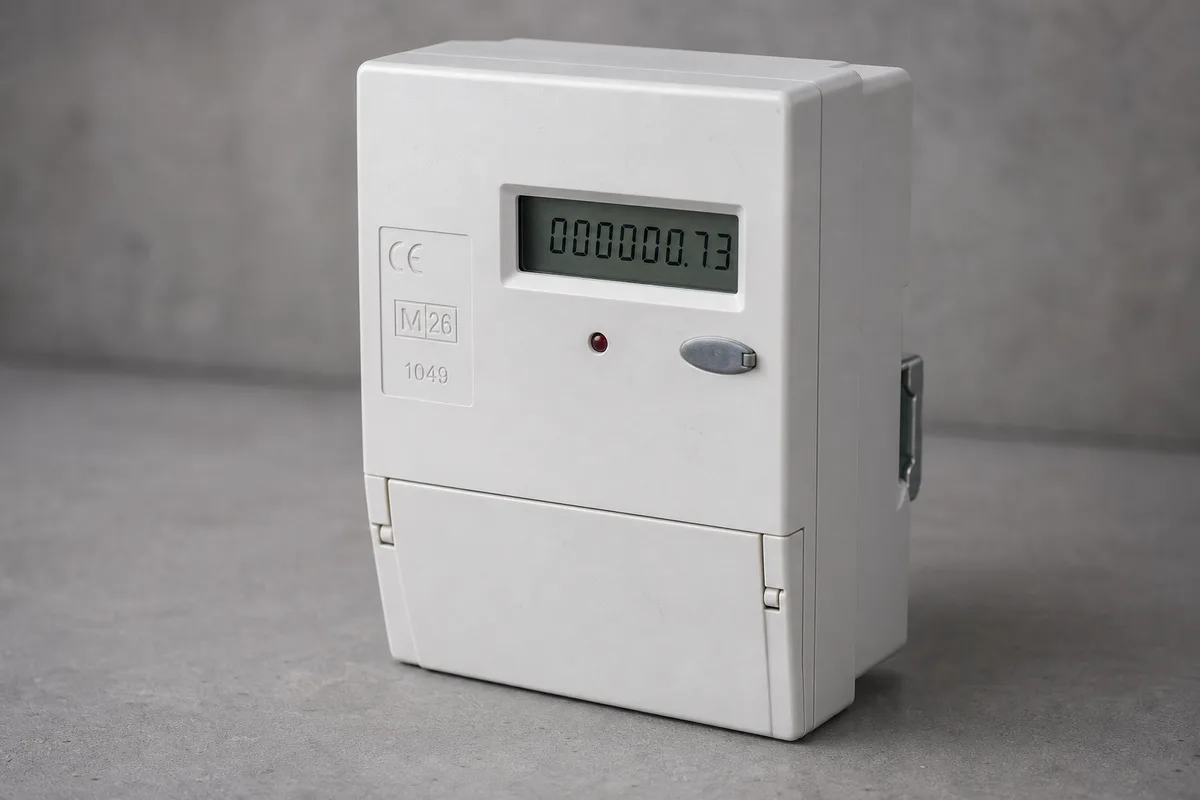
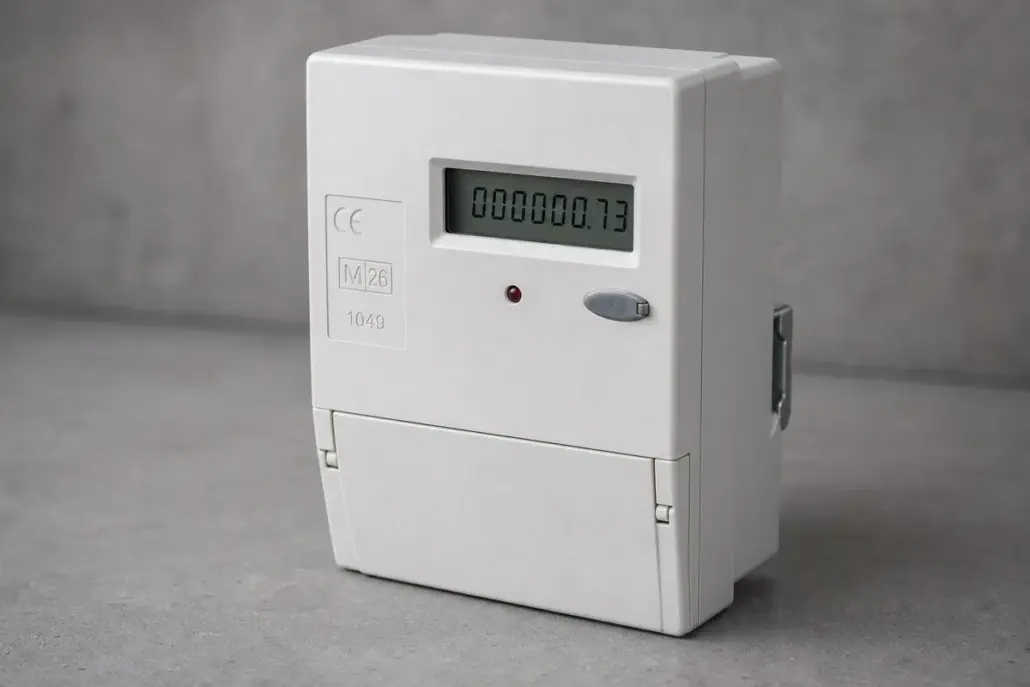
Recognising a modern approved meter takes about a minute. Look for a UKCA (UK Conformity Assessed) or CE conformity marking, an M inside a rectangle followed by the two digit year that marking was applied, and a four digit number identifying the body involved in the production control. Where the faceplate has no room, those details can sit on a data plate or in the accompanying documentation instead. If you cannot find them anywhere, check the model against the approval records before you write the meter off, because the answer decides whether you have a billing instrument or a monitoring device. Our walkthrough on checking a sub-meter is MID-approved covers what to do next.
Who pays for the light in the hallway?
You do. Landing lights, stair sockets, the boiler pump and anything else serving the building rather than one letting is your consumption as landlord. It comes back through the rent, or through a service charge where the tenancy or lease already provides for one, and you cannot invent a new service charge just to carry it. No resale is happening, because nobody is buying it from you.
The practical version of that rule is a wiring question. If a tenant’s sub-meter sits on a circuit that also feeds the hallway, that tenant is quietly paying for the hallway every month. In a converted house the lighting and socket circuits were not laid out with bedroom doors in mind, which is why per room metering usually needs the circuits separated first, and that is an electrician’s job rather than a meter question. Our guide to how many sub-meters an HMO needs works through where that line falls in a typical shared house.
What should the tenancy agreement say about sub-metered electricity?
Put the method in writing before the first bill rather than after the first complaint. Nothing in the resale direction demands it, so this is contract housekeeping rather than a regulatory duty, but it is the cheapest dispute prevention available. The agreement should say that electricity is charged separately and recovered at cost, name the meter by serial number, and record the opening reading on the day the tenancy starts.
It should also say how the unit rate is set, and the safest wording ties it to the rate the landlord’s own supplier charges at the time of use, so a fixed deal ending mid tenancy does not turn into an accusation of profiteering. Add how the standing charge is shared, how often bills are issued, and what happens to the reading when someone moves out mid month. Keep the supplier bills that evidence your own price, because a tenant is entitled to ask what you paid. None of this is legal drafting advice, so have the wording reviewed by someone qualified before you use it across a portfolio.
Keeping readings that survive a dispute
Photograph the display with the meter serial number in the same shot. A picture of a number on a screen proves nothing about which meter produced it, and riser cupboards get relabelled by whoever was last in them.
Read on the same date each month, keep the supplier bills covering the same period, and file both together. Close the outgoing tenant’s account with a reading on the day they leave and open the next one with the same figure, which is what settles who owns an empty room’s consumption when the tenancy dates and the meter dates disagree. When a tenant asks how a bill was built, the answer should be an attachment rather than an afternoon of reconstruction. A remote reading system removes most of this work once a property has more than a few meters, though the record keeping discipline stays the same.
“In our experience a disputed recharge usually comes down to which meter was read, not what the meter said. Riser cupboards get relabelled by whoever was last in them, and a photo of a display with no serial number in shot proves nothing at all. Read the serial first, then the register, and keep both in the same picture.”
Meters UK technical team
Common Mistakes to Avoid
These are the patterns behind most of the billing arguments that reach us.
Rolling the shared landing and stair load into whichever tenant’s meter happens to catch it is the most expensive. It is an overcharge under the resale rules even though nobody planned it, and it stays invisible until someone compares two bills.
Folding an administration fee into the unit rate is the next one. The rate you charge has to be the rate you paid, so anything you want to recover for the work of billing has to be identified separately and has to be recoverable under the tenancy in its own right.
Assuming an unmarked meter is fine, or assuming it is worthless, both cause trouble. Check the model and its approval before the meter goes on the wall, not when the first query arrives.
Leaving the unit rate undefined in the agreement causes the slowest arguments. A tenant who signed up under a fixed deal at 24p and gets billed at 31p after it expired will ask why, and “that is what we pay now” only works if the agreement said so from the start.
When metered recharging is the wrong answer
Metering pays for itself where usage genuinely differs and the circuits allow a clean split. In a four bedroom house share on shared circuits, with bills that swing by a few pounds a month between rooms, an inclusive rent priced sensibly costs less to run and produces fewer arguments. The landlord’s guide to sub-metering sets out where the numbers start to justify the install.
Prepayment is worth a look in the other direction. Where the problem is arrears rather than fairness, letting the tenant top up their own supply removes the monthly recharge entirely, and the resale cap still applies to the rate you set.