Ten years is the number everyone quotes. It turns up on landlord forums, in supplier letters, and now in regulations that came into force this March. The trouble is that the ten years belongs to a different meter from the one on your wall.
When should a landlord replace a sub-meter? Replace it when it fails, when the display cannot be read, or when its accuracy is in real doubt after checking. A secondary meter used to recharge tenants carries no certification expiry date in Great Britain. The ten year certification clock runs on the supplier’s meter.
Key Takeaways
- The 2026 certification change applies to meters certified for supply, not to a secondary meter you use to recharge tenants.
- In practice a mains powered electric sub-meter runs for 15 to 20 years, while most battery powered water and heat meters stop at 10 to 12.
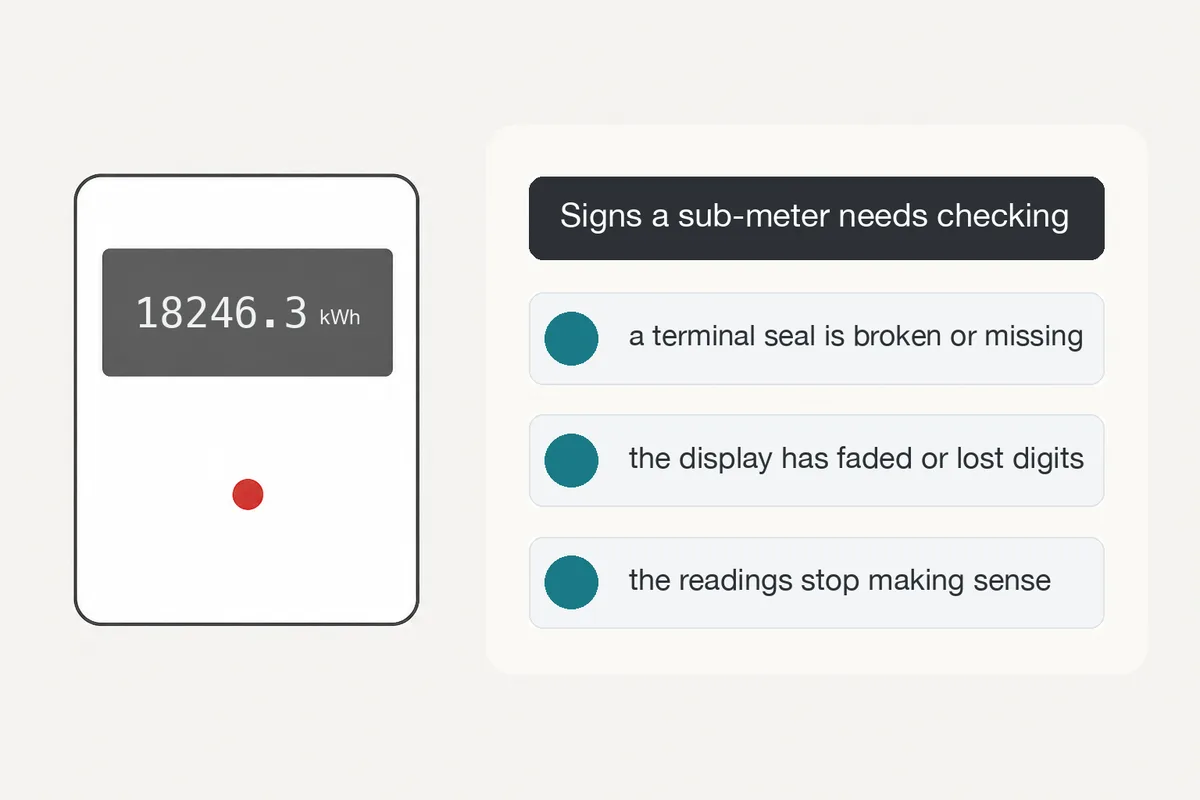
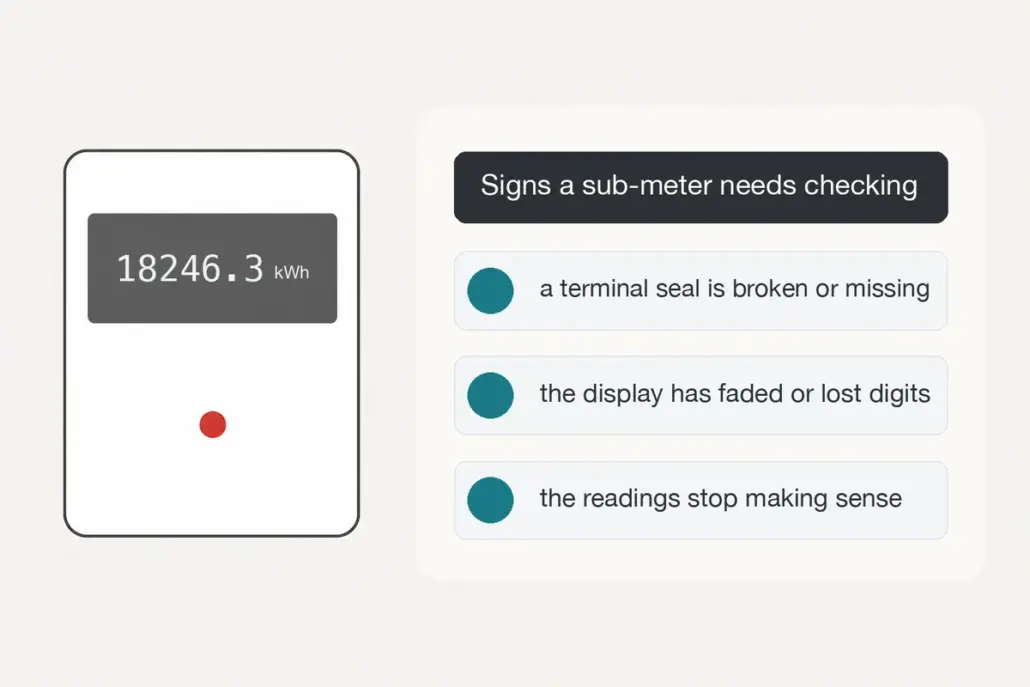
- Broken seals, a fading display and a flat consumption pattern are the three signals worth looking into.
- Read and photograph the old meter before it comes off the wall, or the tenant’s final bill becomes an estimate.
- Electric and gas sub-meter swaps go to a qualified electrician or a Gas Safe registered engineer.
Do landlord sub-meters have an expiry date?
No, not in the way supply meters do.
The meter your energy supplier owns, the one measuring what the whole building draws, sits under the Electricity Act 1989. It has to be certified, and certification runs out. The Meters (Certification) (Amendment) Regulations 2026 came into force on 23 March 2026 and put defined periods on meters certified by type, commonly ten years, with longer periods and extensions in the detail. Those meters are not your property, and your supplier replaces them.
A sub-meter is a different thing. It sits downstream, it belongs to you, and it splits one bill between several people. Schedule 7 does not call for certification on a secondary meter in a landlord and tenant arrangement, though dispensing with it takes a written agreement, and the meter still has to be of an approved pattern. No certification clock runs out on your sub-meter. The approval question never goes away.
Approval sits under the Measuring Instruments Regulations 2016, the British version of the Measuring Instruments Directive (MID), and it attaches to the meter’s design at the point it is made. A meter that meets those regulations is treated as certified for the purposes of the Electricity Act, and no set interval says a working sub-meter has to be re-checked. Our guide on how to check a sub-meter is MID-approved walks through the markings.
How long does a sub-meter actually last?
Longer than most people expect, and the limit is rarely the measuring part.
A mains powered electricity sub-meter has no moving parts, and measurement does not depend on a cell even where one backs up the clock. Left alone in a dry cupboard it can run for two decades and still measure inside its accuracy class. What ends it first is usually the display, the comms port, or a case gone brittle behind a hot riser.
Battery powered water and heat meters work the other way round. The sealed lithium cell is commonly rated at 10 to 12 years, longer on some models, and in most units it cannot be changed. When it goes flat the meter goes dark, and a meter you cannot read is a meter you cannot bill from. A mechanical water meter with a pulse output sidesteps that, since the dial turns without power. Our guide to water sub-metering for landlords covers that.
No published standard sets a service life for these. The figures below are what we see in the field.
| Meter type | Typical service life | What usually ends it |
|---|---|---|
| Electric, mains powered | 15 to 20 years | Display failure or case damage |
| Water, battery and pulsed | 10 to 12 years | Sealed battery, then low flow accuracy |
| Heat meter | 10 to 12 years | Sealed battery and sensor drift |
| Gas, diaphragm | 15 to 20 years | Mechanical wear and seal condition |
How do you tell a sub-meter is on its way out?
Four checks are worth doing, and three of them take a minute in the hallway.
Start with the seals. A sub-meter leaves the factory with a seal over the terminal cover, and a broken or missing one puts the readings in question until you have found out why. Our note on spotting meter tampering in a shared house covers what to look for.
Then the display. Faded segments and missing digits on a mains powered meter point at a unit near the end of its life. A battery meter whose screen only wakes on a button press is usually just saving power, so check the manual first. If you cannot photograph a clear reading, you cannot evidence a bill.
Then the reading history. A meter logging the same consumption every month whatever the weather, or jumping for no reason, is telling you something.
The fourth check is accuracy, and that one is harder.
“Before you condemn a sub-meter, run a known load through it. Switch everything else in the flat off, note the reading, then run a 2 kilowatt fan heater for half an hour with the thermostat wound right up so it does not cycle off. The meter should move by about one unit. Use a heater rather than a kettle, because a kettle stops at boiling. It is a rough check, not a calibration. Nine times out of ten the meter is fine and the real fault is a socket wired onto the wrong circuit.”
Meters UK technical team
That test shows whether the meter is broadly right. It will not show whether it has drifted outside its MID accuracy class, and the permitted error for a Class B electricity meter is not one flat figure. It changes with load, power factor and temperature. Pinning that down needs a bench test at an accredited laboratory, which on a domestic sub-meter costs more than the meter. Fit a new one instead.
Who is allowed to replace a landlord’s sub-meter?
Not you, in almost every case.
Changing an electricity sub-meter means isolating a circuit and working inside an enclosure, so it goes to a qualified electrician. Our list of recommended installers is a starting point. The supplier’s own meter and the incoming service cable stay off limits to everybody but the supplier and the network operator.
Work on any gas meter, including a sub-meter on your own pipework, goes to a Gas Safe registered engineer. Water is the mildest of the three, though a swap still means re-making joints to the water regulations.
What happens to the tenant’s bill when the meter is swapped?
The new meter starts at or near zero, so read both meters before the old one comes off the wall.
Photograph the outgoing meter with its serial number and final reading in one frame, then the new meter’s opening reading the same way. Note the date and both serial numbers. Bill the two sets of units separately, at the rate you were paying at the time, and never add the readings together.
Keep the new meter’s paperwork. The declaration of conformity and the approval markings show it is MID approved, the first thing a tenant or a trading standards officer asks about.
Common Mistakes to Avoid
Swapping a meter without reading the old one costs real money. Once the unit is in a skip the last reading is gone for good, and the tenant’s final bill rests on an estimate you will struggle to defend.
Buying on price alone catches people out on water and heat. A cheap battery meter with an eight year cell, in a building you will still own in fifteen years, buys you a replacement and a set of labour costs that a twelve year cell would have avoided.
Assuming the ten year rule applies to you is the newest one, and it will spread as the 2026 regulations work through the trade press. Landlords are being told to bin sub-meters with years of service left in them. Check the seal, check the display, test it if you are unsure, and spend the money when the meter has earned it.