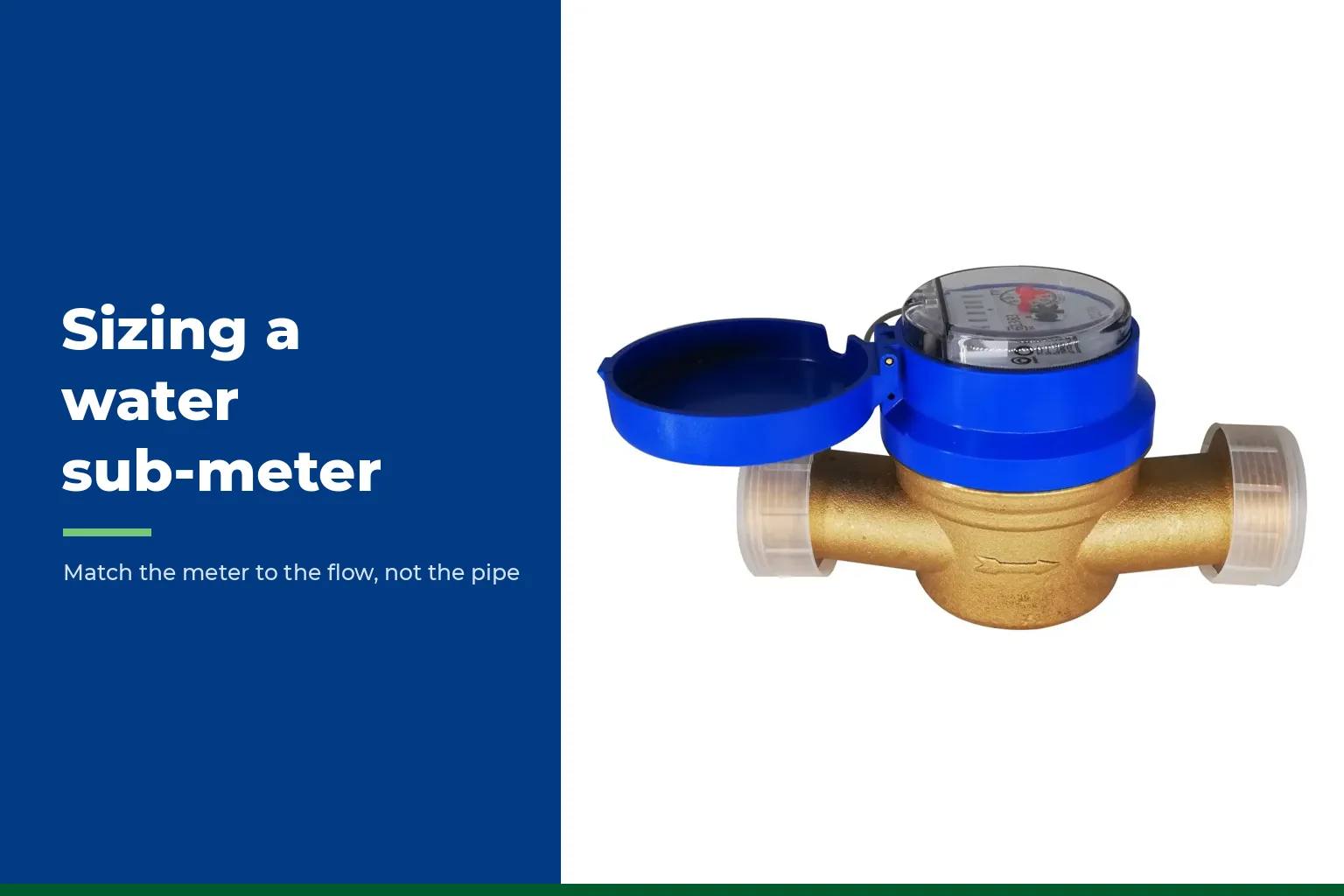
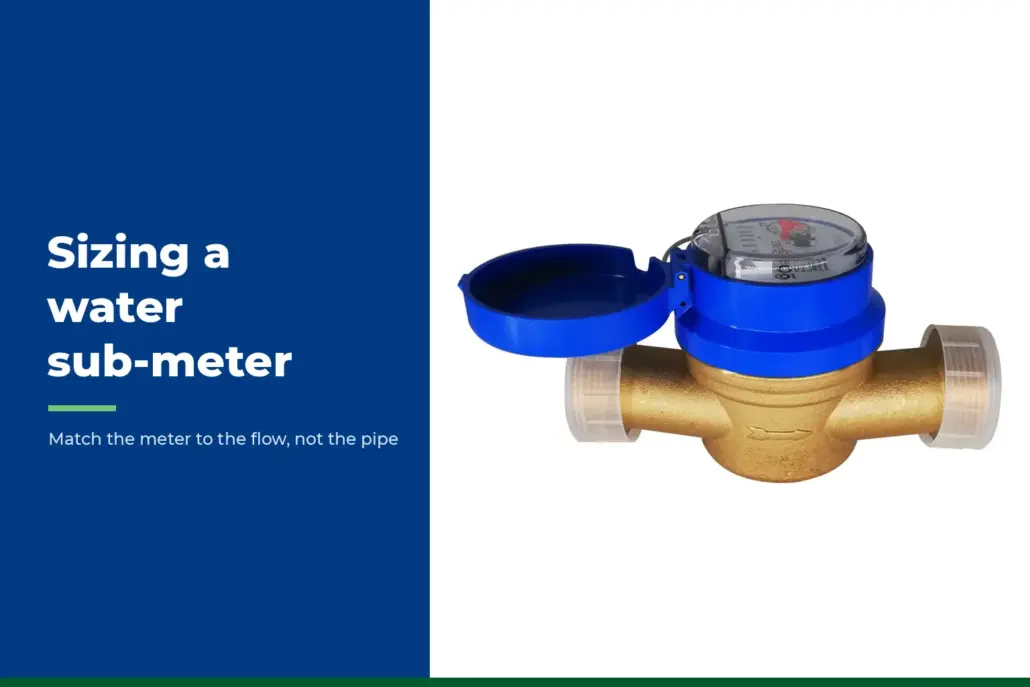
A common slip is to size a water sub-meter by looking at the pipe it will sit on. It feels sensible. The pipe does tell you what connection the meter needs. It does not tell you how fast water will move through the meter, and the meter has to suit that.
That matters because a meter that is too big can lose accuracy on the small flows that make up a good part of a tenant’s water use.
How do you size a water sub-meter? Work out the highest flow the taps and appliances behind the meter can draw at once. Then choose the smallest meter whose permanent flow rate, called Q3, covers it. For one flat that is often the smallest size, a 15 mm meter. Check the minimum flow, Q1, as well.
Last updated: October 2026. Figures reflect manufacturer data and published rules as of this date.
Key Takeaways
- Size the meter by the flow your fittings create, not by the diameter of the pipe it bolts onto.
- Every meter has a working range. Below its minimum flow (Q1) it is no longer promised to read accurately.
- An oversized meter can under-record dribbles and slow leaks, so a tenant can be under-billed and the landlord can end up absorbing the cost.
- A small meter can be fitted to a bigger pipe with the right connections. Ask your plumber to check the pressure loss.
What Do Q1, Q3 and R Mean on a Water Meter?
A water meter reads accurately only between two flows. Q1 is the lowest flow at which it meets its accuracy limits. Q3 is the highest flow it can handle continuously in normal use. R is the ratio between them, so Q1 is Q3 divided by R.
There are two more points on the scale. Q2 sits between Q1 and Q3 and splits the range in two. Q4 is the overload flow, which a meter can only take for a short time.
The rules set the accuracy for each zone. Under the water meter annex of the Measuring Instruments Directive (MID), a meter for water up to 30 °C must read within 5% between Q1 and Q2. From Q2 to Q4 the limit tightens to 2%. The ratio of Q3 to Q1 must be at least 40.
How Do You Work Out the Flow You Need?
List every tap, shower, toilet and appliance on the pipe after the meter. Find the flow rate for each from the maker’s data. Then ask a simple question. How many of these could realistically run together?
A flat rarely runs everything at once. The shower and the kitchen tap might overlap. The washing machine and the dishwasher might too. Your plumber can help you judge a sensible peak, and that peak is what Q3 must cover.
A single flat is often served by the smallest meter on the list, but do the sum rather than assume it. A shared riser is different. Add the fittings of every flat it feeds, and check the combined peak against Q3.
What Size Water Meters Are There?
Water meters are named by a nominal size in millimetres, such as 15 mm or 20 mm. The table below shows one manufacturer’s single-jet range, as listed in a Hydraquip datasheet. The meters are rated R80.
| Meter size | Permanent flow (Q3) | Minimum flow (Q1) | Typical fit (a guide only) |
|---|---|---|---|
| 15 mm | 2.5 m³/h | 31.3 litres an hour | Often one flat or small house |
| 20 mm | 4.0 m³/h | 50 litres an hour | A large house or a small shared supply |
| 25 mm | 6.3 m³/h | 78.8 litres an hour | A shared supply serving several flats |
| 40 mm | 16 m³/h | 200 litres an hour | A commercial or plant feed |
Figures are from a Hydraquip datasheet for an R80 single-jet meter. Other makes and models differ, so read the datasheet for the meter you buy.
What Happens If a Water Sub-Meter Is Too Big?
Look at the Q1 column. A 15 mm meter is accurate down to 31.3 litres an hour. A 25 mm meter does not promise accuracy until 78.8.
Now picture a tenant with a toilet that runs on. Say the leak passes 40 litres an hour. That is above Q1 on the 15 mm meter, so it is counted properly. On the 25 mm meter it sits below Q1, so the maker no longer promises accuracy and the reading may come up short.
Over a day that leak is 960 litres. Over a 30-day month it is 28.8 cubic metres. If the meter misses part of it, the landlord can end up paying the water company for water nobody billed.
Slow fills, dripping taps and a tap left on a trickle behave the same way. They are small flows, and small flows are where an oversized meter loses accuracy.
Is a Meter That Is Too Small a Better Choice?
Not by much. Push more water through a meter than it is designed for and a mechanical meter can wear faster. It also costs more pressure. A tenant at the far end of the pipe may notice a weak shower.
A smaller meter on a larger pipe is possible with the right connections. The pressure loss should be on the datasheet. Ask the plumber to check it against the pressure at your property.
Enquiries often start with a pipe size. We ask what is plumbed in after the meter. A single flat frequently suits the smallest size on the list, but the sum has to come from the fittings, not from a guess.
Meters UK technical team
Does Meter Type Change the Sizing?
It changes the choice, though the logic stays the same. Meters UK sells single-jet, multi-jet and turbine water meters. Single-jet meters are also sold without a pulse output, which suits manual reading. Multi-jet meters come with a pulse output for remote reading. Turbine meters are built for high flows, such as a commercial feed.
For hot water, pick a meter rated for hot water. Under the same rules, a meter is designed either for water up to at least 30 °C or for water from 30 °C to at least 90 °C. A cold-rated meter on a hot line is outside its rating, and it can lose accuracy.
If you plan to read the meter remotely, see our guide to remote meter reading for landlords.
Common Mistakes to Avoid
Matching the meter to the pipe is the big one. A 22 mm supply does not automatically need a 25 mm meter. The flow the fittings create is what counts, and the pipe may be able to carry far more than that.
Buying bigger “to be safe” is a close relation. It feels careful, and it quietly costs money, because the meter can then under-record light use. If the peak sits well inside a 15 mm meter, buy the 15 mm.
Ignoring the datasheet causes plenty of trouble too. Two meters of the same size can have different Q1 values, because their R ratings differ. At the same Q3, a meter rated R160 reads lower flows than one rated R80. Compare them before you order.
Leaving the fitting to chance is the last slip. Have a competent plumber fit the meter, and ask your water company whether it has rules for work on the supply.