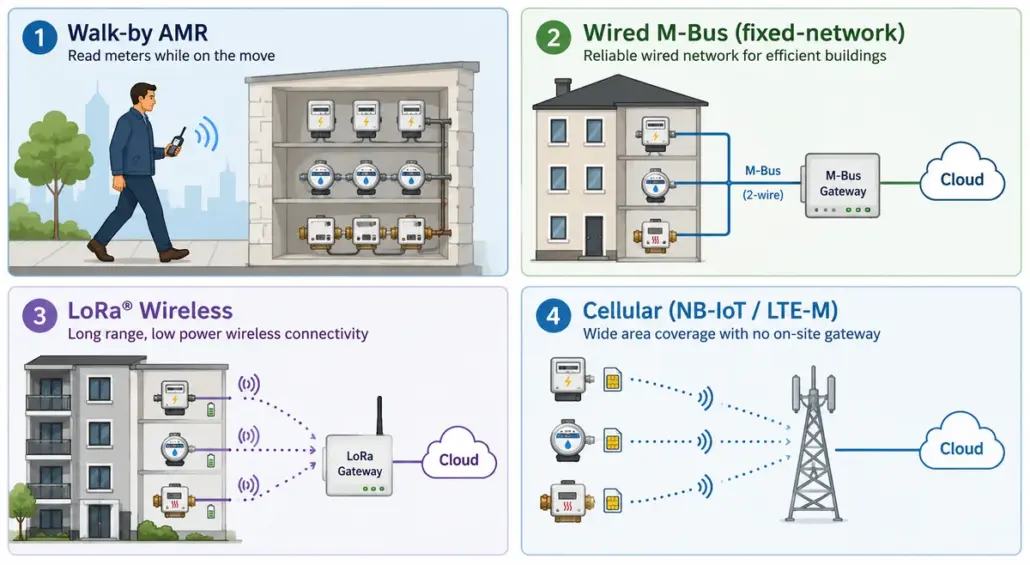
Every landlord with sub-meters faces the same low-grade ongoing problem. Someone has to read the meters. That someone walks round the building once a quarter, knocks on tenant doors, and transcribes numbers from a display into a spreadsheet. The work is tedious, the numbers get mistyped, the tenant is out, and the bill goes out late. Remote meter reading is the way out of that. The question worth asking is what kind of remote reading actually fits your portfolio, because there are several and they cost very different amounts.
Is remote meter reading worth it for a landlord? Usually yes once you’re past three or four sub-metered units, but the right system depends on your building. For a small HMO (House in Multiple Occupation) with sensible cable runs, an M-Bus (Meter Bus) network back to a single gateway is the cheapest and simplest answer. For a large or hard-to-cable site, LoRa (a low-power long-range wireless protocol) or cellular makes sense. Walk-by AMR (Automatic Meter Reading) sits in between, useful where you can’t run cable but a once-a-month visit is acceptable. Whatever you choose, the meter, the network, and the platform have to be specified together.
Last updated: June 2026.
Key Takeaways
- Remote meter reading covers any setup that delivers consumption data without someone physically reading the meter face. It splits into walk-by AMR (Automatic Meter Reading), fixed-network AMR, and wireless using LoRa or cellular.
- For most HMOs (Houses in Multiple Occupation), a wired M-Bus (Meter Bus) network feeding a single gateway is the cheapest and easiest setup. LoRa and cellular suit larger or harder-to-cable buildings.
- The platform is part of the cost. Most cloud reading systems carry an ongoing per-meter or per-site subscription, typically £1 to £5 per meter per month.
- Cellular meters need decent mobile signal at the meter cabinet. Concrete plant rooms in basements are where these often fall over.
- Whatever the comms layer, the meter itself still has to meet the Measuring Instruments Regulations 2016 if you’re using it to bill tenants.
How does remote meter reading work for sub-metered properties?
The data flow is simple in principle. A sub-meter measures consumption and stores it in a register inside the device. A comms layer carries that register value off the meter to somewhere a person can see it. A platform stores, displays, and sometimes bills from the data.
The three layers are largely independent. You can pair an M-Bus meter with a small cabinet gateway and a basic cloud dashboard, or a cellular meter with no gateway and a more sophisticated platform, or anything in between. What matters for a landlord is that the three pieces work together and you understand which bit costs what.
Industry shorthand sometimes splits this into AMR and AMI. AMR (Automatic Meter Reading) is one-way, from meter to platform, with no remote control. AMI (Advanced Metering Infrastructure) is two-way, which means the platform can send commands back, change tariffs, switch supply, and so on. For landlord sub-metering, AMR is usually all you need. AMI matters more when you’re feeding data into a wider BMS (Building Management System).
AMR or walk-by: which makes sense for a UK landlord?
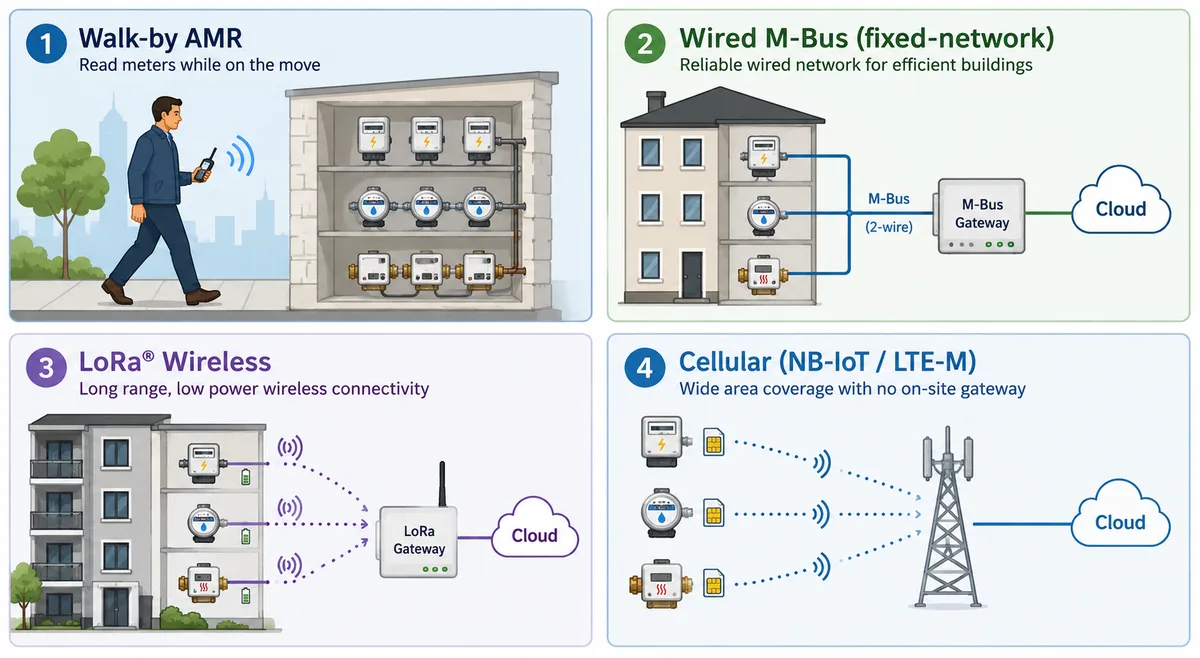
Walk-by AMR uses short-range radio. Meters carry a small transmitter that broadcasts the latest reading every few seconds. A meter reader walks past the building with a handheld unit, picks up every meter in range, and uploads the lot when they get back to the office. No live network, no platform subscription, no need for site Wi-Fi or cellular signal. The trade-off is that someone still has to walk past once a month or quarter.
Fixed-network AMR removes the walk. Every meter connects to a permanent gateway on site, the gateway sends data to a cloud platform over the building’s internet connection (or a mobile SIM, Subscriber Identity Module, card), and the landlord logs in to see the numbers. No site visit required.
For a small portfolio with buildings near each other, walk-by often works out cheaper. For anywhere remote, anywhere you don’t want to send a person, or anywhere the tenant base would resent a regular visit, fixed-network is the answer. As a working rule of thumb based on the projects we see, walk-by tends to make sense below roughly a dozen meters across one or two buildings. Above that, the labour of the walk usually outweighs the platform subscription, and fixed-network wins.
Which comms protocol should the meters use?
This is where the M-Bus vs Modbus question we covered earlier comes back in. For wired remote reading of landlord sub-meters, M-Bus is almost always the right choice: two-wire bus, bus-powered meters, lots of devices on one run. Modbus is preferred where the meters share infrastructure with a building management system. We’ve written that comparison in detail in the M-Bus vs Modbus guide.
For wireless remote reading, the practical options are LoRaWAN (LoRa Wide Area Network), cellular (specifically NB-IoT, Narrowband Internet of Things, or LTE-M, the cellular variant designed for low-power machine communications), and Wireless M-Bus.
LoRa wins on range and battery life. A single LoRa gateway can cover most landlord buildings on its own (actual in-building range depends heavily on construction and meter location), the meters run on batteries that are typically designed for 5 to 10 years (transmit interval matters), and there’s no SIM card or ongoing per-meter data cost (just a platform fee). The catch is you need a gateway on site. LoRaWAN itself is bidirectional, so a return path exists for over-the-air updates, but most metering deployments use it mostly uplink for power efficiency.
Cellular meters skip the gateway entirely. Each meter has its own SIM card and reports directly to the cloud. Great for one-off properties and remote sites. The drawbacks are the per-meter SIM cost (a small monthly fee per meter, exact figures depending on volume and operator), battery drain on cellular radios, and the dependency on having usable mobile signal at the meter location. A meter cabinet in a concrete basement is exactly where cellular often falls over.
Wireless M-Bus is the wireless variant of the wired protocol, defined in EN 13757-4. It works in two modes that matter to landlords: as a fixed system, where meters report to a stationary gateway, and as a walk-by mode for occasional collection. Range is shorter than LoRa but power requirements are low and the protocol is mature for water and heat meters where running cable is impractical.
What does a remote reading platform actually do?
The platform is the cloud service that holds the meter data and presents it to the landlord. At minimum it stores readings, shows consumption over time, and lets you export to a spreadsheet for billing. Better platforms add tenant accounts, automatic invoicing, threshold alerts, and integration with billing or prepayment systems.
Pricing is normally per meter per month. Based on what we see from UK suppliers in 2026, a basic reading platform sits in a low single-digit pounds-per-meter-per-month range. Tenant-facing features and prepayment integration push that figure up. Fully featured prepayment platforms with tenant app and payment processing often add a percentage of collected revenue on top. Specific figures vary widely between vendors, so ask for written quotes before committing.
Before signing anything, check whether you can export your raw data, and what happens to your meters if you leave the platform. Cheaper platforms occasionally tie meters to their service in ways that make switching painful. Reputable suppliers don’t, but ask.
Our SmartLink platform is one example. It reads M-Bus, pulse, and wireless meters, presents per-tenant consumption and billing, and runs as a monthly subscription. See the SmartLink help section for how it works in practice.
Can I retrofit remote reading to existing sub-meters?
It depends on what’s already on the wall. The simplest case is meters with a pulse output. Most modern electric, water, and heat sub-meters include one. You add a small pulse-to-M-Bus or pulse-to-LoRa converter at the meter, wire it back to a gateway, and the meter is now part of a remote reading network without being replaced.
That works for postpay billing. If you also want prepayment, the meter usually has to support it natively, so retrofit means meter replacement. The cost is roughly that of a new install: meter, comms, install labour.
The retrofit question worth asking before you start is whether your existing meters have a pulse output, and whether you have the calibration paperwork showing they’re still MID-approved. If both answers are yes, pulse retrofit is cheap. If either is no, just replace them and start clean.
What does it cost to set up?
The figures below are indicative ranges based on the projects we see, not market benchmarks. Real quotes vary with site complexity, install labour rates, and platform features. Always get written quotes for both hardware and ongoing subscriptions before committing.
For a small HMO with four to six sub-meters and a wired M-Bus gateway, hardware (meters, gateway, cable, accessories) typically lands in the mid-hundreds of pounds, plus install labour of a few hours. The ongoing platform cost is a low single-digit pounds per meter per month, with tenant-facing features adding to that.
For a larger building with twenty to fifty meters, the hardware step up is mostly more meters and possibly a higher-end gateway. Per-meter cost falls a bit at volume. Platform cost scales linearly.
Cellular per-meter setups skip the gateway but add SIM costs. For a one-off property with one or two meters, this can be the cheapest option overall. For anything bigger, the per-meter cellular cost usually outweighs the saved gateway.
| Approach | Best for | Setup characteristics | Ongoing cost |
|---|---|---|---|
| Walk-by AMR | Small portfolios, buildings close together | Meter plus short-range RF, no gateway | Labour of monthly or quarterly walk |
| Wired M-Bus + gateway | HMOs and small blocks with sensible cable runs | Meters, two-wire bus, single gateway | Per-meter platform subscription |
| LoRa wireless | Larger or harder-to-cable buildings, mixed meter types | Battery meters plus on-site LoRa gateway | Per-meter platform subscription |
| Cellular (NB-IoT or LTE-M) | One-off properties, remote sites with no Wi-Fi | SIM-equipped meters, no on-site gateway | SIM fee per meter plus platform fee |
How does remote reading affect prepayment vs postpay billing?
For postpay billing, remote reading is purely a data convenience. The meter records, the platform reads it monthly or daily, the landlord invoices. Nothing about the bill itself changes.
For prepayment, remote reading is the platform. The system has to read the meter, decrement the tenant’s balance in real time, and either disable supply or send warnings as credit runs low. That requires meters that natively support prepayment (not just pulse-output postpay meters), and a platform that handles payment, top-up, and credit management. Our prepayment meters guide covers that in detail.
There’s a practical implication for landlords switching tenants from postpay to prepayment. The meters often have to be replaced even if they’re already remote-readable, because the prepayment logic lives in the meter and not the platform.
“The mistake we see more than any other on remote reading projects is people picking the comms layer last instead of first. They source the meters, get them installed, then start asking how to read them. By that point you’re stuck with whatever comms the meter happens to support, often a different protocol per meter, and the gateway and platform job becomes a translation exercise. Decide on the comms layer up front: M-Bus for most wired jobs, LoRa for hard-to-cable buildings, cellular for one-offs. Then specify the meters to match. Five minutes of planning at the start saves a week of comms gateway scripting at the end.”
Meters UK technical team
Common Mistakes Landlords Make
A handful of patterns recur on remote reading projects.
Forgetting the platform subscription cost when budgeting. The hardware is a one-off; the platform fee is every month for as long as you want remote reading. Most landlords budget the install and overlook the running cost, then get a surprise the following spring. Add the annualised subscription to your hardware quote before signing off.
Specifying cellular meters for buildings with no mobile signal. The meter cabinet is often in a basement plant room or a concrete-walled riser. Signal there is a fraction of what it is on the street outside. Always do a signal check at the actual meter location, not on the pavement outside, before committing to cellular.
Picking a platform on dashboard looks rather than data control. The dashboard is what you see; the export rights and meter ownership are what determines whether you can leave the platform later. Read the contract before signing.
Mixing comms protocols across the same site without a plan. If half the meters are M-Bus and half are Modbus, you need a gateway that handles both or you need two gateways. Either is fine if you’ve planned for it, expensive if you haven’t.
What should I actually do?
For a typical landlord weighing this up, the sequence is short.
Count the buildings and the meters. As a working rule of thumb, walk-by AMR tends to be the cheapest answer below roughly a dozen meters across one or two buildings, and you skip the platform subscription. Above that, fixed-network usually wins.
Choose the comms layer first, before specifying the meters. M-Bus for most wired HMO jobs. LoRa for larger or wireless. Cellular for one-off remote properties where you can confirm signal at the meter cabinet.
Specify meters that match the comms layer and that meet the Measuring Instruments Regulations 2016 for whatever you’re billing. The platform follows from the meter and comms choice, not the other way round.