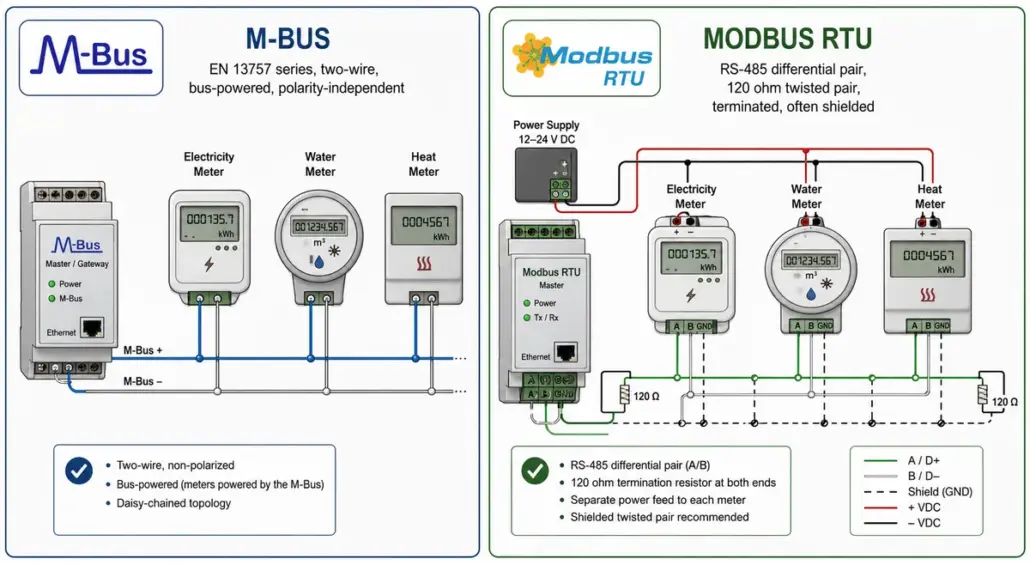
Both protocols turn up on landlord sub-meter product pages, and most modern meters come in both flavours. The data sheet says M-Bus (Meter Bus) or Modbus and you have to pick one. For most landlord installations, the right answer is straightforward, but only after you understand what the two protocols are actually for.
M-Bus or Modbus for sub-metering? M-Bus was designed specifically for utility meters and is the natural choice for most landlord sub-metering setups: cheap cable, lots of devices on one bus, low-power, infrequent reads. Modbus is a general-purpose industrial protocol that fits where the metering needs to slot into a wider building management system or where you need faster polling. For a typical HMO (House in Multiple Occupation) doing daily reads, M-Bus is usually the answer.
Last updated: June 2026.
Key Takeaways
- M-Bus (Meter Bus) is a purpose-built protocol for utility meters, standardised in the EN 13757 series. Modbus is a general-purpose industrial protocol that typically runs over RS-485 in its serial (Modbus RTU) form.
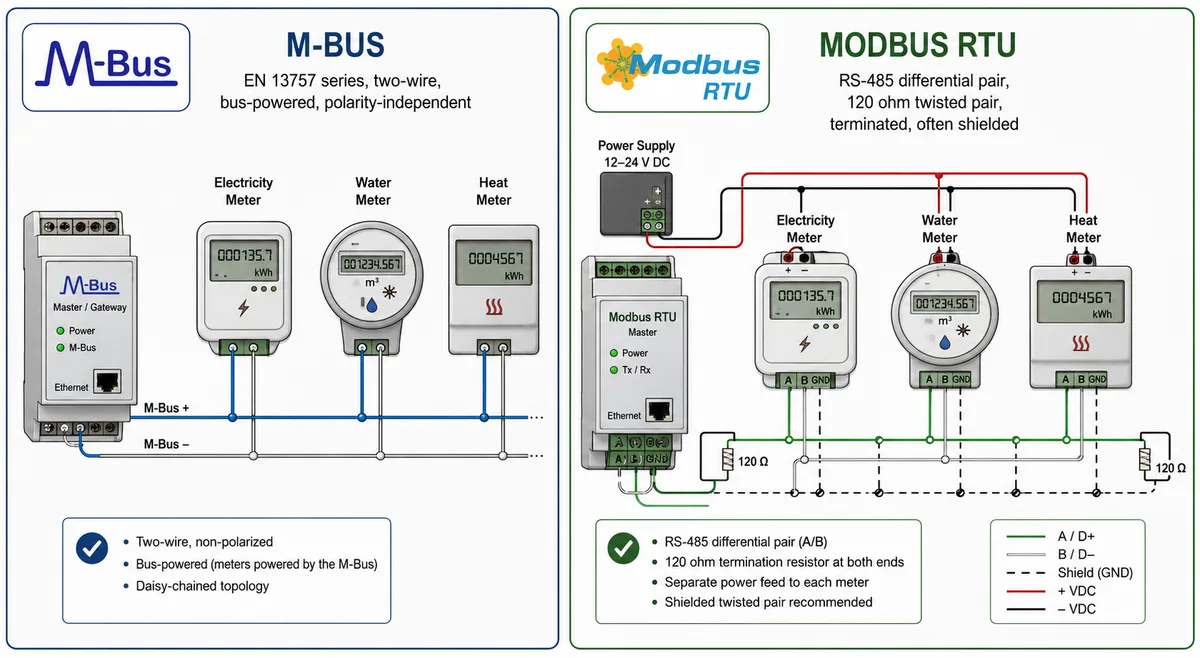
- M-Bus uses simple two-wire current signalling and powers the meters from the bus. Modbus over RS-485 uses differential voltage signalling on a twisted pair, with controlled impedance and termination, and usually needs a separate power feed to each device.
- Practical device limits are different. An M-Bus master sized for the job can handle large numbers of meters on one bus; a classic RS-485 segment supports 32-unit loads, which often means 32 devices, although modern 1/8-UL transceivers can extend that to 256 nodes on one bus.
- M-Bus runs at lower speeds and is happy with daily reads. Modbus is built for faster polling (seconds to tens of seconds).
- For most HMO sub-metering, M-Bus is the easier and cheaper choice. Modbus makes sense when the meters need to integrate with a wider BMS (Building Management System) or industrial system.
What’s the difference between M-Bus and Modbus?
They are different in purpose, not just in protocol detail.
M-Bus (Meter Bus) was specifically designed for utility meter reading. The physical and link layers are defined in EN 13757-2 and the application layer in EN 13757-3. It uses a two-wire bus carrying a current-loop signal. Meters draw their power from the bus, the bus is polarity-independent, and the protocol was built to make reading lots of utility meters cheap and reliable.
Modbus is a general-purpose industrial communications protocol developed by Modicon in 1979. In its serial form (Modbus RTU) it runs over RS-485, which uses differential voltage signalling on a twisted pair. Modbus is fast and well-supported across industrial equipment. This same protocol covers pumps, drives, controllers, and meters. Modbus TCP is the same protocol over Ethernet for networked installations.
The trade-off is straightforward. M-Bus is simpler and cheaper when you’re only reading meters. Modbus is more versatile when meters are one part of a larger control system.
When should I use M-Bus for landlord sub-metering?
Almost always, if metering is the only thing the bus needs to do.
The case for M-Bus in a landlord setup. Meters are bus-powered, so there is no separate PSU at each unit. Cabling is simple two-wire with no polarity to worry about. The protocol tolerates ordinary low-voltage cable without specialist shielding, and one bus can carry a lot of meters before you hit a practical limit. For a typical HMO where you want to read electricity, water, and heat sub-meters once a day, M-Bus is what the protocol was built for.
The Meters UK EM-406 single phase M-Bus meter is a typical landlord-billing example. So is the EM-606 three phase variant. Both wire onto a single M-Bus pair alongside your water and heat meters, then back to a single gateway that uploads readings.
When should I use Modbus instead?
When the meters are going to share infrastructure with a wider building management system, when you need fast polling, or when the rest of the kit on site already speaks Modbus.
A few situations where Modbus is the better fit:
- A commercial unit in a mixed-use building where the same network handles HVAC, lighting controls, and meter reading.
- A landlord using a third-party building management dashboard that is natively Modbus.
- A meter that is also feeding load data into a control system rather than just generating bills.
Modbus also wins when polling speed actually matters. M-Bus runs at modest speeds (commonly 2400 or 9600 baud) and is designed for infrequent reads. The Modbus serial standard recommends 9600 baud and also recommends 19,200; higher rates including 115,200 are an optional extension that many implementations support. The protocol is designed to be polled every few seconds if you want that. For most landlords, you don’t want that. For an industrial site monitoring real-time demand, you do.
The Meters UK EM-408 single phase Modbus meter exists for exactly these scenarios. It’s the same meter family as the M-Bus EM-406, just with a Modbus comms board instead.
How many meters can I put on one bus?
The practical limit depends on the protocol and on the hardware. For Modbus RTU over RS-485, the classic limit is 32-unit loads on a single segment, which for older transceivers usually meant 32 devices. Modern transceivers rated at 1/8-unit load allow up to 256 nodes on the same bus without a repeater, so the ceiling depends on which transceivers are in use. Beyond the relevant unit-load count, you need either an RS-485 repeater or a switch to a different topology. The Modbus protocol itself addresses up to 247 slave devices, so the protocol is not the bottleneck. The physical bus is.
For M-Bus, the answer depends on the master. Each “M-Bus load” represents a single meter; a small master might handle 16 or 60 loads, a typical commercial master handles 250, and larger industrial masters go higher. The bus topology (star, daisy chain, or mixed) and total cable length factor in too.
For a residential HMO with a handful of meters, both protocols handle it without strain. The device-count question matters more for larger developments. A block of 80 flats with electricity, water, and heat sub-meters in each one means around 240 meters. That’s well within M-Bus territory on a sensibly-sized master and would need RS-485 segmentation if you tried to do it over Modbus.
What cable do I need for M-Bus vs Modbus?
This is where M-Bus’s purpose-built design shows. M-Bus runs over the standard two-wire cable, often telephone-grade twisted pair used for low-voltage signalling. The current-loop signalling is more tolerant of routing than RS-485 and many M-Bus installations use plain unshielded twisted pair. Even so, sensible cable routing away from heavy noise sources is still good practice.
Modbus over RS-485 uses differential voltage signalling, which is more sensitive to electrical noise. The recommended cable is a twisted pair with a defined characteristic impedance (typically 120 ohms), with termination resistors at each end of the segment. Shielding is commonly recommended in electrically noisy environments and many installations specify shielded twisted pair as standard. The installation discipline is higher than M-Bus: keep the cable away from mains where you can, terminate the segment properly, and use the cable type the transceiver datasheet asks for.
For a landlord retrofitting an HMO with limited cable runs, M-Bus’s simpler cabling requirements are a genuine practical advantage. For a new-build commercial site where the cabling is being installed properly anyway, Modbus’s cable requirements aren’t a meaningful obstacle.
M-Bus versus Modbus side-by-side
For a landlord choosing between the two, here’s the comparison that matters.
| Feature | M-Bus | Modbus RTU (RS-485) |
|---|---|---|
| Designed for | Utility meter reading | General-purpose industrial control |
| Physical layer | Two-wire current loop, polarity-independent | RS-485 differential pair, polarity-sensitive |
| Cable | Standard two-wire telecom or twisted pair, often unshielded | Twisted pair with controlled impedance (typically 120 ohms), terminated at each end. Shielded in noisy environments |
| Meter power | Powered from the bus (no separate PSU at each meter) | Each meter typically needs its own supply |
| Device count per bus | Up to ~250 on a sensibly-sized master | 32 unit loads per RS-485 segment in the classic case, up to 256 nodes with 1/8-UL transceivers, more again with repeaters |
| Polling speed | Low (daily reads typical) | High (seconds or sub-second) |
| Best fit for landlords | HMO and residential sub-metering, retrofit installs | Mixed-use or commercial where meters share infrastructure with BMS or HVAC |
Can I mix M-Bus and Modbus on the same site?
Yes, and a gateway is how most landlord sites actually do it. M-Bus to Modbus gateways are widely available and the typical pattern is straightforward: M-Bus for the actual meter network (cheap cable, lots of devices, simple), and a single gateway that converts to Modbus where the wider building system needs it.
The other direction works too. A Modbus master can poll an M-Bus segment via the gateway and present the meter data to a Modbus-native dashboard. From the BMS’s perspective, the gateway looks like a single Modbus device that happens to have a lot of registers behind it.
For a landlord with no BMS, you almost certainly don’t need to mix. Stick to pure M-Bus and read the gateway directly through a cloud platform like SmartLink. For a landlord with a BMS already running on Modbus, the gateway approach lets you get the cabling benefits of M-Bus at the meters and the integration benefits of Modbus everywhere else.
“We get the same call every couple of months. A landlord has installed Modbus meters across a block of flats because that was what the electrician had in the van, then they realise the segment has unit-load problems past the first batch and the cable they used wasn’t quite up to RS-485 spec anyway. By the time they ring us, they’ve spent more on the comms than the meters cost. Nine times out of ten, M-Bus would have been the right call from the start. Same meter family, different comms board, much simpler cabling, more meters on one run. If your only job is reading sub-meters, start with M-Bus.”
Meters UK technical team
Common Mistakes Landlords Make
A few patterns we see repeatedly.
Treating the two protocols as interchangeable. Buying Modbus meters because they sound “more modern” misses the point that M-Bus was purpose-built for exactly what most landlords actually need, which is to read a handful of meters once a day on a cheap two-wire bus. Modbus is a perfectly good protocol for the right job; this often isn’t that job.
Planning a Modbus install without checking RS-485’s unit-load and segment limits. The classic 32-unit-load limit is often 32 devices in practice, modern 1/8-UL transceivers stretch that to 256 nodes, and beyond that you need repeaters or segmentation. Specifying a 60-flat development across a single segment without checking the transceiver spec is a fast route to comms problems no one expected.
Skipping the cable specification on a Modbus install to save money, then chasing intermittent comms errors for months. RS-485 needs the twisted pair, controlled impedance, and termination it asks for, with shielding where the electrical environment is noisy. Use the cable type the transceiver datasheet specifies.
Specifying meters and gateway in isolation. An M-Bus meter and a Modbus gateway will not talk directly without a converter. Match the gateway to the meter protocol or buy a converter; do not assume one will magically speak the other.
What should I actually do?
For most landlord sub-metering, M-Bus is the right answer. Specify M-Bus electricity, water, and heat sub-meters from one family, run them on one two-wire bus to a single M-Bus gateway, and read the gateway through a cloud platform. Cheap, simple, plenty of headroom for adding more meters later.
Choose Modbus when the meters need to integrate with a building management system that already speaks it, when polling speed actually matters (real-time demand monitoring, fast load shedding, that sort of thing), or when the rest of the on-site kit is Modbus anyway.
If you’re not sure which fits, the test is what else the comms run is for. If the only consumer of the data is a billing platform, M-Bus. If a BMS or HVAC controller wants the data too, look at Modbus or a gateway.