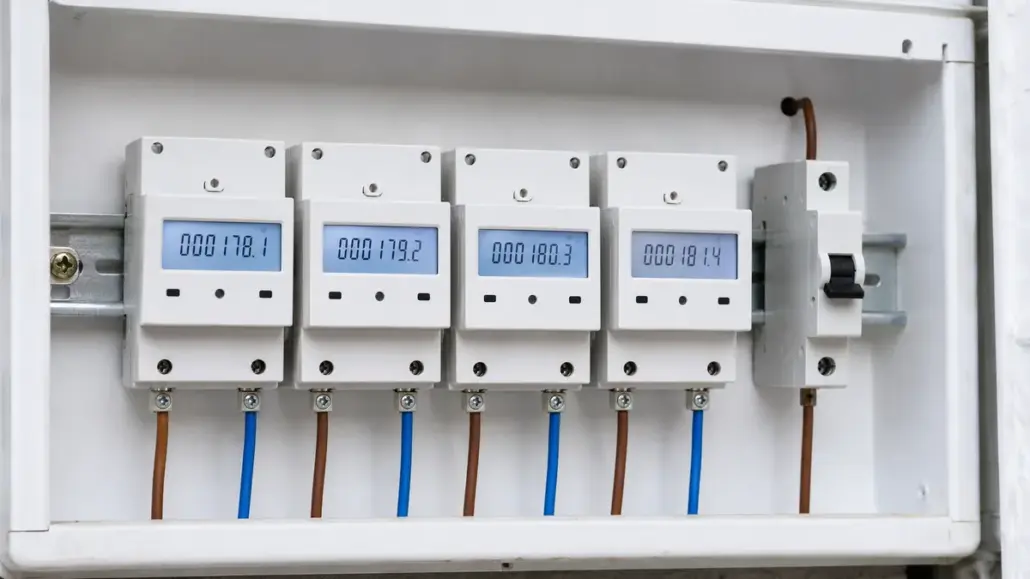
The question sounds simple until you stand in the hallway of a shared house and try to answer it. How many sub-meters does a House in Multiple Occupation (HMO) actually need, and where do they go? An HMO, for the record, is a property let to at least three people who form more than one household and share a kitchen, bathroom or toilet.
The honest answer is that the number follows how you bill, not how many bedrooms you have, and you are not actually obliged to meter at all. Get the thinking wrong and you either pay for meters you cannot use, or you rewire half the house for accuracy you did not need. This guide covers how to work out a sensible count, where per-room metering falls down, and what you can charge, all from what a meter supplier can properly tell you. Any circuit or wiring work belongs to a qualified electrician.
How many sub-meters does an HMO need? Strictly, none. You are allowed to recover energy through an inclusive rent or a fair, stated estimate. If you want to bill each unit on its actual use, you would fit one sub-meter per unit you can electrically isolate, and keep the shared load off the tenants’ meters. It is not one per bedroom, because in a typically wired shared house the circuits cross between rooms.
Key Takeaways
- There is no fixed number. You are not required to sub-meter an HMO at all, so the count follows the billing method you choose.
- To bill each unit on its actual use, fit one sub-meter per unit you can electrically isolate, and keep the shared or landlord load off the tenants’ meters.
- Metering each bedroom is often impractical, because in a typically wired shared house the sockets and lights of different rooms share circuits, so separating them can mean a significant rewire.
- Ofgem’s Maximum Resale Price (MRP) rules in Great Britain cap what you recharge a tenant at what you paid, with no profit. They bite on resold energy, not on energy folded into an inclusive rent.
- Some councils attach their own metering or common-parts conditions to an HMO licence, so check yours before you design the setup.
Last updated: August 2026. HMO licensing and energy resale rules change, so treat figures here as illustrative and confirm the current position with Ofgem and your local council.
How many sub-meters does an HMO actually need?
Start from the billing unit. A sub-meter earns its place when it measures something you bill as a single line, so the useful question is how many units you can, and want to, bill on their own. If a converted house is split into self-contained flats, each flat is really its own dwelling rather than an HMO room, and metering is clean, with one sub-meter per flat and the shared supply kept separate. If each flat instead has its own supplier meter, they are not sub-meters at all, and there is nothing for you to fit.
A house let room by room is the harder case. If your tenancies bill each room separately, the unit you would want to measure is the bedroom, but the wiring rarely matches. Sockets and lights are usually grouped onto a handful of circuits that run across the building, so a meter on any one circuit records a mix of rooms. You cannot read one room’s true usage off a number that includes the room next door.
So there is no magic figure. A common design for a block of separate units is one meter per unit plus a way of handling the shared load, but that is a choice, not a rule. Where the units cannot be isolated, the sensible answer is often to leave per-room metering out, which is the next question.
Can you put a sub-meter on each bedroom?
Often not without separating the circuits first. To meter a bedroom on its own, the loads in that room need to be measurable on their own, which usually means the room sits on its own circuit or circuits back to the consumer unit, with a meter on them. Many shared houses were never wired that way. The upstairs sockets might sit on one ring that serves several bedrooms and the landing, so a single meter cannot separate them.
Making it possible means an electrician re-splitting the circuits so each room is measurable on its own, then metering it. Depending on how the house is already wired that can be a modest change or a serious rewire, and on a larger house the cost can outweigh the billing accuracy it buys. It tends to suit a high-turnover let where usage really varies between rooms, and to be hard to justify on a small house that will be inclusive anyway.
The practical alternatives are to fold energy into an inclusive rent, or to fit a per-room prepayment meter where the room already has its own supply or circuit. Prepayment is often used in student and professional HMOs and shifts the day-to-day cost to the tenant, though it does not remove your resale-price, safety or metering duties. Fitting or moving any circuit is a job for a qualified electrician, not one to take on yourself.
What about shared areas and the landlord’s supply?
Every HMO has load that belongs to nobody in particular. Hallway and stair lighting, the fire alarm, the outside lights and often a shared boiler all draw power that is not any one tenant’s to pay. The important rule is that this shared load must not run through a meter you bill a tenant from. Beyond that you have a choice of approaches, from putting it on its own meter, to a separated circuit, to working it out as the residual once the units are read, to simply carrying it as a running cost.
How you recover it matters too. Electricity used in the common parts, like the hallway and stairs, is really the landlord’s own use, so it is usually carried in the rent or a stated service charge rather than resold to tenants as if it were their metered usage. Truly shared domestic use, such as a communal kitchen, can be apportioned between the tenants on a fair and disclosed basis. What you cannot do is present an arbitrary figure as though it were a real meter reading.
How much can you charge HMO tenants for what you meter?
No more than it cost you. Under Ofgem’s Maximum Resale Price rules in Great Britain, a landlord reselling gas or electricity to a domestic tenant cannot charge above what they paid their own supplier, with the standing charge shared in proportion to use and no profit on the energy. This applies whether you bill from a meter or from a fair estimate, and it does not bite where energy is genuinely part of an undifferentiated rent.
Metering is not compulsory. Where a suitable meter is not practical, Ofgem lets you recover energy on a reasonable, explainable basis, as long as you disclose the method on request and put right any overcharge. A meter simply makes the sums cleaner and easier to defend. And while the mandatory HMO licence conditions do not set a standard meter count, some councils add their own, including a separate landlord supply for the common parts, so it is worth reading your licence before you design the setup.
Which meters do you need, and how many of each?
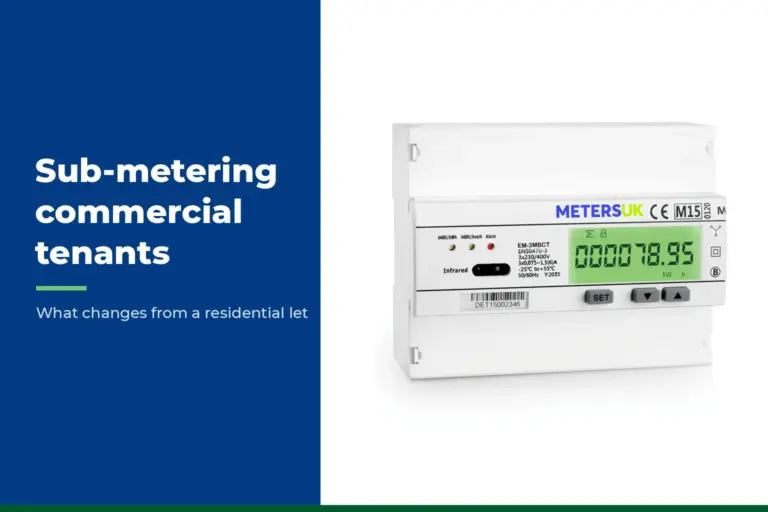
For a unit on a normal domestic supply, a single-phase sub-meter does the job and wires into the circuit feeding that unit. A larger building with heavier or uneven demand may run on a three-phase supply, which lets you spread units across the phases and still give each one its own meter. Any meter you bill a tenant from must be an approved pattern, carrying the full conformity markings such as those under the Measuring Instruments Directive (MID), so the reading stands up if it is ever challenged.
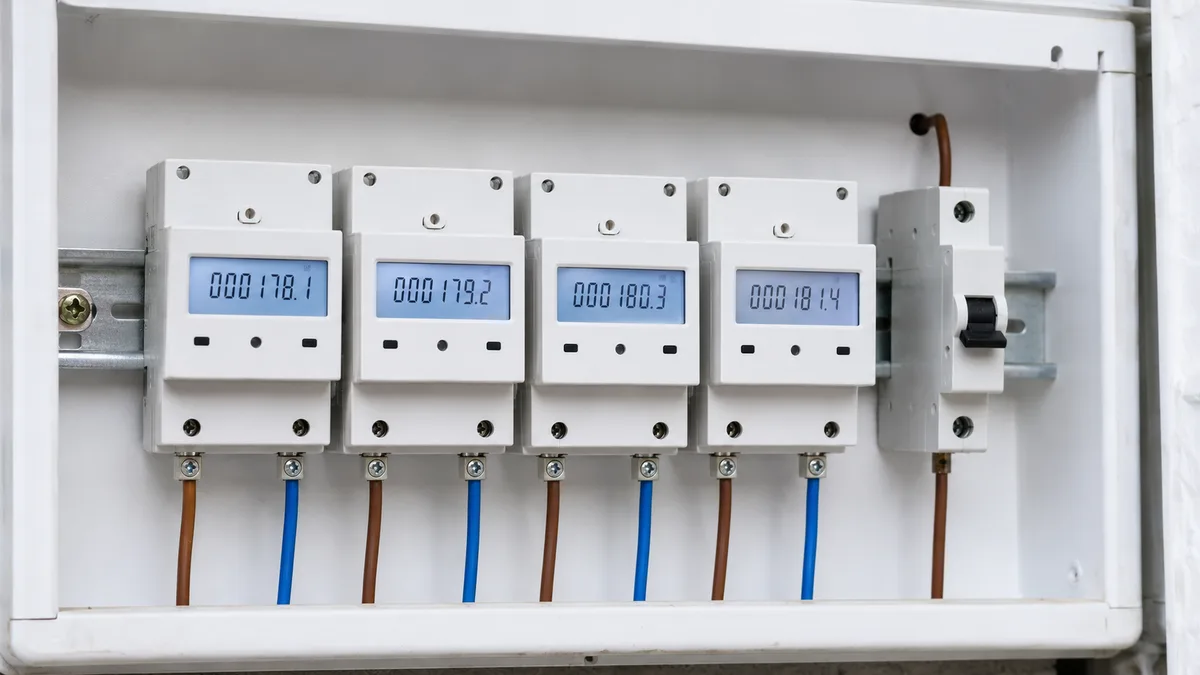
The count then comes down to units plus shared load, and it varies with the setup rather than following a single rule. The table below shows how the same six-bedroom property lands very differently depending on how it is let.
| Billing setup | Typical sub-meters | Why |
|---|---|---|
| Split into six self-contained flats | Six, plus a way to handle the shared load | One per flat, if the flats do not already have their own supplier meters |
| Room-let, standard wiring | Often none that bill fairly | Room circuits cross over, so a meter cannot isolate a room without circuit work |
| Room-let after circuit separation | One per room, plus the shared load | Each room can be measured once it is on its own circuits |
| Inclusive rent | None required | Energy is in the rent, so a whole-house meter is only for monitoring |
“The count people miss is the landlord supply. They meter the flats, feel sorted, then realise the stair lights, the boiler and the fire alarm are still landing on one of the tenant meters. Put the shared load on its own meter or its own circuit from the start, and the sums add up the first time.”
Meters UK technical team
When sub-metering an HMO is not worth it
If the house is let by the room on shared circuits, the honest answer is often to leave the sub-meters out. The circuit work needed to make room metering fair can cost more than the disputes it saves, and an inclusive rent set at a sensible level keeps things simple. In our experience many small room-let HMOs are better off inclusive, with the energy risk priced into the rent and reviewed if usage runs high.
Sub-metering earns its keep where units are already separate, where usage really varies between them, and where tenancies run long enough for the fairness to matter. A block of self-contained flats is the clear case. A four-bedroom student house on one ring main, much less so.
Common Mistakes Landlords Make
The same errors turn up on almost every HMO metering job, and each one is cheaper to avoid than to unpick.
- Counting bedrooms instead of billable units. Ordering one meter per room on a house with shared circuits leaves you with meters that cannot isolate anyone.
- Letting shared load run through a tenant’s meter. Hallway lights, the boiler and the alarm belong on their own meter or circuit, or carried by the landlord, not billed to whoever happens to share their meter.
- Treating an estimate as a meter reading. A fair, disclosed apportionment is allowed, but dressing an arbitrary figure up as measured usage is not.
- Assuming the licence decides your metering. Mandatory conditions do not set a meter count, though your council may add its own, so the design is mostly yours to get right.