The keys come back on a Saturday morning. The room is empty by lunchtime, the new tenant arrives on Monday, and nobody wrote down what the sub-meter said. Six weeks later the old tenant queries the final bill and there is no clean line between one tenancy and the next.
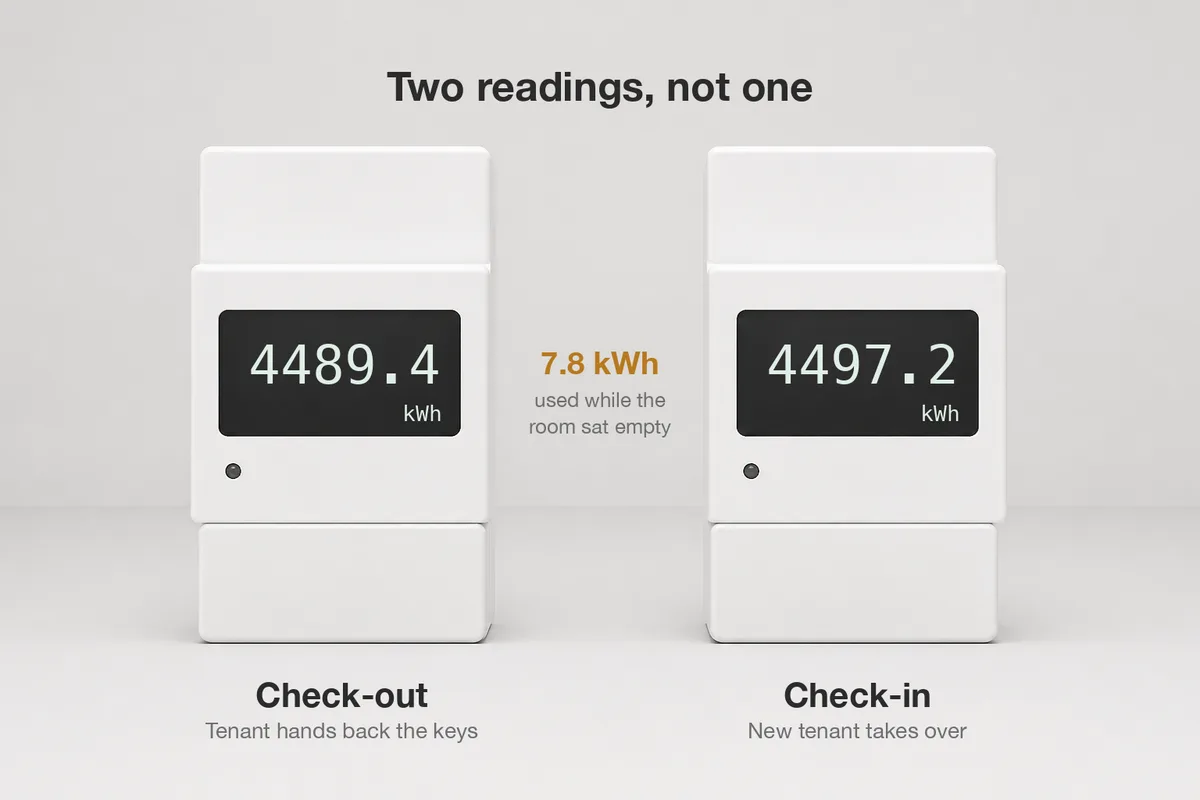
Which sub-meter readings should you take when a tenant moves out? Take one reading when the outgoing tenant hands back the keys and another when the new tenant takes over. Photograph both, with the meter serial number and the display in the same shot. Where there is a genuine gap between the two tenancies, that consumption is normally yours.
Key Takeaways
- Read the meter when the keys change hands, and record the tenancy’s legal end date too. They are not always the same day.
- A dated photo showing the serial number and the display still stands up six weeks later.
- Where a room genuinely sits empty between tenancies, take two readings. That gap is normally the landlord’s cost.
- Deposit adjudicators work from what both sides send in, so send the photo, the rate and the sum.
- Ofgem’s Maximum Resale Price rules cap the final bill in Great Britain at what the electricity cost you.
What should you record at check-out?
Write down more than the number. A reading on its own proves very little six weeks later, when the tenant says the figure looks high and you cannot show where it came from.
Record the reading, the date, the time and the meter serial number. The serial ties a reading to a meter. Your own written schedule ties that meter to a room. You need both, because a board of six identical meters in a shared house, or House in Multiple Occupation (HMO), tells you nothing on its own. Frame the photo so the serial plate and the display both appear in it.
If your sub-meters feed a remote reading system, the portal gives you a timestamped reading without the hallway visit, and it settles the question of when the reading was taken before anyone asks it.
Note the tenancy’s legal end date alongside the handover date. Handing back keys does not by itself end a tenancy, and those two dates drifting apart is what turns a tidy final bill into an argument.
Bill for water or heat as well and read those meters the same day, logged the same way. Both sit under their own charging rules, so keep the records separate.
| What to record | At check-in | At check-out |
|---|---|---|
| Meter reading | Opening figure, decimal digits included | Closing figure, decimal digits included |
| Photo of the display | Yes, serial in the same frame | Yes, serial in the same frame |
| Meter serial number | Matched to the room schedule | Checked against the check-in record |
| Dates | Handover and tenancy start | Handover and tenancy end |
| Unit rate you pay | Noted, so the tenant knows the basis | Noted again if your contract changed |
Does a meter photo count as evidence in a deposit dispute?
It counts for a great deal, and it is the cheapest evidence you will ever gather.
Deposit schemes in England and Wales settle disputes on the paperwork both sides send in. Nobody visits the property. Scotland and Northern Ireland run their own schemes on the same evidence-based footing, with different rules and timescales. An adjudicator looking at a typed figure has one landlord’s word for it. A dated photograph with the serial visible can be checked against the check-in shot.
Taking energy costs out of a deposit needs more than a reading. The tenancy agreement has to make the tenant liable. The money has to be a real loss to you, meaning something you paid out and are owed back. The sum has to be evidenced. A debt the tenant owes their own energy supplier follows the tenant, so it does not belong on your deduction list.
Get any of that wrong and that part of the deduction is likely to fail. This is general information rather than legal advice.
How do you turn two readings into a final bill?
Subtract the opening reading from the closing one, then charge those units at the rate you paid.
Say a room opened at 4,182.0 and closed at 4,489.4. That is 307.4 kWh. At 27.5p a unit the energy comes to £84.535, so £84.54 on the bill. Then add the tenant’s share of the daily standing charge for the days they were in the room. That share follows the energy each person used rather than being split evenly. The full method sits in our guide to billing HMO tenants from electric sub-meters.
This works cleanly where both readings come off the same register and your rate held steady. If your supply contract changed mid-tenancy, split the period at that date and apply each rate to its own stretch.
Show the working on the bill. Two readings, the units, the rate, the standing charge share, the total.
Who pays for the electricity while the room is empty?
You do, in most cases. Where the supply contract is in your name, which is the usual arrangement in a shared house on one supply, every unit the building uses is yours until you bill it on. Check the tenancy agreement rather than assuming, because the arrangement varies.
That matters at changeover. An empty room can still be drawing power, from a fridge left on, a heater on frost setting, or whatever the last tenant left plugged in. The standing charge runs whether anyone is there or not. Hand the incoming tenant the outgoing tenant’s closing figure as their start reading and they quietly pay for that empty stretch, and few would ever spot it.
So take the second reading on the day the new tenant takes over. The difference between the two is a void cost, like the empty room itself, and it belongs in your own numbers. Liability follows the tenancy agreements rather than the removal van, so work from the dates those agreements run to.
Where the changeover happens on the same day, one reading can do both jobs. Take it at the point responsibility passes rather than first thing in the morning, because cleaning and maintenance draw power too.
What if the tenant argues with the closing reading?
Start with the meter itself. On a board of six identical units, reading the wrong one is easier than it sounds. Check the serial in your photo against the room schedule and that part of the argument is settled.
Then look at the decimal, which is where a lot of these disputes actually live.
“Nine times out of ten, a disputed sub-meter reading comes down to the decimal. Displays vary. Some show two decimal places, some show one, and the last digit sometimes sits in a red box. Read both endpoints a place out and the units land ten times too high. Get one endpoint wrong and the error is anyone’s guess. Photograph the whole display, red digits included, and check the manual for the register you are reading.”
Meters UK technical team
If you are unsure how a display is laid out, our note on reading a meter dial covers the common formats. Where a tenant still disagrees after the photo and the sum, put the working in writing and keep the exchange. A calm paper trail is what an adjudicator wants to see.
Common Mistakes to Avoid
Reading the meter a week after the tenant has gone is the one we see most. The room has stood empty, the meter has moved on, and the outgoing tenant gets billed for days they were not there. Read it at handover, or carry the difference yourself.
Rounding the start reading for an incoming tenant is a small error with a long tail. Writing 4,490 instead of 4,489.4 costs about 17p at the rate above, which is nothing. What it costs you is a record that no longer matches the meter, and that is the thread a tenant pulls in a dispute.
Skipping the photo because the tenant stood there and agreed the number is the one that stings later. People move out, change their minds and stop answering emails. A photo costs nothing and outlasts the goodwill.