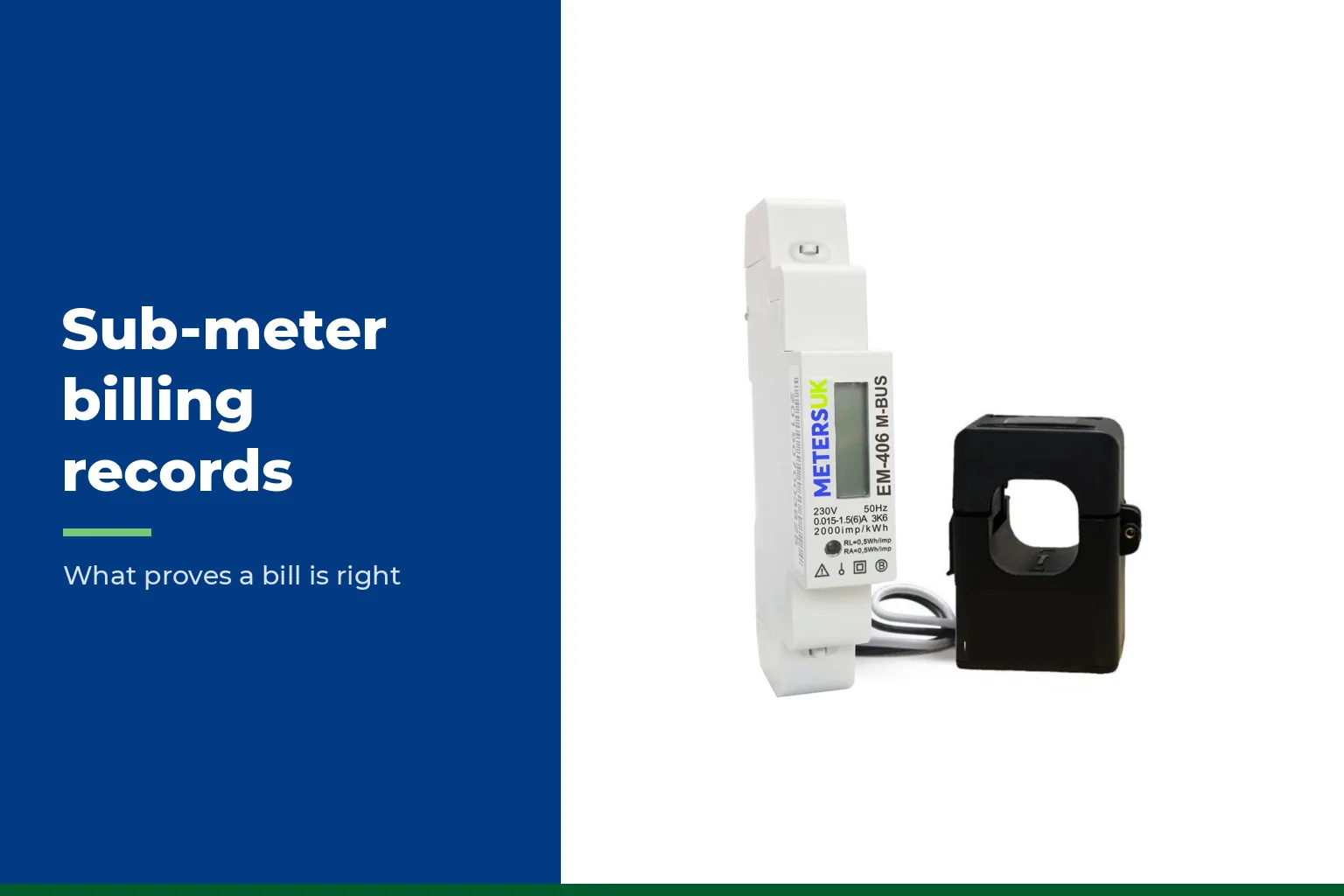
Sooner or later a tenant will question a sub-meter bill. The landlord who can answer in five minutes keeps the peace. The one who cannot ends up arguing from memory.
Good records turn an argument into a quick check. They also happen to be what the rules let a tenant ask for.
What records prove a sub-meter bill is right? Keep the supplier invoice showing the price you pay, dated opening and closing readings with the meter serial number, a schedule linking each meter to a tenant, and your working for the standing charge. Mark estimates clearly, and keep everything for at least six years, longer if tax rules say so.
Last updated: October 2026. Figures reflect published rules and guidance as of this date.
Key Takeaways
- Under Ofgem’s resale rules, a tenant can ask what you pay your supplier and see documents that prove it.
- A bill is only as strong as its readings. Each one needs a date, the full display and the meter serial number.
- Estimates are allowed in some cases. Label them as estimates and reconcile them against real readings.
- Six years is a sensible starting point for keeping billing records, because that is the usual time limit for a contract claim.
What Can a Tenant Ask a Landlord to Prove?
If you pass energy costs on to a tenant, you are a reseller. Ofgem’s Maximum Resale Price (MRP) direction sets the rules. The most you can charge is what you paid your supplier, with the standing charge shared out fairly.
The direction also gives the tenant a right to check. On request, you must tell them the price or prices in your supply contract and give them documents that support it. If you used an estimate, you must explain how you worked it out.
Answer late and it costs you. There is no fixed deadline, because timing is judged against what the tenant needs. If you fail to respond in time, the price you can charge falls by a percentage equal to twice the Barclays Bank base rate on the date of the request, for as long as the failure lasts. Overcharges are repayable with interest at twice the average Barclays base rate.
Ofgem does not enforce the rules in individual disputes. In its 2025 call for input it said tenants usually have to negotiate or go to court or a tribunal. A clear paper trail is your best protection.
Which Records Should You Keep for Each Bill?
Each line of a bill needs something behind it. The table sets out what to keep.
| Record | What it proves | How to keep it |
|---|---|---|
| Supplier invoice | The unit rate and standing charge you pay | Keep the full invoice, not a screenshot of the total |
| Opening and closing readings | How much the tenant used | A dated photo of the whole display, with the serial number in shot |
| Room and meter schedule | Which meter serves which tenant | One sheet listing room, serial number, fit date and tenancy dates |
| Standing charge working | How the daily charge was shared | Show the days, each tenant’s share of the units and the sum |
| Estimate note | That an estimate was flagged and later corrected | Mark the bill “estimate” and log the correction |
| Meter datasheet | The meter’s accuracy class and approval status | Keep the maker’s datasheet and any approval or conformity paperwork |
The datasheet row matters more than it looks. If a tenant doubts the meter itself, you want paperwork showing it is suitable for billing. Our guide to checking a meter is MID approved explains what to look for. MID stands for the Measuring Instruments Directive.
What Does a Bill That Holds Up Look Like?
Take a house in multiple occupation (HMO) with five rooms on one supply. Say Room 3 was read on 1 July and again on 31 July. The opening reading was 12,480.0 kWh and the closing reading was 12,962.4 kWh.
That is 482.4 kWh. At an example supplier rate of 24.5p a kWh, the usage charge is £118.19. The supplier’s standing charge is an example 53p a day, or £15.90 over 30 days.
Ofgem’s direction says the standing charge is shared in proportion to the units each person pays for. Say the whole house used 1,608.0 kWh that month. Room 3 used 30% of it, so its share is £4.77. The bill comes to £122.96 before VAT.
These rates are made up to show the working. Use the figures on your own invoice. How VAT applies depends on your own tax position, so ask your accountant. Citizens Advice says domestic electricity has no VAT from 1 October 2026 to 31 March 2027, so check the VAT line on each invoice.
Every number traces back to a document. If the tenant queries the £122.96, you show the two photos, the invoice and the sum.
For the full method behind a bill like this, see our guide to billing HMO tenants with electric sub meters.
How Should You Record Meter Readings?
A number in a notebook is easy to doubt. A photo is harder to doubt. Frame the whole display and the serial number together, so one image shows which meter it was and what it said.
Keep the original file, not a copy sent through a messaging app, because originals carry the date and time. Store them somewhere backed up, in a folder named for the property and month.
The room schedule catches a classic slip. A meter gets swapped, nobody updates the list, and a tenant is billed for the wrong meter. Update the schedule the day a meter changes, and note the final reading on the old one. Our guide to sub-meter readings when a tenant moves out covers the handover side.
Where a meter cannot be reached, an estimate may be unavoidable. Ofgem allows estimates for unmetered supplies, as long as you can explain the method on request. Label the bill as an estimate and reconcile it when you get a real reading. Ofgem’s direction expects you to settle any over-recovery within a period of no more than a year. If you need access to read it, see whether a landlord can enter to read a sub-meter.
How Long Should You Keep Billing Records?
Three separate rules are worth knowing. A claim founded on a simple contract generally cannot be brought after six years, under section 5 of the Limitation Act 1980, which applies in England and Wales. A tenant’s overcharge claim may fall under that.
HM Revenue and Customs (HMRC) is the second. It says you must keep records of rent received and expenses for at least five years after the 31 January tax return deadline for each tax year.
The third pulls the other way. The Information Commissioner’s Office (ICO) says personal data should not be kept longer than you need it. Tenant names and readings are personal data. Set a retention period, write it down, and delete records once it passes.
Work out both dates for each year of records and keep them until the later one. The tax rule runs from the filing deadline, so it can be the longer. If a dispute is live, keep everything until it is settled.
A reading with no date and no serial number is the weak spot in a billing dispute. Photograph the full display with the serial number in shot, and most questions answer themselves.
Meters UK technical team
Common Mistakes to Avoid
Keeping only the total from the supplier invoice leaves a gap. The total tells a tenant nothing without the unit rate and standing charge.
Photographing the reading but not the serial number is another slip. Months later nobody can say which meter it shows.
Estimates are easy to let slide. One presented as a real reading looks like a misleading bill, and it weakens every honest bill around it.
Folding your own costs into the unit rate is the last trap. Billing and sub-meter upkeep sit outside the cap, according to Ofgem, so show any such charge as its own line with its own records. Hidden in the rate, it can push the price over the cap.