You need one number. The tenant in flat 3 has stopped answering messages, the quarterly supply bill has landed, and the sub-meter that would settle the whole thing sits inside their flat.
It is tempting to assume you can just go and read it. That assumption is where the trouble starts.
Can a landlord enter to read a sub-meter? Only with the tenant’s agreement, or under a term in the tenancy agreement that allows it. The statutory right of entry in section 11(6) of the Landlord and Tenant Act 1985 covers viewing the condition and state of repair, not a visit made purely to take a reading for billing.
This guide covers private lettings in England. Wales, Scotland and Northern Ireland have their own access rules.
Key Takeaways
- The 24 hour notice rule landlords quote comes from section 11(6) of the Landlord and Tenant Act 1985, and it is about repairs, not billing readings.
- Your right to read a sub-meter inside a let flat or room comes from the tenancy agreement or the tenant’s consent.
- An energy supplier can ask a court for a warrant to read its meter. Owning a sub-meter gives you no equivalent power.
- You can bill from a fair, clearly explained estimate where no reading is available, then correct it once a real reading arrives.
Can a landlord enter to read a sub-meter?
Not on your own say so. Where the statutory repairing covenant applies, section 11(6) of the Landlord and Tenant Act 1985 lets you, or someone you authorise in writing, enter on at least 24 hours written notice, at a reasonable time of day, for one stated purpose. That purpose is viewing the condition and state of repair of the property. A visit made only to collect consumption figures for a bill is not that.
The 24 hour rule gets quoted so often that it has drifted into meaning general access. It has not. Checking a meter installation is safe is a repair question. Noting the display to send a bill is not.
Even where you do have a right of access, notice is not permission to force your way in. A tenant who refuses may be in breach of the agreement, but the answer is a court, not a key. Entering without consent can amount to harassment under section 1 of the Protection from Eviction Act 1977, a criminal offence in England and Wales. The test covers acts likely to interfere with the tenant’s peace or comfort, by a landlord or their agent who knows, or has reasonable cause to believe, they are likely to make the tenant leave or stop pursuing a right.
Shared parts can sit differently. In a house in multiple occupation (HMO) let room by room, a meter cupboard in a communal hallway you still control is often outside what any one tenant rents. On a single joint tenancy of the whole house, the hallway is part of the let. Read the agreement before relying on it.
What should the tenancy agreement say about meter access?
Cover two jobs, whether in one clause or two. The first lets you or your agent enter on reasonable written notice to read, inspect or maintain any sub-meter serving the property. The second asks the tenant to supply a reading on request within a set number of days. The law does not fix one, so choose something clear and fair.
The second job is the one that saves you. In our experience, many tenants would happily send a photo of the display and have simply never been asked in a way that creates an obligation.
Name the meters while you are at it. A schedule of serial numbers against rooms removes the “that is not my meter” argument. More in our guide to billing HMO tenants from electric sub-meters.
From 1 May 2026, under the Renters’ Rights Act 2025, most private assured tenancies in England are periodic. No fixed term ending will hand you a chance to fix weak wording, and the Act adds no meter access power. Adding an access clause to an existing agreement normally needs the tenant’s consent.
What if the tenant still refuses?
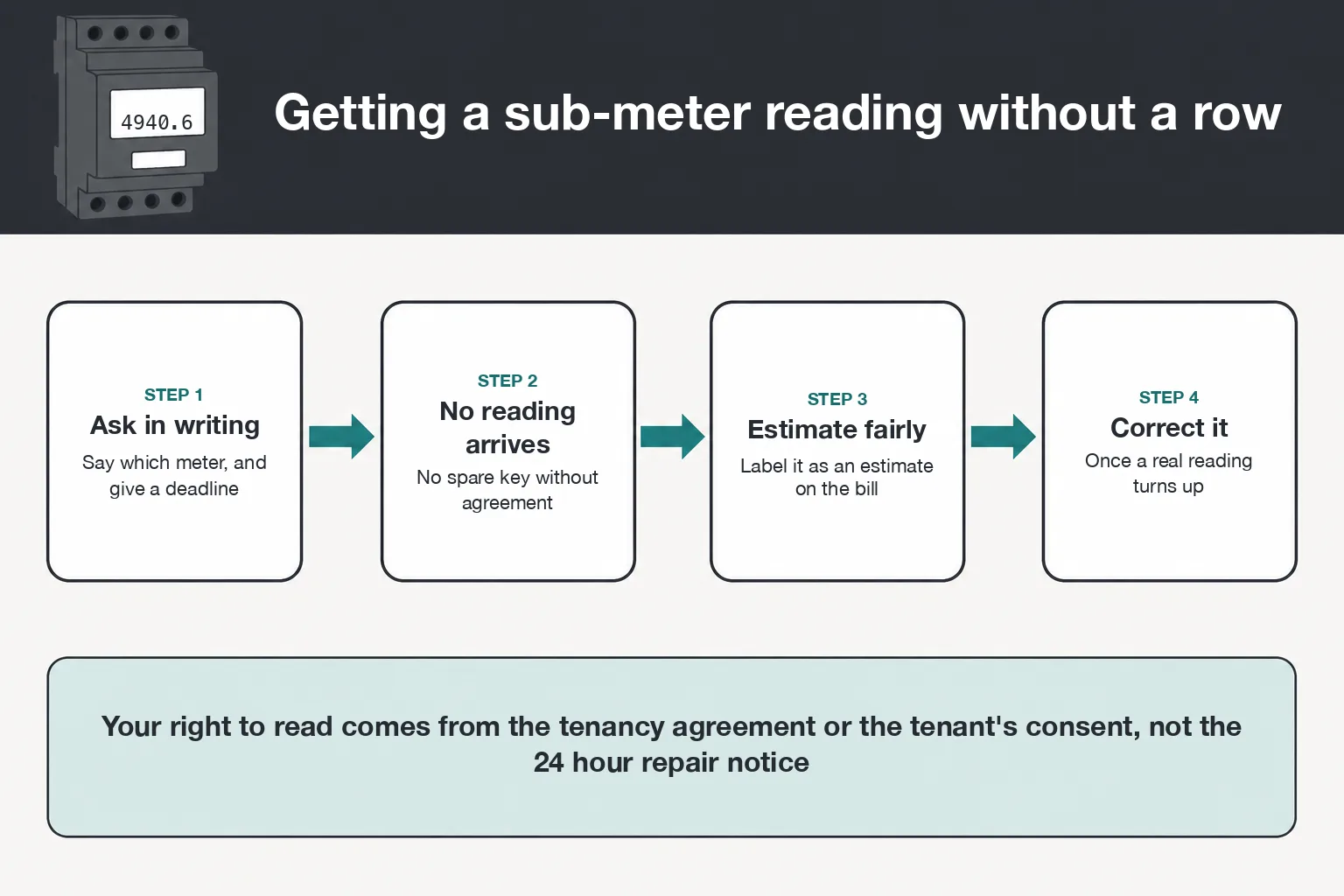
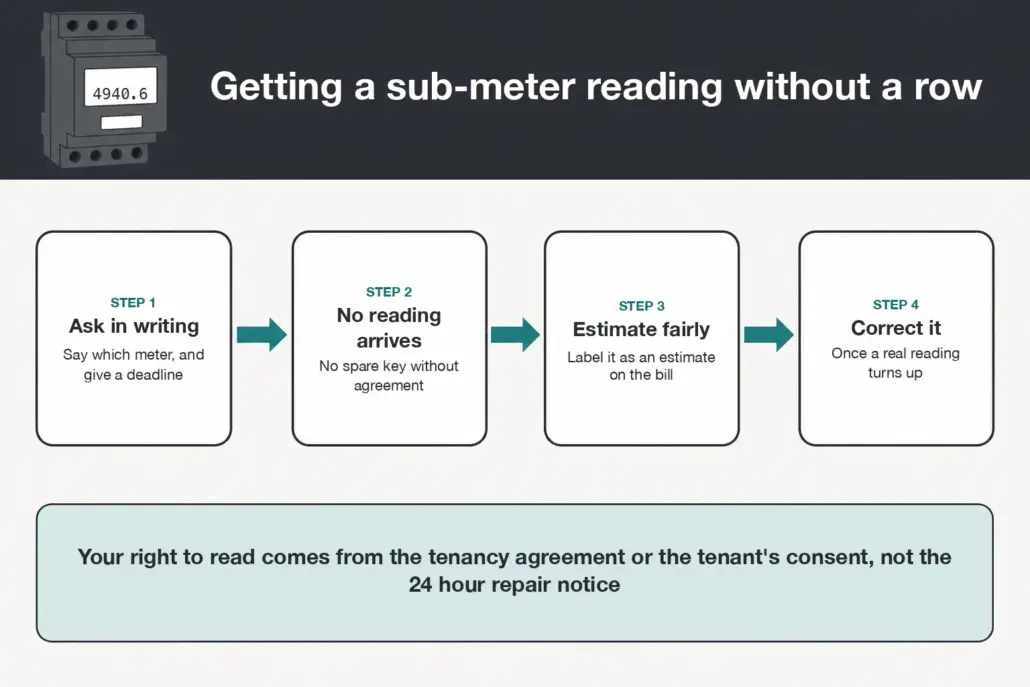
Put the request in writing and keep it. Date it, say which meter and why, and give a deadline. Every later step rests on that record.
What you must not do is force it. No spare key without the tenant’s agreement, no changed lock, no switching the supply off to make a point. Interfering with a supply to pressure a tenant is the kind of act the 1977 Act targets, and it can turn a billing annoyance into a criminal matter.
Where the agreement does give you access and refusal is persistent, the route is a county court injunction requiring the tenant to allow it. It enforces an access right you already have; refusal alone does not create one. Weigh the cost and delay against the money in dispute, which tells you the real fix is rarely a legal one.
| Question | Your sub-meter | The supply meter |
|---|---|---|
| Who usually owns it | You, as landlord | The supplier or a meter asset provider, though customer owned meters exist |
| Right to enter without consent | No statutory power just from owning it | The supplier can seek a warrant under the Rights of Entry (Gas and Electricity Boards) Act 1954, from a magistrate, or a sheriff in Scotland |
| Where the right to read comes from | The tenancy agreement, or the tenant’s consent | Statute, backed by the warrant process |
| If access is refused | Chase in writing, then consider court if the agreement gives you access | The supplier may apply for a warrant, which the court can refuse |
The warrant route belongs to energy companies exercising statutory powers, not to anyone who happens to own a meter, and it does not extend to Northern Ireland.
Can you bill a tenant from an estimate instead?
Yes, within limits. Ofgem’s resale guidance accepts a reasonable estimate, by a method you can explain, where there is no suitable reading. It does not mention refusal specifically, so treat that as a sensible reading of the guidance, and check the agreement lets you bill for energy separately.
Ofgem’s Maximum Resale Price (MRP) rules cap what you charge at what you paid, including a fair share of standing charges. A provisional estimate is not unlawful just because it later proves high. Where a proper reading shows you charged more than the tenant used, though, the difference is theirs, normally credited on the next bill.
Worked through, assuming 27.5p a unit including VAT is what you pay. A room has averaged 290 kWh a quarter across the periods you could read. You bill 290 units, which is £79.75, and mark it clearly as estimated. The tenant then sends a dated photo taken on the last day of that same quarter showing 4,940.6, against an opening reading of 4,612.1. Real usage was 328.5 kWh, so 38.5 units went unbilled, about £10.59, bringing the true quarter to £90.34. That goes on the next bill with the working shown.
Run it the other way and you owe money back. Our guide to the Maximum Resale Price rules covers the cap in detail.
“The landlords who rarely have this problem ask for a reading on day one of the tenancy, not day ninety. The standoffs we hear about tend to start with a first request made months in, next to an unexpected bill.”
Meters UK technical team
How do you stop needing access at all?
Move the reading off the tenant’s goodwill. A sub-meter with a pulse output or a communications port can report to a gateway in a communal area, and the figure arrives without anyone opening a door. Faults and maintenance still need occasional access, but not every quarter. Our remote meter reading systems are built for this, and the options are compared in our guide to remote meter reading for landlords.
Prepayment tackles it from the other end. The tenant pays before using the energy, and routine billing readings largely fall away.
Common Mistakes to Avoid
Letting yourself in with a spare key does the real damage. It feels harmless, and it hands the tenant a harassment complaint and sours every conversation about the bills that follow.
Estimating and never going back is the quiet one. Four uncorrected estimates, and the tenant leaves owing a figure nobody can evidence. A verified reading from the right meter, on the right dates, is the strongest evidence you will have.
One vague access clause catches out landlords who believed they were covered. Repairs wording should not be read as covering billing visits, and general inspection wording may not stretch that far either.