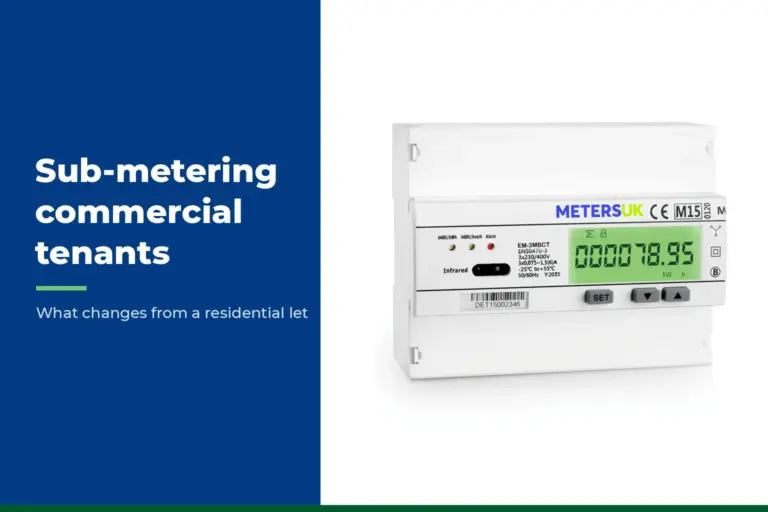

Two landlords, two identical six-bed houses on the same street. One fits prepay sub-meters and gets paid before the electricity is used. The other fits credit sub-meters, reads them quarterly and sends a bill. Both are legal ways to run a House in Multiple Occupation (HMO), and they go wrong in completely different ways.
Prepay or credit sub-meters in an HMO? Prepay sub-meters take money before the energy is used, which cuts arrears but adds top-up admin and the risk of a tenant sitting in the dark. Credit sub-meters usually cost less to fit and are easier to evidence. Ofgem’s resale price cap applies to both.
Last updated August 2026. Ofgem’s resale rules and the metering guidance quoted here cover Great Britain. The Tenant Fees Act 2019 applies in England. The Protection from Eviction Act 1977 applies in England and Wales. General information, not legal advice.
Key Takeaways
- Ofgem’s Maximum Resale Price (MRP) direction caps what you charge at what you paid, on prepay and credit alike.
- Prepay fixes your cash flow, then leaves you holding a rate that has to stay under your own cost.
- Any meter used for billing, by a supplier or a landlord, must be of an approved design.
- Ofgem’s rules on forced prepayment installs bind licensed suppliers, not landlords.
- Credit suits self-contained flats. Prepay suits rooms let individually.
What is the difference between a prepay and a credit sub-meter?
A prepay sub-meter takes payment first and releases energy afterwards. The measuring part is identical to a credit meter. What changes is the switch behind it and who chases the money. The tenant tops up online, by app or in a shop, the credit reaches the meter over a data link or as a code, and a relay inside cuts the supply once the credit runs out. Our prepayment meter range works this way.
A credit sub-meter just counts. You read it at each end of a period and bill the difference at your own unit rate, as our guide to billing HMO tenants from sub-meter readings sets out.
Can a landlord fit a prepayment sub-meter in an HMO?
Yes, a landlord can fit prepay sub-meters behind their own supply and recharge tenants for what they use. There is no licence to hold and no permission to seek, though conditions do attach.
The meter has to be of an approved design. The Office for Product Safety and Standards states that any gas or electricity meter used for billing, whether by a licensed supplier or a landlord, must be approved. Approval and certification are different things, and that catches people out. A secondary electricity meter in a landlord and tenant setup can be excused certification where there is a written agreement to dispense with it, but it still has to be of an approved type. Here is how to check a sub-meter is approved.
The tenancy agreement matters as much. If a room is let with bills included, you cannot fit prepay meters mid-tenancy and start charging on top without agreeing a variation.
| Feature | Prepay sub-meter | Credit sub-meter |
|---|---|---|
| Who pays first | Tenant, before use | Landlord, then recharges |
| Arrears risk | Much lower | Sits with you |
| Cost to set up | Higher, often with a platform fee | Usually lower, meter only |
| Admin per tenant | Light, plus rate checks | A bill each billing period |
| Standing charge | Buried in the rate, easy to get wrong | Its own line on the bill |
| On non-payment | Supply stops at the meter | You chase the debt |
| Best suited to | Rooms let individually | Self-contained flats |
What can you charge tenants on a prepay sub-meter?
No more than you paid. Ofgem’s Maximum Resale Price direction sets the most you can charge for each unit at the same price you paid your own supplier. The current version came into force on 11 April 2014 and covers resale for domestic use and for accommodation, with one carve out for electricity resold from an electric vehicle charge point.
The standing charge is handled on its own. Ofgem says it must be charged to tenants pro rata with the amounts payable for the units resold, and if you occupy part of the building or run common services from the same supply, your own share goes into that split. Our guide to the Maximum Resale Price covers the arithmetic.
Prepay makes that cap harder to hold. You fix a rate in advance and your supplier’s rate moves under you, while a credit bill is worked out afterwards from a real invoice and lands on the right number by construction. A prepay rate that was right in January can be above your cost by April, and every unit sold above cost is an overcharge the tenant can reclaim with interest. Set the rate a little under your blended cost, check it against every supply invoice, and drop it when your own price drops.
Do Ofgem’s prepayment meter protections apply to a landlord’s sub-meter?
No, and this is the point landlords most often get wrong. The rules Ofgem brought in during 2023 on installing prepayment meters without consent sit inside the licence conditions of energy suppliers. Your sub-meter is not a supplier meter and you are not a licensed supplier, so those rules do not bite on you.
That is not a free pass. Housing law, consumer law and the tenancy agreement all still apply. What you lose is the specific supplier machinery, the site welfare visit and the ban on forced installs for the most vulnerable households, so the standard behind your own supply is whatever you set.
What happens when a tenant runs out of credit?
The meter cuts the supply to that room or flat. A decent platform lets the tenant take emergency credit, and sensible landlords set the meters so they will not disconnect overnight, at weekends or on a bank holiday.
Get that setup wrong and you have a legal problem, not just an unhappy tenant. Under section 1 of the Protection from Eviction Act 1977, in England and Wales, persistently withholding services reasonably needed for occupation of a home is a criminal offence where it is done to make someone leave or to stop them using their rights. A tenant who chooses not to top up is a different case, though affordability, vulnerability and a faulty meter all change the picture. Keep the payment channel working, keep a record of top-ups, and never use the relay as a lever in a dispute.
“The failure we see again and again is a prepay rate set once and never looked at. A landlord picks a rate in a year when electricity is dear, the supply contract renews cheaper, and nobody goes back to it. Two years on there is money owed back and no records to work it out from. Put a reminder in the calendar for the day after each renewal.”
Meters UK technical team
Which setup suits your HMO?
- Rooms let individually on short tenancies. Prepay usually wins. You are paid up front and there is nothing to chase once someone has gone.
- Self-contained flats on longer tenancies. Credit costs less to fit, and a bill that shows your working is the easiest thing to defend.
- Rooms let with bills included. Neither. With no separate energy charge in the agreement there is no resale to cap, and you carry the price risk.
- Mixed building, or not sure? Look at the meter options or ask our technical team.
Common Mistakes to Avoid
Setting the prepay rate at your peak tariff costs tenants real money. If your supply contract has a cheaper night rate and the meters charge one flat rate all day, that flat rate has to sit at or below the average you actually paid across the day. Pitch it at the daytime price and you are charging above your own cost, which is an overcharge whoever is using the electricity.
Adding a top-up fee is worth taking advice on first. Ofgem’s cap stops you making a margin on the energy itself, and in England the Tenant Fees Act 2019 bans any payment not on its permitted list. Utility payments are on that list. A separate charge for running the meter platform is far less settled than landlords assume.
Fitting prepay meters and then never reading the supply meter hides what you most want to see. Prepay tells you what tenants bought, not what the building used, and the gap between the two is where a wiring fault or a tampered meter turns up.