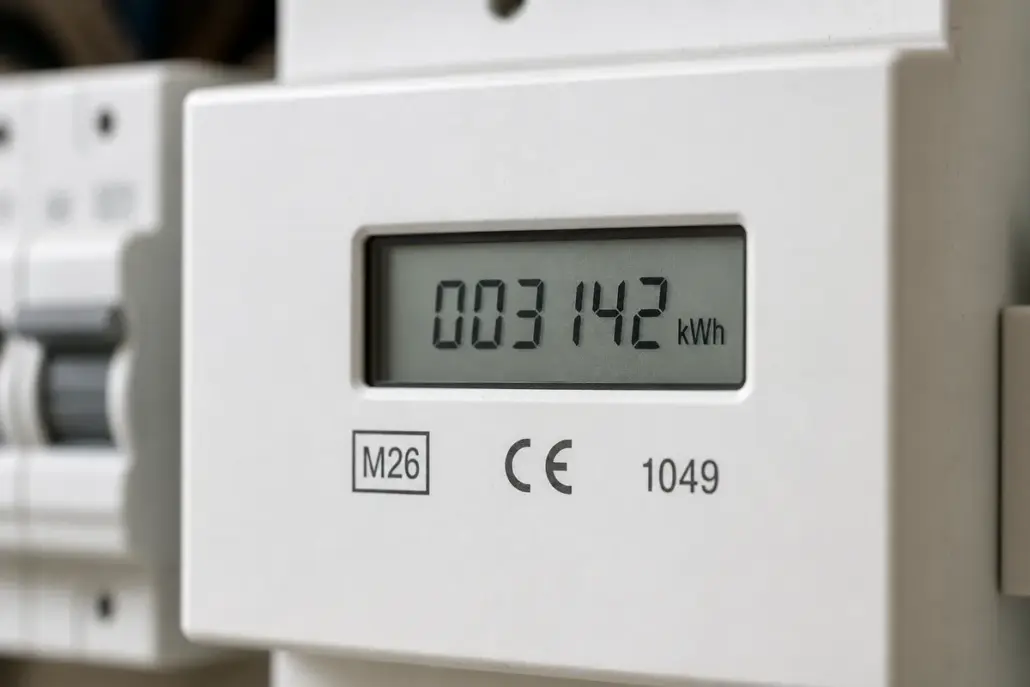
Every billing dispute over a sub-meter eventually arrives at the same question. Prove the meter is approved. Landlords who can produce the markings and the paperwork win that conversation in minutes. Landlords who bought “a meter off the internet” three years ago and never looked at the faceplate lose it slowly and expensively. Checking approval takes about five minutes per meter, and this is the checklist for doing it before a tenant ever asks.
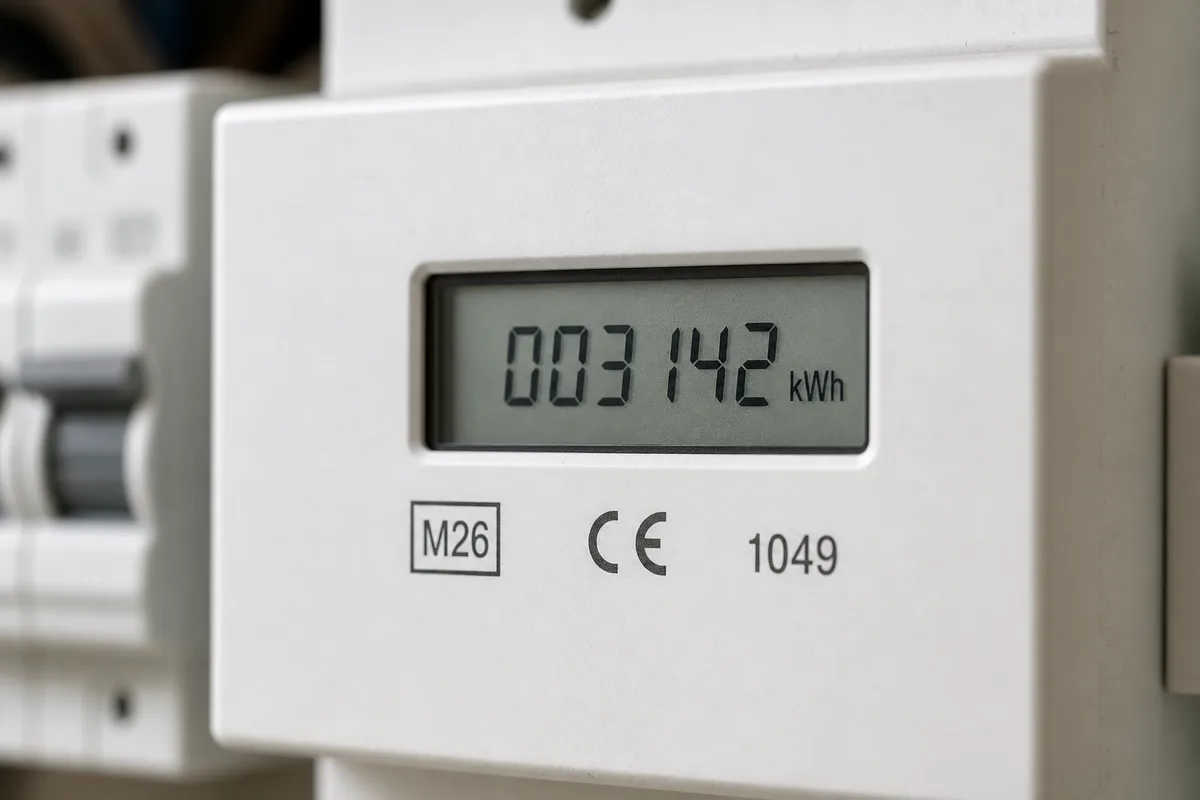
How do you check a sub-meter is MID (Measuring Instruments Directive) approved? Look for three markings together on the faceplate: a CE (Conformité Européenne) or UKCA (UK Conformity Assessed) mark, an M followed by two digits showing the year the metrology marking was applied (in practice, when the meter was made), and the four-digit identification number of the body that assessed it. Then match the meter against its DoC (Declaration of Conformity) paperwork. If any of the three markings is missing, treat the meter as unverified and dig into the paperwork before billing through it, whatever the listing said when you bought it.
Last updated: July 2026.
Key Takeaways
- An approved billing meter carries three markings together: CE or UKCA, the M plus a two-digit year, and a four-digit conformity assessment body number.
- MID (Measuring Instruments Directive) is the EU route behind CE marking; the Measuring Instruments Regulations 2016 provide the GB route behind UKCA. The routes are distinct, but meters approved under either are accepted for sale in Great Britain.
- The DoC (Declaration of Conformity) is the paperwork half of the check. A reputable supplier provides it without being chased.
- The M-year stamp shows when the metrology marking was applied, in practice when the meter was made, and approval has no fixed expiry for a meter in normal service.
- A meter that fails the check can still be used for monitoring. It cannot be the basis of a tenant’s bill.
What should be on the faceplate?
Start with the physical meter, because the markings are the part a tenant or a tribunal can verify without trusting anyone’s paperwork. The regulations put them on the instrument or its data plate, with packaging or accompanying documents allowed where marking the body is impractical, but on mainstream sub-meters expect them on the faceplate.
First, the conformity mark. CE marking is the European route and remains recognised in Great Britain; UKCA marking is the domestic equivalent introduced after Brexit. Either works on a meter sold for the GB market today.
Second, the metrology marking, a capital M and two digits inside a rectangle (the rectangle is part of the legal marking, not decoration). The digits are the year the marking was applied, which in practice tracks the year of manufacture, so M24 reads as a 2024 meter. This is the marking that distinguishes a billing-grade instrument from a lookalike monitoring meter.
Third, the four-digit number of the conformity assessment body involved in the production-stage checks, printed beside the conformity mark. On CE-marked meters this is normally an EU Notified Body number; on UKCA-marked meters a UK Approved Body number, though a Fast-Track UKCA route introduced in late 2024 can rely on EU Notified Body work, so a UKCA meter’s paper trail may legitimately reference an EU body. Under some assessment routes a different body handles the type design, which is why the DoC matters as well as the faceplate.
All three together is the normal picture on a mainstream sub-meter. If one is missing, stop and verify rather than condemning the meter outright, because the regulations allow markings on packaging or accompanying documents in limited cases, UKCA may sit on a label or accompanying document under an easement running to the end of 2027, and older meters can be lawful under pre-MID national approvals. A lone M stamp with nothing else on a cheap import is still the classic red flag, and our MID approval guide covers why sellers get away with that more often than they should.
What should the paperwork show?
The DoC is the manufacturer’s formal statement that the meter type meets the regulations, and manufacturers are required to draw one up and ensure it accompanies the instrument. It names the manufacturer, identifies the meter model, cites the legislation and standards applied, and identifies the assessment body involved.
When the meters arrive, check the model number on the DoC against the model on the faceplate, and the body number on the DoC against the one printed on the meter. Two minutes per delivery, and mismatches are exactly what the check exists to catch.
Then file it where a dispute can find it. A digital folder per property holding the DoC, a photo of each installed meter’s faceplate, and the serial numbers turns “prove it” into an attachment rather than an archaeology project. Date the photos at install time and the file quietly documents the meter’s condition as well as its markings.
Can the body number be verified independently?
Yes, and this is the step that catches the convincing fakes. The four-digit number on the meter identifies a real organisation, and both the EU and the UK publish public registers of them. The EU’s NANDO (New Approach Notified and Designated Organisations) database lists Notified Bodies and the legislation each is designated for; the UK government publishes an equivalent register of UK Approved Bodies on gov.uk.
To run the check, look the number up, confirm the body exists, and confirm it is designated for measuring instruments. A meter carrying a four-digit number that belongs to a toy-safety body, or to no body at all, has failed the test regardless of how official the faceplate looks.
This is a five-minute desk check per meter model, not per meter, since every unit of the same model carries the same body number. Do it once at specification time and the whole order inherits the answer. For an older meter already on the wall, judge the body’s status as at the time the meter was placed on the market, since bodies can resign or lose designation later without invalidating meters lawfully sold beforehand.
What if a meter fails the check?
Stop billing through it, in the sense that new statements should not rest on it. A meter without approval can keep working as a monitoring device, tracking consumption for your own management information, but it cannot be the legal basis of a charge to a tenant.
Replacement is the fix. There is no retrofit route to approval, because certification happens at design and manufacture, not in the field. Budget the swap, use the moment to specify the comms and sizing you actually want, and keep the old meter’s readings as management data rather than billing history.
For the period already billed, take advice appropriate to the situation rather than improvising. This article is general information, not legal advice, and historic billing through an unapproved meter is exactly the scenario where a professional opinion earns its fee.
The buying checklist
Condensed into the sequence that avoids the problem entirely.
| Stage | Check | Red flag |
|---|---|---|
| Before ordering | Ask the supplier for the DoC for the exact model | Hesitation, excuses, or a datasheet offered instead of a DoC |
| Before ordering | Look up the body number in NANDO or the UK register | Number missing from the registers or designated for unrelated products |
| On delivery | Faceplate shows CE or UKCA, plus M-year, plus body number | Any of the three missing, or an M stamp with no body number |
| On delivery | Model and body number match the DoC | Paperwork describing a different model or body |
| At install | Photo the faceplate, file it with the DoC and serial number | No record; disputes then depend on ladder access and legible labels |
“File the evidence at install time, not when you need it. The pattern we see is a dispute arriving eighteen months after installation, the meter is behind a locked cabinet in a tenant’s hallway, the label has faded, and the landlord is negotiating access to their own equipment just to read a body number. A phone photo of every faceplate on the day of install, saved next to the Declaration of Conformity, answers the whole question from a desk. It is the cheapest insurance in metering and almost nobody does it.”
Meters UK technical team
Common Mistakes Landlords Make
Buyers hit the same documentation gaps time after time.
Trusting the listing over the faceplate. Online listings say “MID approved” because the words sell meters. The faceplate and the DoC either back the claim or they do not, and only one of those survives a dispute.
Accepting a datasheet as if it were a DoC. A datasheet describes what a meter does; a Declaration of Conformity states what it legally is. Suppliers who muddle the two when asked are telling you something useful about their paperwork.
Checking one meter in a batch and assuming the rest. Mixed batches happen, particularly through marketplace sellers who source the same “model” from wherever is cheapest that month. The delivery check is per unit, the register check is per model.
Filing nothing. The whole verification only pays off if the evidence is retrievable years later. One folder per property, DoC plus faceplate photos plus serials, and the check you did once keeps answering for the life of the installation.
Where does this fit in the bigger picture?
Approval checking is one link in the billing chain, sitting between choosing the right meter and running the billing correctly. The meter selection questions live in our guides on single versus three phase and CT (Current Transformer) versus whole current, and the billing rules in the Maximum Resale Price guide. Get all three links solid and the sub-metering setup as a whole becomes the boring, defensible asset it should be.
Buying from a specialist supplier shortcuts most of this, because the DoC arrives with the quote and the models are certified as standard. The checklist matters most at the cheap end of the market, which is precisely where the certification gaps live.