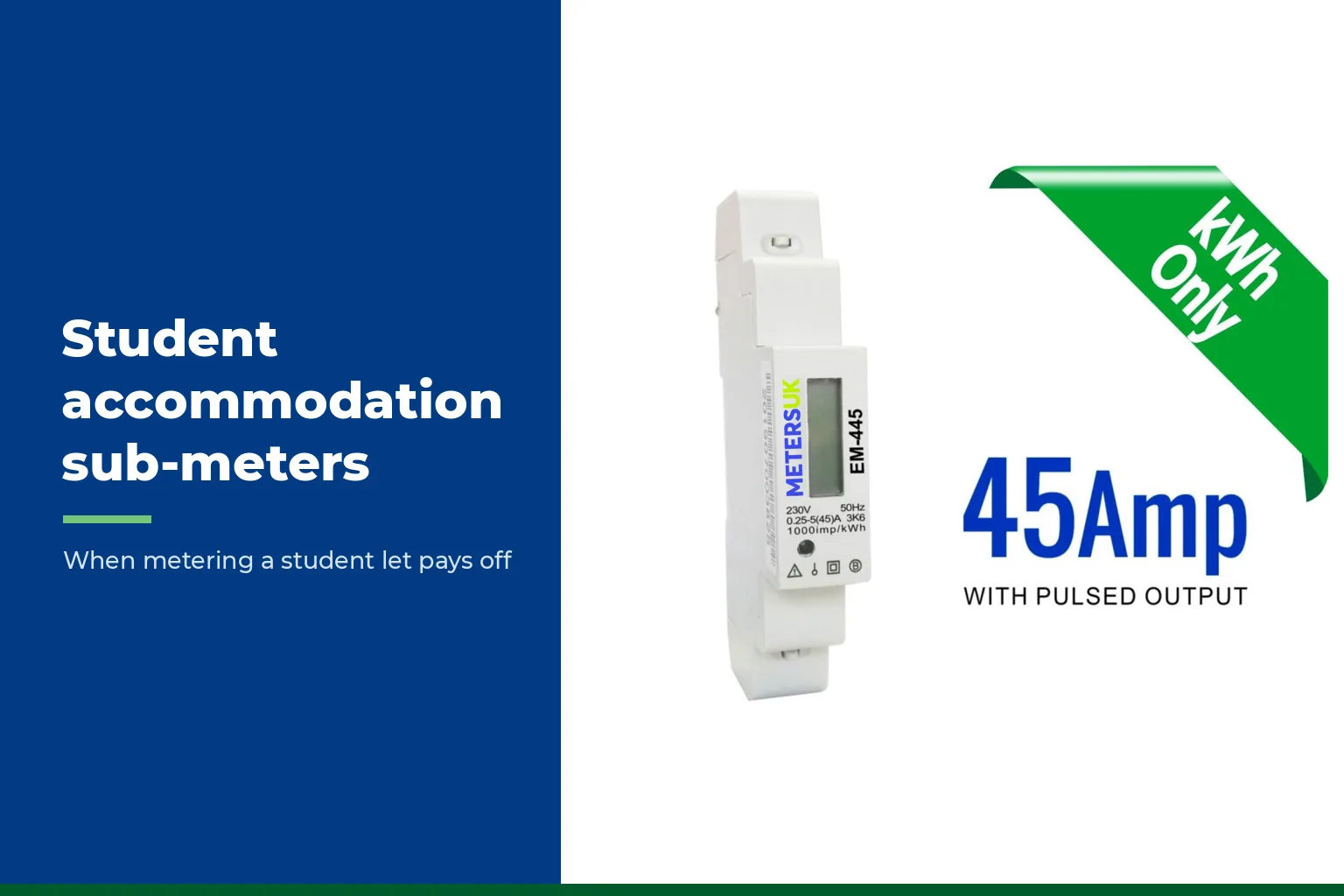
Students like one monthly figure. No energy accounts to open, no rows over who left the heating on. So bills included is a common way to let a student house or block.
That raises an odd question for a sub-meter supplier. If the rent already covers the energy, why meter it? The answer depends on whether you cap usage and charge for the excess.
Should student accommodation have sub-meters? Yes, if one supply feeds several flats or studios that each have their own usage cap. Sub-meters give the readings to enforce a cap and prove any excess charge. A single house on its own supplier meter, with no cap, does not need them.
Last updated: October 2026. Figures reflect published rules and guidance as of this date. This article covers England, and Ofgem’s rules apply across Great Britain.
Key Takeaways
- Unipol said in 2022 that most all-inclusive student contracts have a fair use cap. Bills are included only up to that cap.
- A sub-meter earns its keep when one supply feeds several units, because each unit needs its own allowance.
- Any term that lets you charge extra must be fair under the Consumer Rights Act 2015. An unfair term is not binding on the student.
- Price any excess at what you pay your supplier. Real readings are the strongest evidence, and Ofgem allows estimates only with safeguards.
Do Energy Resale Rules Apply to a Bills Included Let?
Ofgem’s Maximum Resale Price rules cap what you can charge when you resell energy. The most you can charge is what you pay your supplier. Our guide to the maximum resale price covers the cap in full.
Ofgem’s resale guidance treats accommodation as outside the cap where the rent is all inclusive, with no specified energy charge and no separate energy resale agreement. A flat rent with no energy line is a different arrangement from billing for energy. Simply collecting an energy charge alongside the rent does not put you outside the rules.
An excess usage charge is a separately calculated charge for energy, so treat it as resale. The safe approach is to price any excess at what you pay your supplier, and to take advice on your own set-up. Our piece on bills included against sub-metering in a house in multiple occupation (HMO) sets out the wider choice.
What Should a Fair Use Cap Say?
Unipol, the student housing charity, says most all-inclusive contracts carry a usage cap. It can be set in units of energy or as a sum, such as £15 per person per week. Above the cap, the landlord can charge extra, if the clause is fairly worded.
Fairness has a legal test. Under section 62 of the Consumer Rights Act 2015, an unfair term in a consumer contract is not binding on the consumer. A term is unfair if, against the requirement of good faith, it causes a significant imbalance in the parties’ rights to the consumer’s detriment. The Act applies to traders. Whether a landlord counts as one depends on whether they act for business purposes, and owning a single property does not settle it. Do not build your clause on that hope.
No checklist guarantees a clause is fair, because that depends on the contract as a whole. A well drafted clause still covers five things. It gives the cap figure and says what it covers. It names the meter or bill used to measure usage. It says how the excess is priced and when it falls due. It says how the excess is shared among joint tenants. And it says that you will show the evidence on request.
In England, utilities are also on the list of permitted payments under the Tenant Fees Act 2019, where the tenancy agreement says the tenant pays them. Government guidance says the Act covers student accommodation. Permission to charge is not permission to overcharge, and the resale price rules still apply.
Which Letting Model Needs a Meter?
| Model | How the student pays | Sub-meter needed? | Main risk |
|---|---|---|---|
| Bills included, no cap | Rent only | No | High users cost you money all year |
| Bills included, fair use cap | Rent, plus any excess | Yes, for shared supplies with a cap per unit | A badly worded clause you cannot enforce |
| Bills excluded, student opens account | Pays the supplier directly | No, if each home has its own supplier meter | Students struggle to set up accounts and may default |
| Bills excluded, billed by sub-meter | Pays you for measured use | Yes | Breaching the resale price rules if you overcharge |
The second row is where a sub-meter turns a vague allowance into something you can prove. Unipol adds that a landlord must show evidence of the bills to claim extra costs.
What Does a Capped Studio Block Look Like in Numbers?
Take a block of 12 studios on one landlord supply. Each lease includes electricity up to 3,600 kWh a year. Anything above that is charged at the landlord’s supplier price.
Say the supplier unit rate is an example 25p a kWh. The 3,600 kWh cap is worth £900 a year per studio. These figures are made up to show the working. Use the rate on your own invoice. The example ignores standing charges and VAT, which you would handle separately.
At the end of the year, Studio 4 has used 5,200 kWh. That is 1,600 kWh over the cap, or £400 at 25p. Studio 9 has used 2,900 kWh and owes nothing.
Without sub-meters, you only know the block total. You could split it equally and charge Studio 9 for someone else’s heating. With a meter on each studio, the bill for Studio 4 is a sum on two dated readings. For the layout, see our guide to how many sub-meters an HMO needs.
A single student house is simpler. The supplier’s meter already gives you the house total. Sub-meters only help there if you want a separate allowance for each tenant.
No rule forces you to meter. A sub-meter is the practical way to prove each unit’s use, and Ofgem’s rules also allow estimated arrangements with fair allocation and reconciliation.
Do You Meter for Billing or for Control?
In many student lets, the real value is control rather than billing. A monthly reading shows in January that a studio is heading past its cap. That gives you time to talk about heating before an excess charge lands in June.
Student tenancies often start and end on the same dates, so manual readings can bunch up at a handful of changeover days. Meters that report on their own take that pressure away. Our guide to remote meter reading for landlords explains the options.
Prepayment is another route. The student tops up, and nobody argues about an excess. But it is billing energy to a tenant, so the resale price rules apply in full. Our comparison of prepay and credit sub-meters covers the trade-offs.
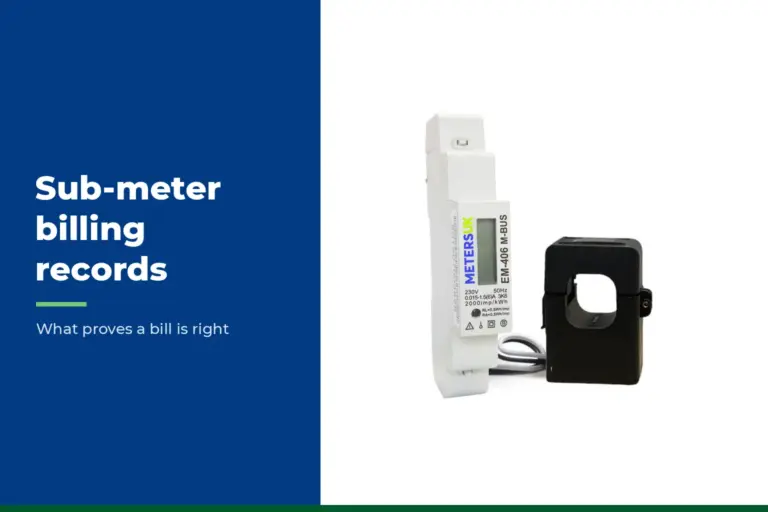
Our guide to the records that prove a sub-meter bill is right lists what to hold behind each charge. The changeover itself is covered in our piece on sub-meter readings when a tenant moves out.
In a student block, the dispute is often about the opening reading. Photograph every meter at check-in, with the date and the serial number in shot, and many excess charge arguments end before they start.
Meters UK technical team
Common Mistakes to Avoid
Setting the cap per month is a trap. Student homes usually use more energy in winter, so a monthly figure can penalise the tenant for the season. Setting it over the whole tenancy is fairer.
Estimates cause trouble too. Unipol tells students to check that charges rest on real meter readings. Ofgem allows estimates in some arrangements, but a charge built on one is harder to defend.
Adding a mark-up to the excess rate is the most expensive slip. Once you bill for energy, the resale price rules point to your supplier price, so a margin invites a refund claim.
The last one is forgetting the opening reading. If nobody recorded it on day one, you cannot show what the tenant used. Take it at check-in, every time.