A tenant email asking for an EV (Electric Vehicle) charger used to be rare enough to handle case by case. It no longer is, and the awkward question inside it is not the hardware, it is the billing. The charger draws serious electricity through the landlord’s supply, someone has to pay for it, and the rules around charging tenants for that electricity are in a genuinely unusual state right now. This one rewards getting the metering right from the start.
Can a landlord bill tenants for EV charging? Yes, and the metering question decides how cleanly. Ofgem’s 2014 direction currently excludes resale of electricity for EV charging from the Maximum Resale Price (MRP) rules, an exclusion originally made to encourage charging infrastructure. Ofgem opened a Call for Input in October 2025 revisiting that exclusion, so the settled answer may change. The durable approach is to meter the charger circuit properly and bill on a transparent cost basis, which positions you well whichever way the rules land.
Last updated: July 2026. This article is general information, not legal advice. Check Ofgem and gov.uk for the current position before setting tariffs.
Key Takeaways
- Ofgem’s 2014 direction currently excludes EV charge point electricity resale from the MRP (Maximum Resale Price) rules, and an October 2025 Ofgem Call for Input is reviewing that exclusion.
- Since 30 June 2022 it has been illegal to sell home and workplace charge points in Great Britain that do not comply with the Electric Vehicles (Smart Charge Points) Regulations 2021, with the security requirements following from 30 December 2022.
- A charger’s built-in session data is useful, but it is not a billing-grade measurement. For per-kWh billing, fit an MID (Measuring Instruments Directive) approved sub-meter on the charger circuit.
- A 7 kW home charger runs on a normal single phase supply. Faster units are usually three phase designs, which most rental properties cannot feed without a supply upgrade.
- Installation is a job for a qualified electrician using an approved charge point, with any supply notification handled with the DNO (Distribution Network Operator).
Do the Maximum Resale Price rules apply to EV charging?
Currently, no, and that surprises landlords who know the MRP rules from ordinary sub-metering. Ofgem’s 2014 direction on maximum resale prices excluded electricity resold for charging electric vehicles, a deliberate carve-out to avoid discouraging investment in charge points when they were scarce.
That exclusion is under review. In October 2025 Ofgem opened a Call for Input on the resale rules, and charging at residential properties is one of the areas explicitly in scope. Ofgem is asking, among other options, whether residential users charging at home need more protection than the current exemption gives them.
The practical read for a landlord is that the exclusion means you are not currently capped at your supply rate for EV charging electricity, but building a business model on marking up tenant charging is a bet against the regulator. Bill transparently at or near cost, and a rule change becomes a non-event. Our Maximum Resale Price guide covers how the cap works for everything that is not an EV.
How should the charging electricity be metered?
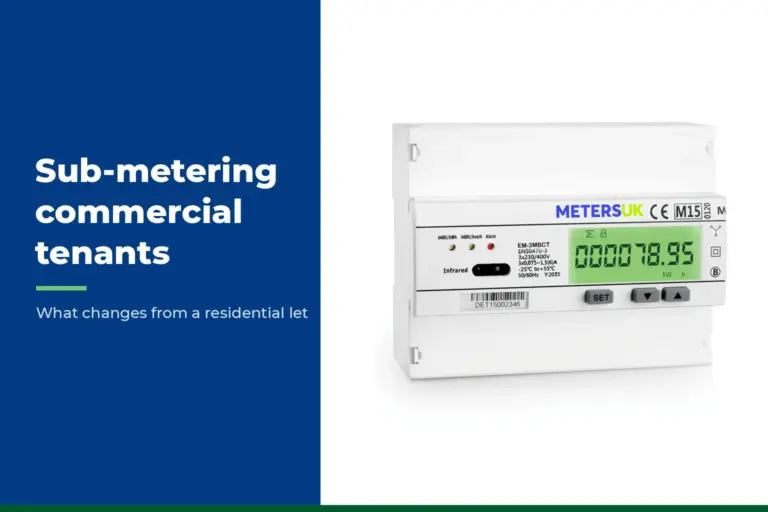
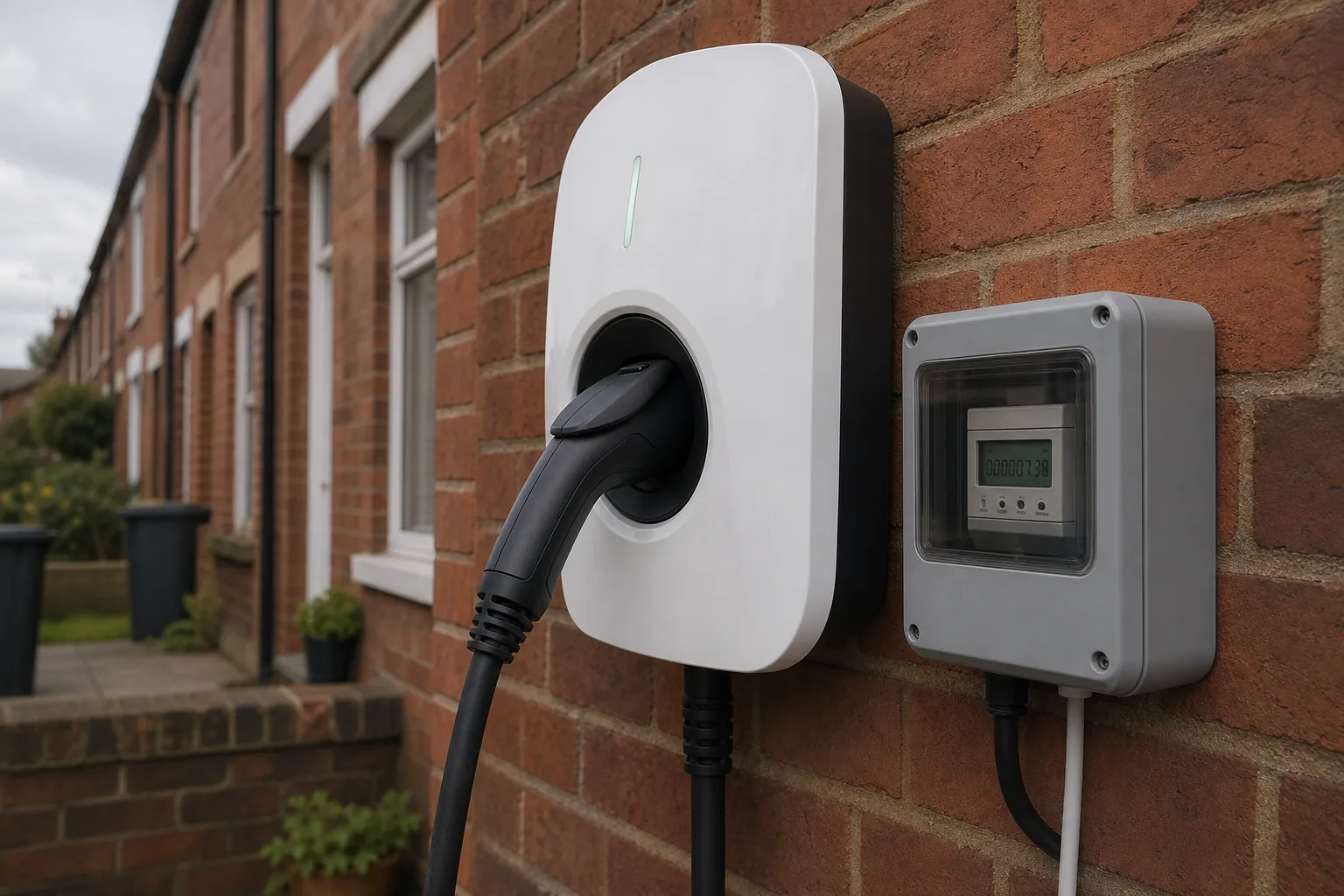
Give the charger its own measured circuit. The clean pattern is a dedicated circuit from the board to the charge point with an MID-approved sub-meter on it, so every kWh (kilowatt hour) through the charger is recorded on a billing-grade instrument separate from the dwelling’s other use.
Most smart chargers report session energy through their app, and that data is genuinely useful for sanity checks and tenant visibility. It is not automatically a billing measurement. Gov.uk guidance is clear that any electricity meter used for billing, including by a landlord, must be of an approved design. A charge point’s integrated meter can serve that role, but only if it carries that approval itself, and the smart charge point rules alone are no substitute, because their measurement requirement permits accuracy within 10%, nowhere near billing-grade. In our experience few consumer charge points document billing approval for their internal metering, so check the paperwork; without it, a tenant disputing a bill built solely on app data leaves you standing on the manufacturer’s firmware rather than on a certified instrument. The pairing that works is the charger app for convenience and the MID-approved meter for the actual bill, the same approval logic covered in our MID approval guide.
Where several tenants share one charger, the billing question shifts from the meter to the platform, because you need per-user identification, which chargers handle with RFID (Radio Frequency Identification) cards or app accounts, sitting on top of the metered total.
Will the property’s supply cope with a charger?
A standard 7 kW home charger runs on a normal single phase domestic supply, and for a single let that is usually the end of the question, subject to the electrician’s load assessment of what else the property draws.
The pressure arrives with multiple chargers or faster units. Chargers above the standard 7 kW are usually three phase designs, and most UK homes, rentals included, are single phase. An HMO (House in Multiple Occupation) car park with several 7 kW chargers can also push the building’s total demand past its supply capacity. The supply-side options and costs are exactly the territory of our single phase versus three phase guide, and the load assessment belongs with a qualified electrician, with any supply upgrade quoted by the DNO.
Notification is part of the install. Charge point installations are notified to the DNO, and installers submit this as standard. Gov.uk guidance places responsibility on the device owner to make sure the DNO actually received it, so get written confirmation from the installer rather than assuming.
Which billing model fits which setup?
Three patterns cover nearly every rental scenario.
| Model | How it works | Where it fits | Watch out for |
|---|---|---|---|
| Tenant’s own supply | Charger wired to the tenant’s electricity supply; they pay their supplier directly | Single lets with a driveway and the tenant’s own meter | Cleanest option; landlord only needs the install done properly |
| Metered resale by landlord | Dedicated MID-metered circuit; landlord bills per kWh on a transparent cost basis | HMOs and blocks where charging runs off the landlord supply | MRP exclusion currently applies but is under Ofgem review; bill near cost |
| Platform-managed sharing | Smart charger with per-user accounts; platform meters sessions and takes payment | Shared chargers, visitor bays, larger blocks | Platform fees; session data should still reconcile against a billing-grade meter |
“The reconciliation gap is the call we get. A landlord bills from the charger app all year, then compares it against the supply meter and finds the app total runs several percent light because it measures at the charger’s output, after losses, while the supply meter measures what actually came through the incoming supply. Neither number is wrong, they measure different points. Decide up front which instrument is the billing reference, make it the MID-approved one, and use the app for visibility rather than invoicing. That single decision removes the whole argument.”
Meters UK technical team
Common Mistakes Landlords Make
Charge point billing goes wrong in familiar ways.
Billing from the charger app alone. Session data is convenience data. When a tenant challenges a bill, the defensible measurement comes from an approved meter, not from firmware. Fit the sub-meter on the charger circuit at install time; retrofitting it later costs more than the meter did.
Treating the MRP exclusion as a pricing opportunity. The exclusion exists to encourage infrastructure, Ofgem is actively reviewing it, and a tenant paying above the going rate will not stay quiet. Transparent near-cost billing is the position least likely to need unwinding after the review.
Specifying a fast three phase charger for a single phase property. The unit will not run on the supply most rentals have. Match the charger to the supply the electrician confirms is there, or price the upgrade honestly using DNO quotes first.
Skipping the tenancy paperwork. Whoever pays, the tenancy agreement should say so explicitly, including the rate basis and how readings are taken. Retrofitting a charging clause into a live tenancy is harder than writing it in at renewal.
Where should a landlord start?
Start with the supply, not the charger. Have a qualified electrician assess the property’s capacity and confirm what the existing supply supports. Their answer decides whether this is a straightforward 7 kW install or a conversation with the DNO.
Choose a compliant smart charge point and an installer who handles the DNO notification, and check gov.uk for whatever OZEV grant schemes are open to landlords at the time, because the schemes and amounts change and some landlord schemes closed to applications in early 2026.
Specify the dedicated metered circuit at the same time as the charger, with an MID-approved sub-meter as the billing reference. Set the tariff on a transparent cost basis, write the arrangement into the tenancy agreement, and keep the readings with the statements the same way you would for any other sub-metered utility.