Energy theft costs consumers in Great Britain over £1.4 billion a year, according to Ofgem (the Office of Gas and Electricity Markets). Most of it ends up spread across everyone else’s bills. In a House in Multiple Occupation (HMO), the landlord is usually the only person who sees the meters, the bills and the readings together. That makes spotting a tampered meter part of the job.
How can an HMO landlord spot meter tampering? Watch for wires clipped or looped around the meter, damaged casing, a burning smell, or a supply that keeps running with no credit on a prepayment meter. Never touch the meter yourself. Report it anonymously to Stay Energy Safe on 0800 023 2777.
Last updated: August 2026. Ofgem’s energy theft guidance covers Great Britain. The criminal offences described are the England and Wales ones, and the electrical safety duties are England only. General information only, not legal advice.
Key Takeaways
- Ofgem puts energy theft at over £1.4 billion a year, with penalties of up to 5 years in prison.
- The supply meter is never yours. Report tampering, never open or repair it yourself.
- Stealing electricity is a separate offence from theft, because electricity is not property in law. Gas and water are.
- Sub-meter readings that fall well short of the supply meter are the earliest warning you get.
- Ofgem treats a locked meter cupboard or refused access as a warning sign, so keep a key available.
Is it a crime for a tenant to tamper with the meter?
Yes, and it carries a prison sentence. Ofgem says penalties for energy theft run to fines and up to 5 years inside.
Which offence gets charged depends on the fuel. Stealing electricity is not theft in the ordinary sense, because electricity is not property under the Theft Act 1968, a point the courts confirmed in Low v Blease. It has a section of its own. Section 13 makes it an offence to dishonestly use electricity without due authority, or to dishonestly cause it to be wasted or diverted. The maximum on indictment is 5 years.
Gas and water are property, so in England and Wales bypassing a gas or water meter can be charged as theft under section 1 of the same Act.
What are the signs of meter tampering?
Ofgem publishes the list, and it is worth reading before your next inspection visit. On an electricity meter, look for wires sticking out, wrapped around the meter or added with clips. Damaged casing counts, so does a burning smell, and so do smoke or sparks nearby. A prepayment meter that keeps supplying power with no credit on it is the clearest sign of all.
Gas gives itself away differently. Pipes that look out of place, dials that are not moving or not visible, a meter fitted back to front so no dials show, rubber piping where the run should be metal, and the smell of gas near the meter box all point the same way.
The easiest time to check is between tenancies, when you are doing the inventory anyway.
Can sub-meter readings show that someone is stealing electricity?
They can, and it is the check most landlords never run. Where a building has one supply and a sub-meter on each flat, the sub-meters should add up to something close to the supply meter. If they do not, something is drawing power nobody is paying for.
Take a converted house with four self-contained flats on one supply. Over a quarter the supply meter clocks 9,400 kWh. The four flat sub-meters come to 5,900 kWh between them, and the sub-meter on the landlord’s communal circuits reads 780 kWh. That leaves 2,720 kWh, near enough 29 per cent of the building, unaccounted for. At 27.5p a unit that is £748 in a single quarter.
A small gap is normal. Meters have a tolerance, and most buildings have a circuit or two that was never metered. A few per cent is housekeeping. A gap approaching a third needs an answer, and it is far easier to ask when you already bill from sub-meter readings every quarter.
What should you do if you think a meter has been tampered with?
Deal with the danger before anything else. If you can smell gas, get everyone out and call the National Gas Emergency Service on 0800 111 999. If there are sparks, smoke or a burning smell around an electricity meter, call 999.
Then report it. Stay Energy Safe takes reports online or on 0800 023 2777, you stay anonymous, and it works alongside Ofgem and the energy suppliers. Tell the supplier named on the account as well.
What you must not do is open the meter, pull off a bypass or press a seal back into place. The supply meter is not yours. It belongs to the energy supplier, or to the meter asset provider they use, and handling it puts you in the frame. Suppliers have their own way in. Under the Rights of Entry (Gas and Electricity Boards) Act 1954 they can apply to a magistrate for a warrant of entry.
| Question | The supply meter | Your sub-meters |
|---|---|---|
| Who owns it | The supplier or their meter asset provider | You, the landlord |
| Who may open it | The supplier only | A qualified electrician you appoint |
| If tampered with | Report to the supplier and Stay Energy Safe | Your loss, recovered through the tenancy |
| Who is out of pocket | The supplier and every other bill payer | You |
Should you lock the meter cupboard?
Lock it carefully, and not in the way most landlords assume. Ofgem’s guidance on tampering in workplaces and public places lists a locked meter cupboard, or refused access to meters, as a warning sign. A landlord who bolts the cupboard shut and keeps the only key can end up looking like the problem.
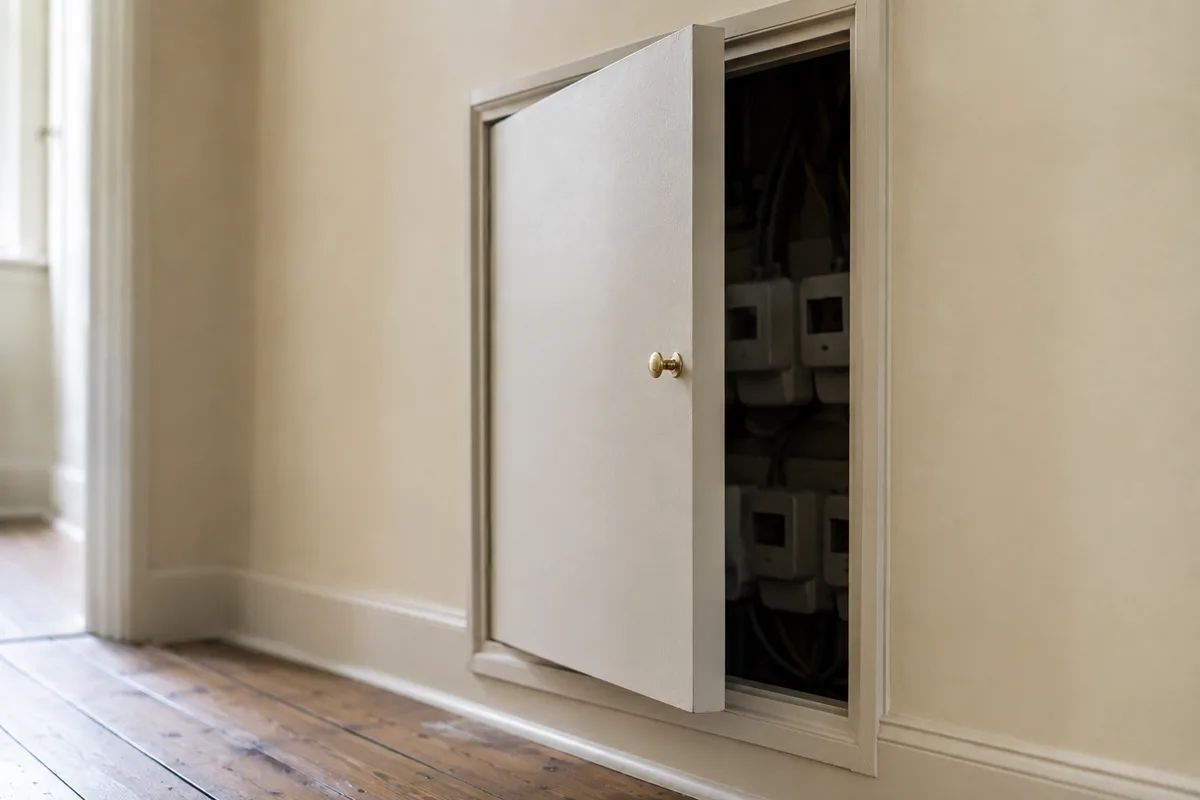
Ownership decides where the line sits. Your own sub-meters can live in a locked enclosure. The supply meter has to stay reachable, so tell tenants where it is and keep a key where it can be found.
How do you make sub-meters harder to tamper with?
Location does most of the work. A sub-meter in a locked meter enclosure in a communal cupboard is far less inviting than one on an open board inside a tenant’s flat. Sealed terminal covers and tamper-evident seals will not stop a determined person. They do turn a quiet bypass into visible damage you can point at.
Buy meters approved under the Measuring Instruments Directive (MID), because a meter you cannot legally bill from is no help once you find the shortfall. Then put the readings somewhere you will actually look. Remote meter reading turns a flat that suddenly reads zero into a question this week, rather than a puzzle at the next quarterly bill.
A tenant who bypasses your sub-meter is not stealing from the energy supplier, because the electricity still passes through the supply meter and the supplier still gets paid. The loss is yours alone, and recovering it usually runs through the tenancy agreement rather than the police. Take advice before you touch a deposit.
“When a landlord rings us about readings that will not add up, nine times out of ten the answer is a circuit nobody metered. An immersion heater, an outside socket, a garage. Rule those out first and write down what you ruled out. Whatever is still missing is the bit worth worrying about.”
Meters UK technical team
Common Mistakes to Avoid
A few patterns come up again and again.
Reaching for the meter does the most damage. A landlord who pulls a looped wire off a supply meter has handled a tampered installation, wrecked the evidence and taken on a risk that was never theirs. Photograph it, shut the cupboard, make the call.
Blaming the gap before checking the wiring runs a close second. Unmetered circuits explain most shortfalls, and accusing a tenant on the strength of a sum nobody has checked is a fast route into a dispute you lose.
Fitting sub-meters inside individual flats saves cable and costs you oversight. Once a meter sits behind a tenant’s front door you need notice to read it.