Ofgem started regulating heat networks in Great Britain on 27 January 2026. If you’re a landlord with a communal boiler heating multiple flats, this matters. You might be a “supplier” under the new rules.
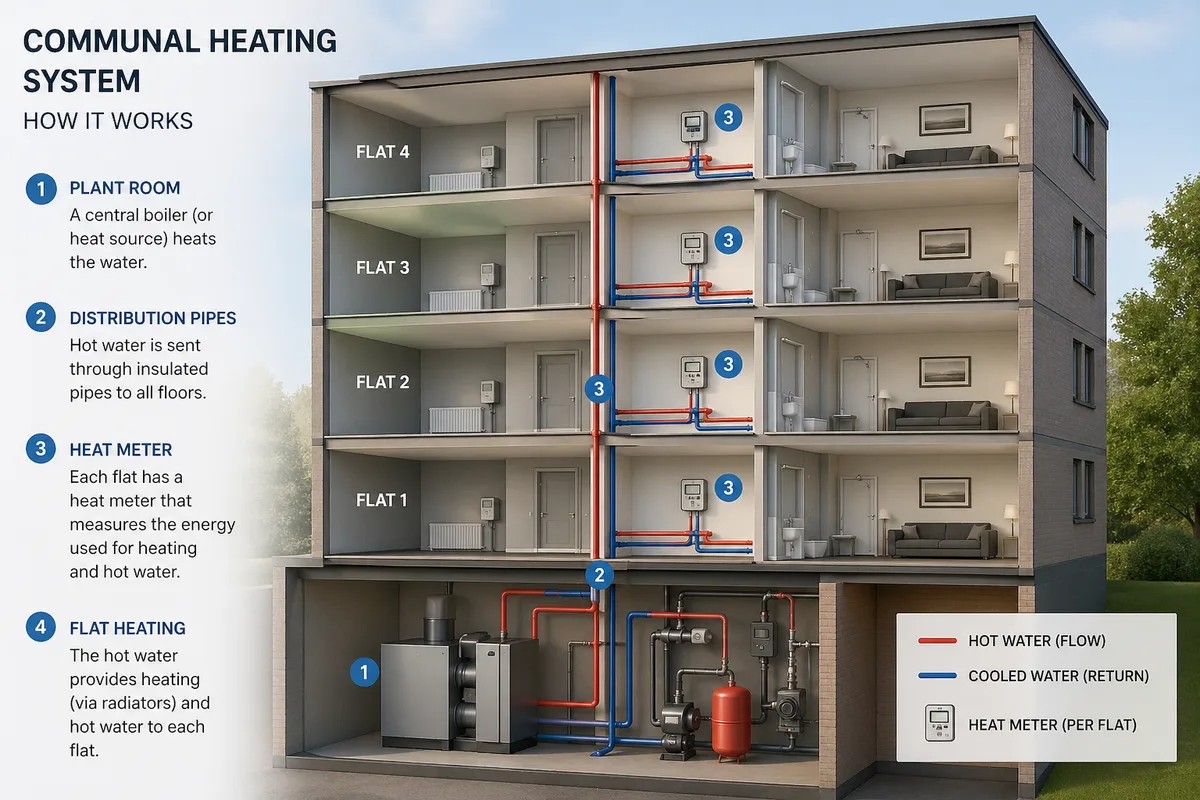
Am I a heat supplier? If you charge tenants for heat from a shared system in your building. Under the Heat Networks (Market Framework) Regulations 2025, Ofgem now oversees pricing, billing, and consumer protection for heat networks across Great Britain. Existing operators are deemed authorised in the meantime, but you must register your network with Ofgem by 26 January 2027.
Last updated: April 2026. This article reflects the regulations and Ofgem guidance current at this date. Heat network regulation is changing rapidly, so always cross-check Ofgem’s published guidance for your specific scenario.
Key Takeaways
- The new rules took effect on 27 January 2026. Ofgem moves to fuller enforcement through 2027.
- Some communal heating arrangements are in scope; some are exempt. The capacity of the shared system and the structure of the building both matter.
- The old Heat Network (Metering and Billing) Regulations 2014 were partially revoked in GB at the same time, to avoid duplication. The OPSS notification duty is no longer required in GB.
- Penalties go up to £1 million or 10% of turnover, whichever is higher.
- Registration on Ofgem’s digital service is rolling out from Spring 2026. The final deadline for existing networks is 26 January 2027.
Am I a heat supplier under the 2026 regulations?
Quite possibly, but the answer depends on what your heating setup looks like. The trigger is whether you supply heat, hot water, or cooling to more than one final customer from a shared central source, and whether your arrangement falls within Ofgem’s scope rather than one of the express exemptions.
The new framework defines two roles. An “operator” runs the network infrastructure. A “supplier” sells the heat to end users. In a small landlord setup, you usually play both roles. In a managed development with a heat-as-a-service contract, the roles often sit with different organisations. Get this clear early, because the obligations differ.
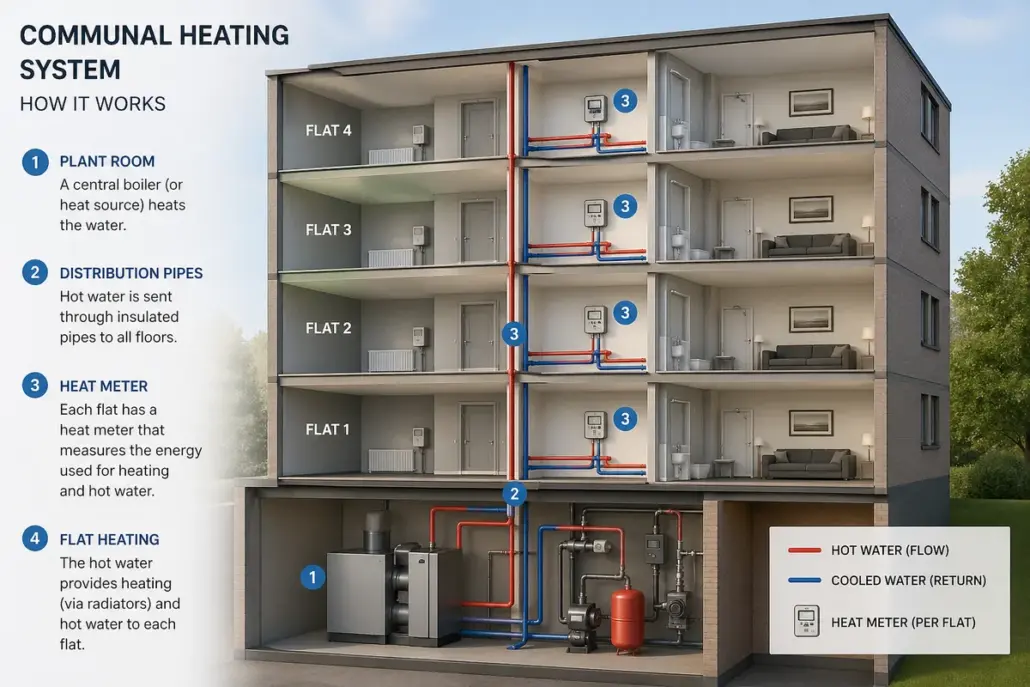
Three things to check on your portfolio. Is there a shared boiler, a district heating connection, or a heat pump system serving more than one occupier? Do tenants pay you, directly or through a service charge, for that heat? And does the property serve two or more dwellings or buildings? If yes to all three, you may well be in scope.
The exemptions are narrower than people assume. A single converted building, as defined in section 254(8) of the Housing Act 2004, that’s served by no more than one heat source of 45kWth or less is exempt. An HMO with shared heating of single-dwelling capacity can also be exempt. But a converted block of self-contained flats under section 257 of the Housing Act 2004 is NOT exempt, even though it gets called an HMO. If your building is a block of flats with a communal plant room, assume you’re in scope until you’ve checked the precise definitions in Ofgem’s registration guidance.
What does Ofgem actually require me to do now?
The Authorisation Conditions sit in three sections. Section A applies to both operators and suppliers and covers fair pricing, financial resilience, and registration. Section B applies to suppliers and carries the bulk of the consumer protection duties, including complaints handling and the Priority Service Register. Section C applies to operators and is about consistent service delivery.
For most landlords with communal heating, you sit on the supplier side. That means you need a sensible answer to how you bill tenants, how you handle complaints, and how you protect vulnerable customers.
The practical list of things to get in order:
- Pricing transparency. Tenants should be able to see what they are paying per unit and why.
- A complaints route. Heat network complaints can now go to the Energy Ombudsman after eight weeks if you’ve not resolved them, so your internal process needs to exist before someone tests it.
- A Priority Service Register, listing tenants who need extra support during outages.
- Back-billing rules. Ofgem’s general 12-month limit applies, though where heat is recovered as part of a service charge, the section 20B Landlord and Tenant Act 1985 18-month period also applies. Either way, don’t sit on errors.
- Standards of Conduct, broadly meaning act fairly, communicate clearly, and respond promptly.
Ofgem has been clear that the first 12 months are a learning period. The regulator wants the sector to embed the rules and will reserve formal enforcement for cases of consumer harm or refusal to engage. That tone changes as enforcement ramps up through 2027.
Do I need to register my heat network with Ofgem?
Yes, the deadline is 26 January 2027, but registration rolls out gradually rather than opening as a single switch. Ofgem’s digital service, called Comply with heat networks consumer protection regulations, has been live in private beta since spring 2026 and is being widened in stages. As of late April 2026, you may not yet have an invitation to register, but the system will be open to all in scope networks well before the deadline.
If your network was already running before 1 April 2025, or it started anywhere between 1 April 2025 and 26 January 2027, you are deemed authorised in the meantime. That covers almost every existing landlord setup. The deeming saves you from operating unlawfully while the registration system catches up. It does not replace registration. You still have to do it.
What you’ll be asked for: organisation details, ownership structure, financial resilience information, your customer base and metering arrangement, your consumer protection setup, and basic technical information about the network. You can save progress and return to it. Each network needs a nominated regulatory contact who signs in via a GOV.UK One Login account.
Practical tip. Pull together your meter inventory, billing records, and tenant contact list now. The registration form is split into sections that follow that structure, so being organised up front turns the registration itself into form-filling rather than discovery.
What happened to the 2014 Heat Network Regulations?
The 2014 regulations were partially revoked in Great Britain on 27 January 2026, the same day Ofgem’s framework took effect. The two regimes were never meant to run in parallel forever, and the revocation closes off the duplication.
What was revoked in GB: the duty to notify the Office for Product Safety and Standards (OPSS), the cost-effectiveness tool, and Regulation 6 covering Heat Cost Allocators, hot water meters, and Thermostatic Radiator Valves. From 27 January 2026, Heat Cost Allocators (HCAs) are no longer accepted as a route to compliance.
What’s still in play is the broader principle that billing has to be accurate and based on actual consumption, which is now a duty under the Ofgem framework rather than the 2014 regs. The 2014 regulations continue to apply in Northern Ireland.
| Obligation | 2014 regulations (pre-2026, GB) | From 27 January 2026 (GB) |
|---|---|---|
| Notify the regulator | OPSS, every four years | OPSS duty revoked. Register with Ofgem by 26 January 2027 plus ongoing data reporting |
| Heat Cost Allocators | Permitted as a compliance route | No longer accepted as a compliance route in GB |
| Cost-effectiveness tool | Required where applicable | Revoked in GB |
| Billing accuracy | Yes, based on actual consumption | Yes, plus Ofgem billing transparency duties |
| Consumer protection | Limited | Standards of Conduct, vulnerable customer rules, Energy Ombudsman |
| Penalty ceiling | Up to £5,000 per offence under HNMB | £1 million or 10% of turnover, higher of the two |
If you operate networks in Northern Ireland as well as GB, you’ve now got two regimes to track in parallel. For GB-only landlords, the picture is simpler than it was a year ago. Less paperwork to OPSS, more substance to Ofgem.
What are the penalties?
Up to £1 million or 10% of annual turnover, whichever is higher. Operating a heat network without the right authorisation is a criminal offence, not just a regulatory one.
Ofgem also has powers to issue enforcement orders, require consumer redress, and take action that’s proportionate to the harm caused. The criminal element is the bit that should focus minds. A landlord with a single block of flats might never face a £1 million fine in practice, but operating without authorisation crosses a different line entirely.
Ofgem has been explicit that the first 12 months are about working with the sector. The flexible approach is real, but it is not permanent. Anyone hoping the regulator will quietly drop this is going to be disappointed.
What about heat meters and approvals?
The Ofgem framework requires accurate billing based on actual consumption, which in practice means proper heat meters fit for billing. Heat meters used for fiscal billing are typically MID-approved (the Measuring Instruments Directive carried over into UK law) and built to BS EN 1434, the heat meter standard. That’s the expected baseline for reputable products on the UK market, and it’s what you should specify when you replace or install meters.
If you’ve installed cheap, unbranded units at any point, this is the moment to audit them. A tenant complaint to the Energy Ombudsman that hinges on questionable meter accuracy will not go your way. The new transparency duties make a weak meter setup easier to expose.
Pulse outputs feeding a remote reading system are fine, provided the underlying meter is accurate, properly approved, and the data path is auditable. If you’ve installed heat meters from a reputable supplier and kept the calibration certificates, you’re already most of the way there. Heat Cost Allocators, by contrast, no longer work as a compliance route in GB after 27 January 2026.
Common Mistakes Landlords Make
A few patterns we see repeatedly.
Assuming the regulations only cover big district networks. They don’t. A communal boiler in a block of flats with self-contained units is a heat network for these purposes. Plenty of landlords with five-flat conversions are in scope and don’t realise it. Equally, plenty of HMO landlords assume they ARE in scope and panic when they aren’t. The capacity and Housing Act classification matter.
Still trying to file an OPSS notification. The OPSS duty was revoked in GB on 27 January 2026. The notification site no longer applies for GB networks. If you’ve been on a four-year OPSS cycle, that’s done in GB.
Leaving the meter audit until last. If your bills are challenged after enforcement ramps up, the meter setup is the single hardest thing to fix retrospectively. The compliance work flows out of the meter data, not the other way round. Heat Cost Allocators in particular need replacing because they no longer count as a compliance route.
Confusing operator and supplier roles. In a small block of flats, the landlord usually plays both. In a managed development with a heat services contract, the two often diverge. Get the roles clear in your registration, because the obligations differ.
“Nine times out of ten, when a heat meter throws odd readings on a retrofit, it’s the temperature sensor pair fitted the wrong way round. Flow sensor on the return pipe, return sensor on the flow. The meter still produces numbers, they’re just inverted. Tag the sensors physically before they go in. A billing dispute six months later isn’t the moment to discover the meter has been measuring negative energy.”
Meters UK technical team
What should I actually do in the next six months?
If you’re a landlord with any kind of communal heating and you bill tenants for it, here’s a sensible running order.
Start with a portfolio audit. Identify every property where heat or hot water comes from a shared source and you bill tenants for it. Note the rough heat output of each system, because the small-network exemption hinges on capacity. Note the building classification too, because section 254 versus section 257 under the Housing Act 2004 changes the answer.
Pull together your existing meter inventory. Make, model, serial number, approval status, and last calibration date for each meter. If anything is unbranded, undocumented, or a Heat Cost Allocator, plan a replacement.
Get a tenant complaints route written down. It does not have to be long. A clear two-step process plus a referral path to the Energy Ombudsman after eight weeks is enough to start.
Set up a Priority Service Register for any tenants who would need extra support during a heating outage. This can be a simple list with consent rather than anything elaborate.
Then watch for your registration invite. Ofgem is rolling out the digital service in stages through 2026, and you’ll need to register before 26 January 2027. Doing the prep now means the registration itself is twenty minutes of form-filling, not three weeks of panic.