A four-unit business park is simpler to run than a house full of tenants. Then the electricity bill for the whole site lands on one landlord’s desk, and it has to be split four ways. The instinct is to treat it like a residential let: fit sub-meters, apply the same cap used for tenants in a house, done. That instinct is wrong, and getting it wrong carries no Ofgem fine, though it can still cost you in a lease dispute later.
Commercial sub-metering runs on different rules to residential sub-metering. The gap between the two has just widened.
Does the Maximum Resale Price (MRP) cap apply to a commercial tenant? No. Ofgem’s Maximum Resale Price only protects domestic use. For a commercial let, the energy charge is set by the lease or service charge, not by a statutory cap. The meter used to work out that charge still has to meet the same approval rules as a residential one.
Last updated: September 2026. This article reflects current Ofgem policy and the Royal Institution of Chartered Surveyors (RICS) service charge rules as of this date.
Key Takeaways
- The Maximum Resale Price cap that limits residential energy bills does not reach purely commercial premises.
- A commercial tenant’s energy charge comes from the lease and the service charge, not from Ofgem. Read that document first.
- The meter itself still has to meet the same accuracy law, whatever the building is used for.
- Ofgem is looking at whether small businesses deserve the same cover as households. No decision yet.
Does the Maximum Resale Price Cap Apply to Commercial Tenants?
Ofgem’s Maximum Resale Price sits behind the Electricity Act 1989 and the Gas Act 1986, with Ofgem’s own direction dated 14 March 2014 setting out how it works. The wording that matters is narrow: the cap applies only when the end use is domestic. A flat, a bedsit, a room in a shared house, all count. A unit let for offices, storage or light industry does not.
Our guide to the Maximum Resale Price for residential landlords covers the domestic version in full. None of it applies once every unit on the supply is commercial. Charge more than you pay your own supplier on a residential let, and you have breached a direction with teeth. Do the same on a commercial let, and there is no cap to breach, only a lease to answer to.
Mixed sites need care. A building with flats above shops still has domestic units inside it, and those units keep their cover. Judge each unit by its own use, not by the building as a whole.
These rules cover Great Britain. Ofgem regulates energy in England, Scotland and Wales; Northern Ireland has its own regulator and its own resale rules.
Who Decides What a Commercial Tenant Pays for Energy?
With no statutory cap, the lease does the job the Maximum Resale Price does for a residential let. Commercial leases usually route energy through the service charge, next to cleaning, security and repairs, priced by a formula written into the lease rather than fixed by government. Get that formula wrong at the drafting stage, and it is hard to change until the lease is renewed or both sides agree to vary it.
The Royal Institution of Chartered Surveyors (RICS) sets the professional standard here, and it has said for a while that landlords should be able to show the reading and the working behind a recharge, and that fitting extra meters to split costs fairly can count as proper service charge spend where the lease allows it. What changed on 31 December 2025 is that this Service Charge Code became compulsory for RICS-regulated surveyors, rather than guidance they could simply choose to follow.
That does not bind every landlord directly, but it raises the bar for anyone using a RICS-qualified agent. Splitting a shared supply by floor area with no meters and no working to show was always weak practice under the Code. Now it is the kind of thing a RICS-regulated agent is expected to have already fixed.
| Feature | Domestic (houses, flats, bedsits) | Commercial (offices, retail, light industrial) |
|---|---|---|
| Price control | Capped by Ofgem’s Maximum Resale Price | Set by the lease or service charge, no cap |
| Who sets the rate | The supplier’s unit rate, passed through | The landlord, within what the lease allows |
| Governing document | Ofgem’s MRP direction | The lease, and for RICS members, the Service Charge Code |
| Meter approval needed | Yes, for any billing meter | Yes, unless a high-capacity exemption applies |
| Dispute route | The courts. Ofgem does not settle individual disputes | The lease’s own dispute clause, then arbitration or the courts |
Do Commercial Sub-Meters Still Need MID Approval?
In almost every real case, yes. Any meter used to work out a bill has to meet the Measuring Instruments Regulations 2016, the UK law that carried the EU’s Measuring Instruments Directive (MID) into domestic law while Britain was still a member. Brexit only changed the marking, not the underlying rule, and both old and new marked meters are still accepted. Everyone in the trade still calls a compliant meter MID-approved, Meters UK included.
There is a genuine exception, easy to misread as bigger than it is. Electricity above 100 kilowatts settled half-hourly, and larger gas supplies above their own flow threshold, follow the UK’s separate national approval scheme instead of the standard route. That is a different approval, not an exemption from approval altogether. A shared building with several tenants on one smaller connection, rather than one large industrial user, almost always still needs a standard MID-approved meter.
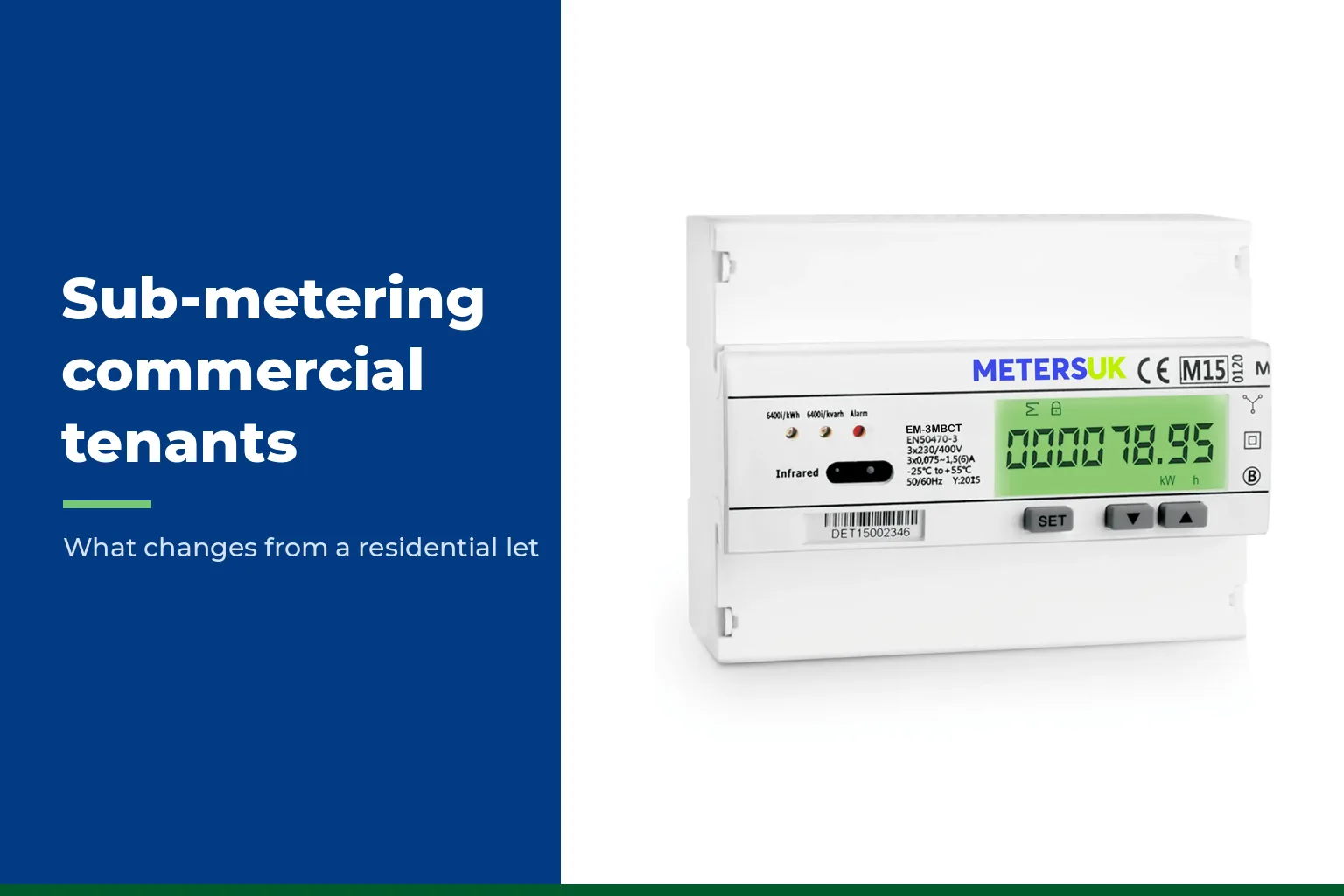
The building still changes what fits. A single-phase meter is often wrong for heavy plant or air conditioning, so a three-phase meter is the usual choice, sometimes paired with a current transformer (CT), which scales a large current down to something a meter can read safely. Gas follows the same pattern: a diaphragm meter suits a small heating load, while heavier gas use runs better on a turbine gas meter built for higher flow. Our guide to checking a meter is MID-approved covers the marking to look for.
“The mistake we see most is sizing the current transformer for a tenant’s normal load, not their peak. A unit that draws 40 amps most of the day can still spike hard when air conditioning and a machine start together. An undersized CT saturates at those peaks and quietly reads low from then on, sometimes for years before anyone checks it. Size it for the peak, and check it against the incoming supply, not just the tenant’s own kit.”
Meters UK technical team
An Illustrative Example
Take a hypothetical four-unit business park on one shared electricity supply, paying 26p a unit before standing charges and tax. Say the site had been splitting the bill equally, on the rough basis that the units were similar in size. Meters would tell a different story: the workshop drawing close to £310 a month, the two offices £95 and £110, and the storage unit, mostly unheated out of hours, £40. That is £555 between them, or £138.75 each split equally.
Split that way, storage would be overcharged by almost £99 a month, and the workshop undercharged by over £170. Neither tenant could point to an MRP breach, because the cap never covered them here. The real exposure is a lease dispute over an unfair service charge, not a regulatory one. Charging by floor area for a cost that plainly does not track floor area is the kind of thing a tenant’s surveyor can pick apart quickly.
Common Mistakes to Avoid
Assuming the residential cap gives cover is the big one. Landlords used to running houses full of tenants bring the same billing habits to a commercial site, and assume Ofgem is still watching. It is not. The safety net that once covered a sloppy billing method is simply not there.
Leaving the lease silent on how costs are split is a common cause of real disputes. A lease that says “tenant to pay a fair share of utility costs” and nothing more invites an argument later, especially once a tenant’s surveyor asks to see the working behind a figure.
Fitting a meter and never checking it against the supply is the quiet failure. A CT sized for day to day load rather than peak demand produces years of numbers that look fine and are wrong. Nobody notices until a tenant asks to see the meter’s own rating.