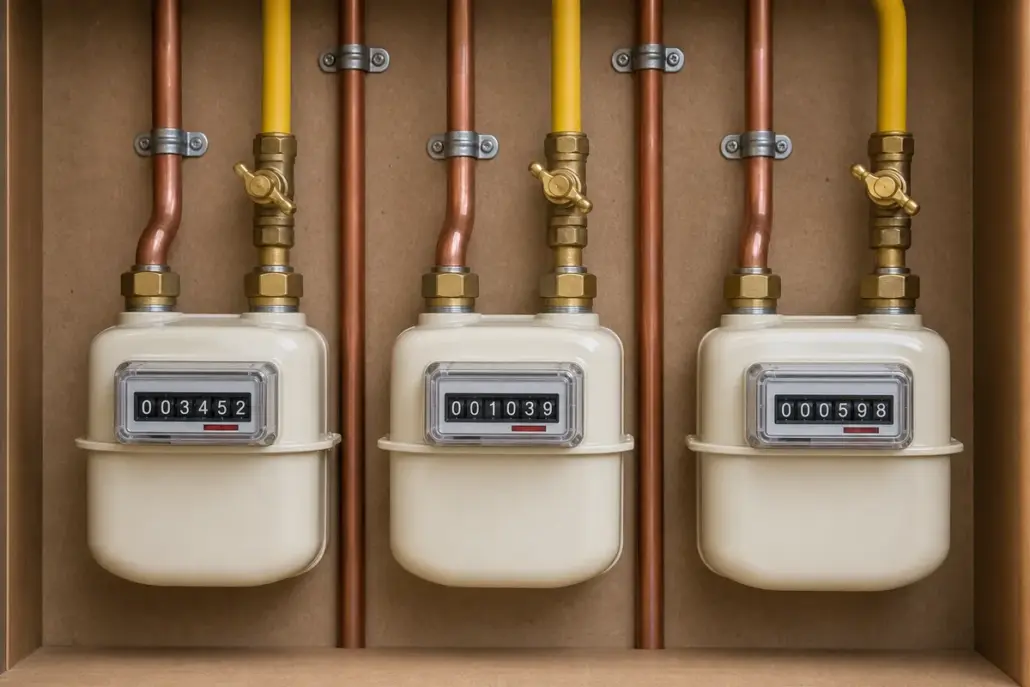
Gas is the utility that trips up landlords most often when they try to share a supply. Electric sub-metering is common and water is catching up, but gas carries an extra layer that catches people out. The meter itself is easy to buy. The rules about who may fit it, and what you are allowed to charge for the gas that flows through it, are where the money and the risk actually sit. This guide covers both from within what a meter supplier can properly tell you, and it is clear about the point where the job stops being yours and belongs to a Gas Safe registered engineer.
What is gas sub-metering for landlords? A gas sub-meter sits downstream of the supplier’s primary meter and measures the gas used by a single flat or unit within a shared supply. It lets a landlord bill each domestic tenant for what they actually use, capped by Ofgem’s resale price rules, and it must be fitted by a Gas Safe registered engineer.
Last updated: July 2026. Figures reflect the position in Great Britain at this date. Ofgem’s resale price rules are legally enforceable and currently under review, so check the latest figures before you set charges.
Key Takeaways
- A gas sub-meter attributes a shared gas supply to individual units, so tenants pay for what they burn instead of an equal share that suits nobody.
- Under Ofgem’s Maximum Resale Price (MRP) rules you can recover only what you paid for gas resold to a domestic tenant, apportioned fairly. There is no margin to add.
- Fitting a gas sub-meter is gas work. By law it goes to a Gas Safe registered engineer, not a handyman and not you.
- For billing, the meter needs valid approval markings under the Measuring Instruments Regulations 2016.
What is gas sub-metering, and how is it different from your supply meter?
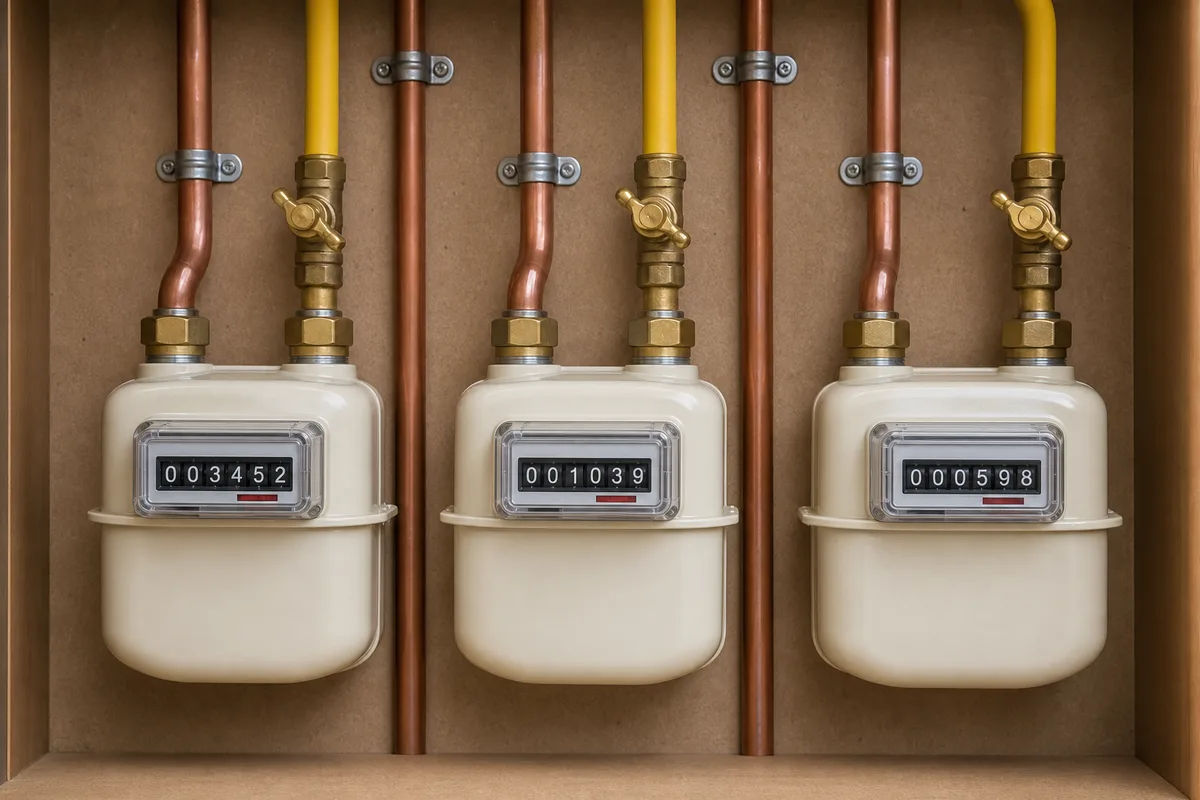
Your building has one primary gas meter where the supply enters. That meter is part of your supply arrangement and is not yours to touch, whoever owns the physical asset. The reading on it is what your energy bill is based on. A sub-meter is a second meter you own, fitted on the pipework past that primary meter, measuring the gas going to one flat, one unit, or one appliance. The supplier never sees the sub-meter. It exists purely so you can divide a single bill fairly between the people behind it.
The distinction matters because it sets the boundary of what you can touch. You can read your own sub-meters, keep the records, and work out each tenant’s share. You cannot move, bypass, or work on the primary meter, and you cannot fit the sub-meter yourself. More on that below.
Here is why it is worth the effort. As an illustration, take a converted property with four flats on one gas supply and an annual gas bill of £4,800. Split equally, that is £1,200 each. Put a sub-meter on each flat and the real picture rarely looks like an even split. A tenant who is out all day might burn £620 of gas a year, while a family running the heating hard could be closer to £1,910. Under an equal split the light user is subsidising the heavy one by hundreds of pounds, and sooner or later they work that out.
Can a landlord charge tenants for sub-metered gas?
Yes, but only at cost, and the cap is about domestic tenants. Ofgem’s Maximum Resale Price rules limit what anyone reselling mains gas for domestic use can charge. In plain terms, you pass on the price you actually paid your supplier, apportioned across the units on the supply, including a fair share of the standing charge. You cannot mark it up, and you cannot round it up for convenience. The moment you add a margin on the gas you are in breach. Business tenants are a different case, governed by the lease rather than Ofgem’s cap, so treat commercial lettings on their own terms.
Sub-metering is what makes that cap easy to honour. Once each unit has its own reading, the apportionment is a straightforward sum rather than a guess. Where no suitable meter is fitted, Ofgem does allow a fair and clearly explained estimate, but a meter reading is far easier to stand behind. Keep your supplier invoices and your meter readings together, because if a tenant queries the bill you should be ready to show your workings and the bills behind them.
Who is allowed to install a gas sub-meter?
A Gas Safe registered engineer, and nobody else. Fitting a meter into gas pipework is work on a gas fitting, which the Gas Safety (Installation and Use) Regulations 1998 reserve for competent persons registered with the Gas Safe Register. This is not a best-practice suggestion. It is the law, enforced by the Health and Safety Executive, and it applies whether the work is on the primary supply or on your own downstream pipework.
That rules out the tempting shortcuts. A general handyman cannot do it. A qualified electrician cannot do it. You cannot do it yourself, however handy you are, because the law wants a Gas Safe registered engineer who is qualified for this category of work, not simply someone confident they can manage it. Registration and the right qualification on the engineer’s card go together. The engineer who fits the meter makes the gas connection sound and checks the pipework is correctly sized.
One point people miss is that reading the meter and billing from it are entirely yours to do once it is fitted. The restriction is on the physical gas work, not on the paperwork that follows. So the sensible split is to buy an approved meter, have a registered engineer install it, and take over from there.
Does a gas sub-meter need approval before you can bill from it?
If you are billing from it, yes. Any gas meter placed on the market for billing use has to carry valid approval under the Measuring Instruments Regulations 2016, shown by the required conformity markings. The Office for Product Safety and Standards confirms that landlord billing counts as a use that needs an approved meter. That approval covers the meter’s design and conformity, so the meter must also be kept in good order to stay accurate in service. A cheap unapproved meter from an unknown source cannot lawfully support a tenant’s bill, whatever else it does well.
In practice this means checking for the approval markings before you buy, not after the engineer has fitted it. A meter sold by a reputable supplier for billing will carry them. When you look at our range of gas meters, the approval status is part of the specification for exactly this reason. If a listing is silent on approval, treat that as a reason to ask for the certificate and markings before you order.
“The mistake we see most often is a landlord buying the cheapest gas meter online, then asking the engineer to fit it. More often than not it either has no billing approval or no safe way to take a remote reading, and it comes straight back off. Sort the meter and the approval first, then book the engineer once.”
Meters UK technical team
Which gas sub-meter do you need?
For most residential and small commercial sub-metering the answer is a diaphragm meter. It is the standard domestic-scale gas meter, accurate across the low and variable flows a flat produces, and it is what our diaphragm gas meter is built for. Larger or steadier commercial loads, such as a boiler house or an industrial unit, are where a turbine meter starts to make sense, because it handles high continuous flow better than a diaphragm can.
If you want to read the meters remotely rather than walking the building, specify a meter with a pulse output. The low-voltage pulse wiring is a separate electrical job from the gas connection, and where the setup needs an intrinsically safe barrier it has to follow the meter maker’s certified arrangement. A good installer will tell you whether a barrier is needed for your meter and where it sits.
| Factor | Diaphragm meter | Turbine meter |
|---|---|---|
| Best for | Flats, houses, small commercial units | Boiler houses, high continuous flow |
| Flow pattern | Low and variable | High and steady |
| Typical use | Most landlord sub-metering | Commercial and industrial |
| Remote reading | Pulse output option | Pulse output option |
- Residential flats and small units: a diaphragm sub-meter on each unit.
- Boiler houses or heavy commercial loads: a turbine meter sized to the flow.
- Not sure? Talk to our team before you order, because matching the meter to the load is where accuracy is won or lost.
When does gas sub-metering not make sense?
Not every shared supply is worth metering. If a building has a single tenant, or the gas cost is very small, the install cost and the upkeep of the extra pipework can outweigh what you recover. Gas installs also tend to cost more than electric or water sub-metering, because the Gas Safe requirement means paying a registered engineer for every meter rather than fitting them yourself.
There is a cleaner option in some buildings, which is to avoid shared gas entirely. Where a property can be laid out so each unit has its own primary supplier meter and its own account, you sidestep resale rules and sub-metering altogether, and the tenant deals with the supplier directly. That is not always possible in an older conversion, but where it is, it tends to be simpler than metering a communal supply. For the wider trade-offs across all utilities, our guide to sub-metering for landlords is the place to start.
Common Mistakes Landlords Make
A few costly errors turn up again and again when landlords set up gas billing, and most of them are cheaper to avoid than to unwind.
- Splitting the bill equally and calling it fair. An even split is not automatically unlawful, but it usually overcharges the light user and undercharges the heavy one. That is the dispute you are trying to prevent, not start.
- Buying an unapproved meter to save money. Without valid approval you cannot bill a tenant from it, so the saving disappears the moment the meter matters.
- Treating the install as a job for anyone but a Gas Safe engineer. It is gas work by law. A cheap fit by the wrong person is an invalid install and a real safety risk.
- Loading the standing charge onto one tenant. The standing charge is part of the price and should be shared fairly across the supply. You can carry it yourself if you choose, but you cannot dump all of it on a single unit.