Landlords tend to pick a gas sub-meter the way they pick a boiler, by looking at how big the flat is. The meter does not care about floor area. It cares how much gas the appliances behind it can burn at the same moment.
Get that wrong in either direction and you pay for it. A meter that is too small starves the boiler. A meter that is too big stops measuring the gentle, everyday use that makes up most of a tenant’s year.
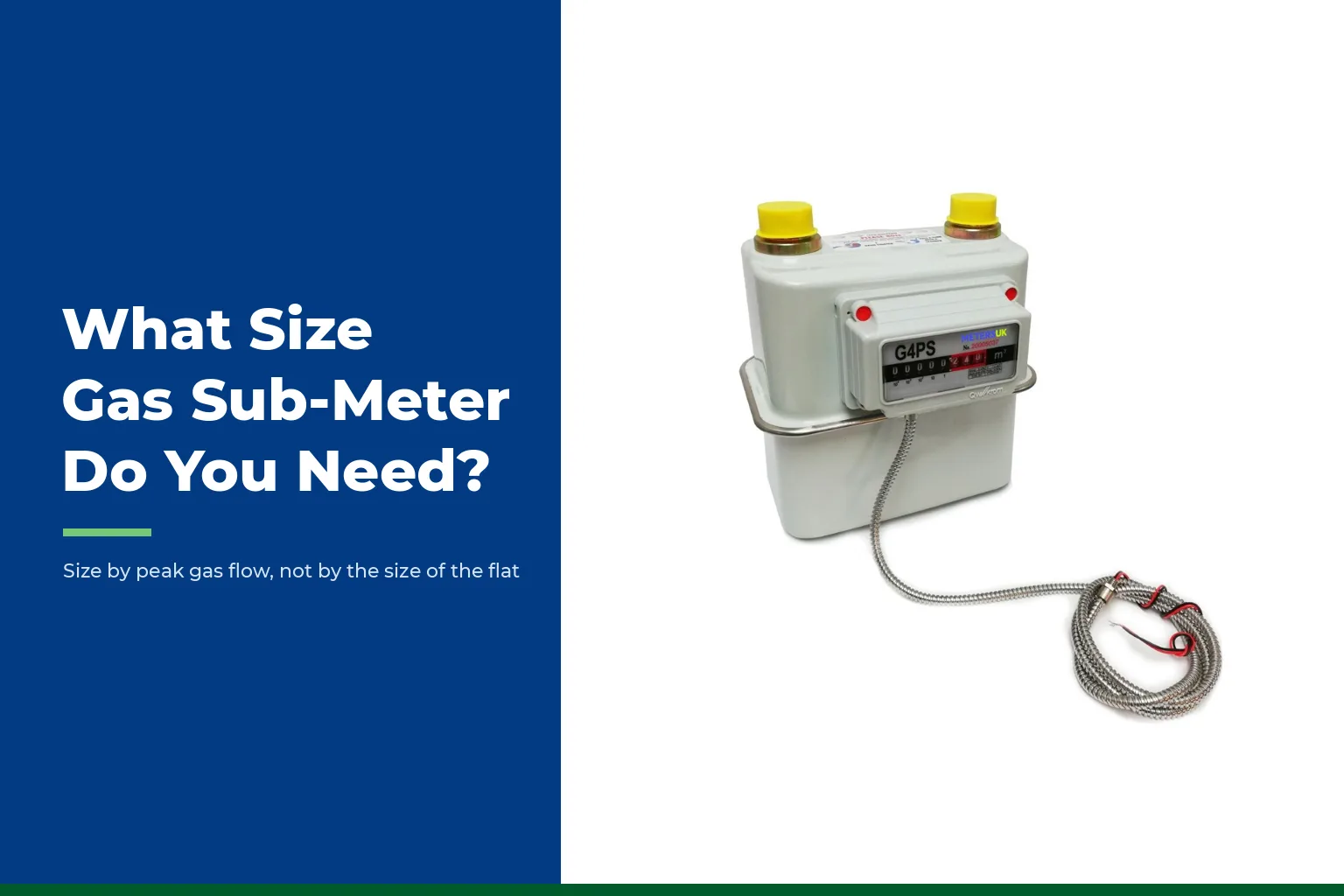
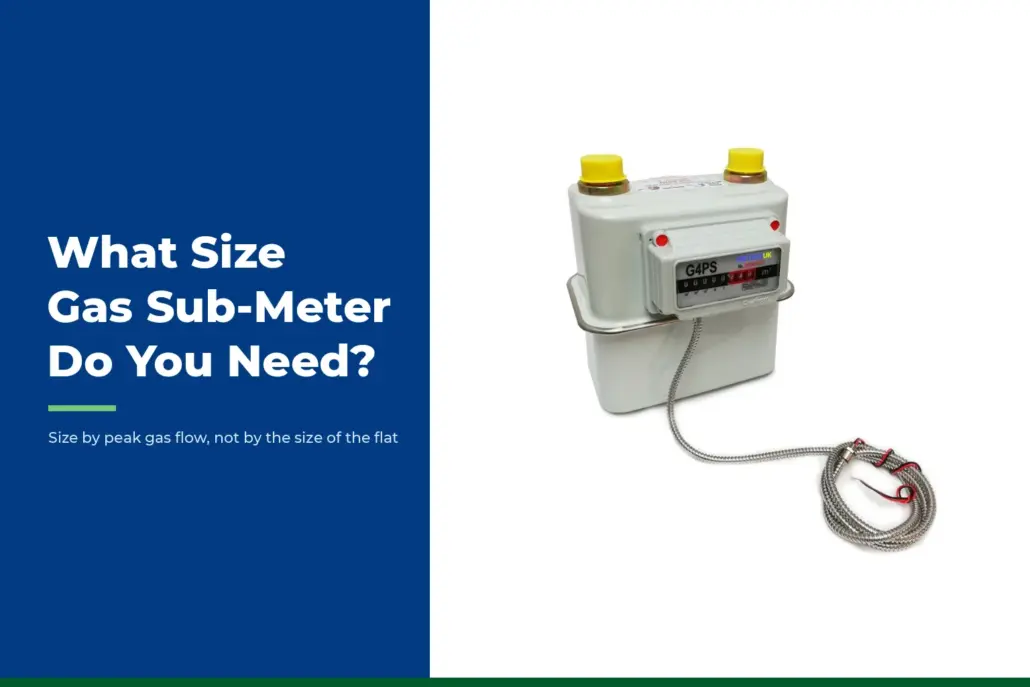
What size gas sub-meter do you need? Add up the maximum gas flow of every appliance behind the meter, then choose the smallest meter that passes that flow. A G4 (also badged U6) passes 6 cubic metres an hour, about 67 kW. That usually covers a flat with a combi boiler and a cooker, once a Gas Safe engineer has checked it.
Last updated: October 2026. Ratings and rules are current as of this date.
Key Takeaways
- Size the meter by the peak gas flow of everything behind it, not by the size of the flat or the pipe.
- A G4 (U6) passes up to 6 cubic metres an hour, about 67 kW. A G10 (U16) passes up to 16, about 180 kW.
- A meter that is too big can under-record light use, and the landlord is left paying for the gas that goes unbilled.
- A Gas Safe registered engineer fits the meter and checks the pipework can carry the flow. Hand them your appliance list first.
How Do You Size a Gas Sub-Meter?
Start with a list of everything on the pipe after the meter. Boilers, hobs, ovens and any gas dryer. Find each appliance’s maximum gas input in kilowatts, on its data plate or in its manual. Check that it is gas input and not heat output, because the two differ. Add them up. That total is the peak load if everything ran at once.
Next, turn kilowatts into flow. The government’s gas bill guidance gives the method. Multiply cubic metres by the calorific value (39.5 megajoules per cubic metre is typical), multiply by 1.02264, then divide by 3.6. One cubic metre comes out at about 11.22 kWh. So divide your kilowatts by 11.22 and you have cubic metres an hour. Your own supply’s calorific value will vary a little.
Here is a worked example. Two flats each have a 30 kW combi boiler and a gas hob rated at 8 kW. That is 38 kW a flat, or about 3.4 cubic metres an hour. A G4 handles that with room to spare, as long as those are gas input figures. Leave some headroom.
Now picture a plant room with two 100 kW boilers serving a whole block. That is 200 kW, or about 17.8 cubic metres an hour. A G10 stops at 16. This job needs a G16.
What Is the Difference Between a G4 and a U6?
Very little. G4 is the European size label. U6 is the older UK badge. Both pass a maximum of 6 cubic metres an hour. In the same way, a U16 is the older badge for a G10, which passes 16.
National Gas says most domestic properties will only need a U6 meter. A sub-meter follows the same logic, because one flat rarely burns more than a G4 can pass. If an old meter in your building says U6, a G4 is the natural replacement. Check the minimum flow and the connections with your engineer before you swap.
| Size | Maximum flow | Minimum flow | Gas input at maximum | Typical fit (a guide only) |
|---|---|---|---|---|
| G4 (U6) | 6 m³/h | 0.04 m³/h | about 67 kW | One flat or house with a combi boiler |
| G6 | 10 m³/h | 0.06 m³/h | about 112 kW | A large house, or a flat with a second boiler |
| G10 (U16) | 16 m³/h | 0.1 m³/h | about 180 kW | A small plant room |
| G16 | 25 m³/h | 0.16 m³/h | about 280 kW | A plant room with several boilers |
| G25 | 40 m³/h | 0.25 m³/h | about 449 kW | A large plant room |
Flow limits are manufacturer figures from Bell Flow Systems and vary by model, so check the meter you buy. Gas input uses 11.22 kWh per cubic metre.
What Happens If a Gas Sub-Meter Is Too Big?
A meter only promises accuracy between its minimum and maximum flow. A G4 starts at 0.04 cubic metres an hour, about 0.45 kW. A G10 starts at 0.1, about 1.1 kW. Below that floor the maker no longer promises accuracy, and the meter can under-record.
Light use, such as a hob ring on low, can fall close to that floor.
If the meter reads low, the tenant is billed for less gas than they used, and the landlord pays the supplier for the rest. It is easy to miss because no single bill looks wrong. How big the shortfall gets depends on the meter and the household, so we will not put a number on it.
Is a Meter That Is Too Small Any Better?
Not really. Push more gas through a meter than its maximum and the pressure loss climbs. One G4 model loses under 2 mbar at its full 6 cubic metres an hour, according to Bell Flow Systems. Go well beyond that and appliances at the end of the line can struggle. A boiler that cuts out at peak demand can be a sign.
A second boiler can be the trigger. A landlord adds one to a converted flat, nobody updates the paperwork, and a G4 that was fine for years hits its limit.
Landlords usually ring us with a pipe size and a bedroom count. We ask for the boiler data plate instead. Most flats only need the smallest size. The one that does not is the flat with a second boiler nobody mentioned.
Meters UK technical team
Does Pipe Size Decide the Meter Size?
No, though the two go together. Meters UK lists the diaphragm range with 20 mm connections on a G4, 25 mm on a G6, 30 mm on a G10, 40 mm on a G16 and 50 mm on a G25. Those are the sizes the meters come with. They follow from the flow rating, not the other way round.
Choose the meter by flow first. Then ask the engineer how it will connect to the pipework already in the building.
How Do You Find Out What Size Meter You Have?
Look near the dial. National Gas says the size appears there as U6, U16 or U25, or as a maximum flow written as Qmax and a number. Meters made to the European system show G4, G6 or G10 instead.
When Does a Diaphragm Meter Stop Being the Right Choice?
Diaphragm meters suit the low, variable flows in flats and small units. Our diaphragm range stops at a G25, which passes 40 cubic metres an hour, about 449 kW. Larger diaphragm meters exist. For heavy loads, or a boiler house that burns gas steadily all day, a turbine meter is often the better fit. The high and low flow turbine gas meter covers that end of the market.
For remote reading, specify a pulse output when you order. Where the pulse wiring needs an intrinsically safe barrier, the installer will tell you. For the legal side, see our guide to gas sub-metering for landlords.
Common Mistakes to Avoid
Sizing by the flat rather than the appliances is the usual one. A three-bedroom flat with one combi boiler and a two-bedroom flat with the same boiler need the same meter. A smaller flat with a range cooker and a second boiler might not.
Ordering bigger “to be safe” is the next. It feels cautious and quietly costs money, because the meter can then under-record light use and the landlord absorbs the loss. If the peak sits well inside a G4, buy the G4.
Trusting the old label without checking is a smaller slip with real cost. A badge reading U6 means 6 cubic metres an hour, and a replacement should match that rating or be sized again from the appliance list. Buying a cheap meter with no valid billing approval is a close cousin, because it cannot support a tenant’s bill.